


Every organisation faces uncertainty, whether from market shifts, operational gaps, technology failures, or regulatory changes. The difference between businesses that struggle and those that adapt often comes down to preparation. A Risk Management Plan helps organizations prepare for the unknown by offering a structured approach to identifying risks and responding to them effectively.
Instead of reacting to issues after damage is done, a risk management plan enables teams to anticipate challenges, reduce negative impact, and maintain stability while pursuing growth.
In Business Strategy: The Role of a Risk Management Plan
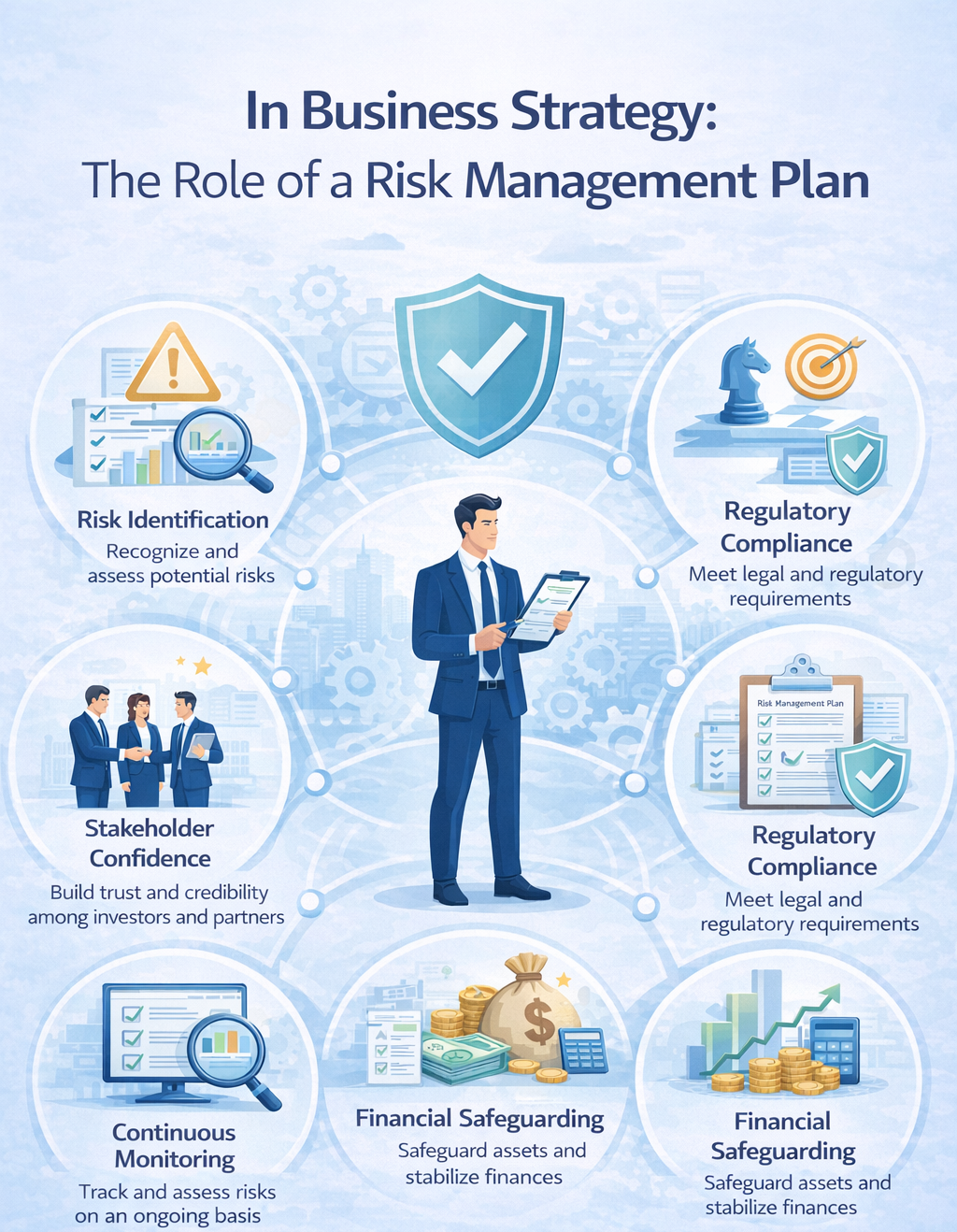

A risk management plan serves as a guiding structure that helps organisations systematically deal with uncertainty. It defines how potential threats are identified, analysed, and managed across projects and daily operations, ensuring that risk-related decisions support overall business objectives rather than working against them.
What Is a Risk Management Plan?
A Risk Management Plan is a structured roadmap that:
-
Identifies potential threats to your business
-
Assesses how likely and severe those threats are
-
Outlines precisely how your organization will address each risk
-
Sets roles, responsibilities, timelines, and response actions
-
Rather than reacting after problems occur, this plan puts you in control, anticipating challenges and reducing negative impact.
Why Businesses Cannot Ignore Risk Planning
Focusing on Critical Risks First
A well-designed risk management plan helps organizations distinguish between minor concerns and serious threats. By ranking risks based on their potential impact and likelihood, teams can direct time, effort, and budget toward areas that demand immediate attention.
Book a Demo With SignalX Risk Master
Why Every Business Needs a Risk Management Plan
1. Proactive Risk Control
Instead of firefighting when problems arise, a risk management plan enables proactive prevention and mitigation.
2. Better Decision-Making
By understanding what risks lie ahead, leaders can make more informed investments, operational decisions, and strategic plans.
3. Operational Stability
Unplanned disruptions like cybersecurity threats or vendor failures are less likely to derail your business when anticipated and planned for.
4. Regulatory & Compliance Assurance
Many industries require documented risk management practices to comply with legal standards.
5. Investor & Stakeholder Confidence
Demonstrating you understand your risk landscape increases credibility with investors, partners, and customers.
Core Elements of a Risk Management Plan
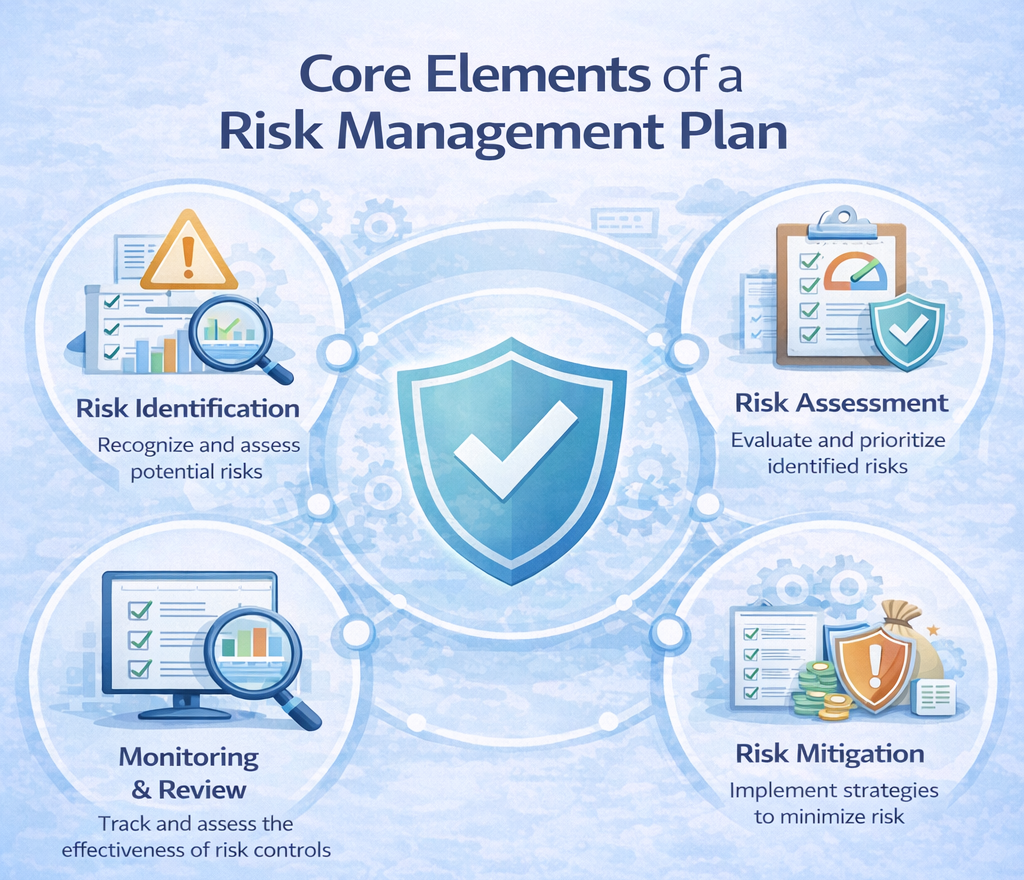

An effective risk management plan is built on several foundational components that work together to reduce uncertainty.
Identifying Risks Early
Risk identification focuses on spotting potential threats before they materialise. These risks may stem from:
-
Economic or financial instability
-
Technology and data security issues
-
Process inefficiencies
-
Workforce-related challenges
-
Legal and regulatory changes
Evaluating Risk Impact and Likelihood
After identification, each risk is assessed based on its probability and potential consequences. This step helps organisations understand which risks require immediate attention.
-
Smart Approaches to Improve Your Risk Management Plan
-
To build a risk management plan that delivers real value.
-
Encourage collaboration between departments to uncover hidden risks
-
Base decisions on reliable data rather than intuition alone
-
Maintain clear and well-organized risk records
-
Clearly define who is responsible for monitoring and responding to each risk
-
Revisit the plan regularly to reflect changing business conditions
Step-by-Step: How to Create a Risk Management Plan
Here’s a practical workflow you can follow:
Step 1: Gather Internal Stakeholders
Bring together key teams operations, finance, IT, legal to ensure diverse perspectives and complete risk coverage.
Step 2: Conduct a Risk Brainstorming Session
Use historical incidents, industry reports, and cross-departmental insights to identify as many hazards as possible.
Step 3: Build a Risk Register
A risk register is your central document listing risks, causes, affected areas, likelihood, impact, and mitigation actions.
Step 4: Prioritize & Score Risks
Use a risk matrix to highlight the most urgent threats. Focus resources where they matter most.
Step 5: Develop Mitigation & Response Actions
For each prioritized risk, assign a mitigation plan, owner, budget, and timeline.
Step 6: Review & Update Periodically
Risks evolve with business changes, so review your plan regularly or after major events. (Metricstream)

Risk Management Examples in Practice
Example: Supply Chain Delay
Risk: Supplier shipment delays
Mitigation: Onboard alternate suppliers, track delivery forecasts weekly
Trigger: Delay > 3 days
Response: Activate alternative supplier contract
Example: Data Breach
Risk: Cyberattack on customer data
Mitigation: Encrypt sensitive information, conduct quarterly security training
Response: Activate incident response team with escalation protocols
These real-world risk scenarios help teams visualize risk management in action.
The Future of Risk Management Plan
As organizations increasingly rely on digital systems and real-time information, risk management is shifting toward predictive and insight-led approaches. Data analytics, automation, and intelligent tools are enabling businesses to detect early warning signs, adapt quickly, and make more confident decisions in an evolving risk landscape.
How SignalX Enhances Risk Management Plan
Traditional risk management methods often rely on static reports and manual reviews. SignalX transforms the risk management plan into a dynamic, insight-driven process.
SignalX enables organizations to:
-
Detect early warning signals before risks escalate
-
Analyze patterns and trends using advanced analytics
-
Gain real-time visibility into emerging risks
-
Support faster and more confident decision-making
-
Shift from reactive problem-solving to proactive planning
By integrating SignalX, businesses can strengthen their risk management plan with intelligent insights that support timely action.
Conclusion
Discover SignalX and take control of emerging risks now.
A risk management plan is more than a safety measure it is a strategic asset. It helps organizations anticipate challenges, protect critical operations, and make informed decisions under uncertainty. When supported by intelligent platforms like SignalX, risk management becomes a powerful enabler of resilience and long-term success.
FAQ
1. What is a Risk Management Plan?
A Risk Management Plan is a structured document that identifies potential risks to an organization, analyzes their impact, and outlines strategies to prevent, reduce, or respond to those risks.
2. Why is a Risk Management Plan important?
It helps organizations:
-
Prevent unexpected disruptions
-
Reduce financial and operational losses
-
Improve decision-making
-
Ensure compliance with laws and regulations
-
Protect people, data, and reputation
3. What types of risks are included in a Risk Management Plan?
Common risk categories include:
-
Operational risks(process failures, system outages)
-
Financial risks(budget overruns, fraud)
-
Cybersecurity risks(data breaches, ransomware)
-
Compliance risks (regulatory violations)
-
Vendor or third-party risks
-
Strategic risks(market changes, competition)
4. Who is responsible for managing risks?
Risk management is a shared responsibility, but typically:
-
Senior leadership provides oversight
-
Risk managers or compliance teams manage the plan
-
Department heads identify and report risks
-
Employees follow risk controls and procedures
5. How are risks identified?
Risks are identified through:
-
Risk assessments and audits
-
Brainstorming sessions
-
Historical incident reviews
-
Vendor evaluations
-
Regulatory and industry analysis
6. How are risks evaluated?
Each risk is evaluated based on:
-
Likelihood (how likely it is to occur)
-
Impact (how severe the consequences would be)
This helps prioritize which risks need immediate attention.
7. What are risk treatment strategies?
Common strategies include:
-
Avoid– eliminate the risk
-
Mitigate– reduce the likelihood or impact
-
Transfer– shift the risk (e.g., insurance, contracts)
-
Accept– acknowledge and monitor the risk
8. How often should a Risk Management Plan be updated?
It should be reviewed:
-
At least annually
-
After major organizational changes
-
After incidents or near-misses
-
When new regulations or technologies arise
9. What is the role of documentation in risk management?
Documentation:
-
Tracks identified risks and controls
-
Supports audits and compliance
-
Ensures accountability
-
Helps communicate risks across teams
10. How does a Risk Management Plan relate to vendor risk?
Vendor risks are included to assess threats posed by third parties, such as data breaches, service failures, or compliance gaps. Vendor risk management ensures external partners meet security and performance expectations.
11. Can small organizations have a Risk Management Plan?
Yes. A Risk Management Plan can be simple or detailed depending on the organization’s size and complexity. Even small organizations benefit from basic risk identification and mitigation.
12. How does SignalX support ongoing improvement in risk management?
SignalX supports continuous improvement in risk management by:
-
Tracking risk trends over time and identifying areas for improvement within the Risk Management Plan.
-
Providing insights into risk mitigation effectiveness, allowing organisations to assess whether their strategies are working or if further action is needed.
-
Helping teams learn from past incidents, offering lessons learned and recommendations for strengthening future vendor relationships.
13.What is SignalX and how does it contribute to a Risk Management Plan?
SignalX is an advanced vendor risk management platform that plays a pivotal role in identifying, assessing, and mitigating risks within a company’s third-party relationships. It integrates seamlessly into your Risk Management Plan by offering real-time insights, continuous monitoring, and AI-driven assessments to manage and reduce vendor and third-party risks.
14.How does SignalX integrate into the response and recovery phase of risk management?
SignalX enhances the response and recovery phase by:
-
Alerting organisations to risk events as soon as they occur, such as breaches or vendor performance failures.
-
Providing guidance on response actions, helping teams respond quickly to contain or mitigate damage.
-
Recommending recovery strategies, such as identifying backup vendors or activating crisis management plans.
-
Offering incident tracking tools to ensure a structured recovery process and prevent future recurrence of the same risks.


