5 Due Diligence Checks You Must Execute on your Vendors and Partners






In today’s interconnected business environment, no organization operates in isolation. Whether you are a startup scaling quickly or an established enterprise expanding globally, your vendors and partners play a direct role in your success or your failure. A single weak link in your supply chain can disrupt operations, damage your reputation, or expose you to legal and financial risk.
Major corporate collapses and compliance scandals have repeatedly shown that third-party relationships can create serious vulnerabilities. Regulatory frameworks such as the U.S. Securities and Exchange Commission and international laws like the Foreign Corrupt Practices Act have made it clear that companies are responsible not only for their own actions but also for misconduct carried out by their partners and vendors.
Due diligence is no longer optional. It is a strategic necessity.
Below are five critical due diligence checks every business must execute before onboarding and while continuing to work with vendors and partners.
1. Financial Stability Assessment
Before entering into any partnership, the first question to answer is simple: Is this organization financially stable enough to meet its commitments?
A vendor’s financial weakness can quickly become your operational crisis. If a supplier suddenly files for bankruptcy, your production may halt. If a logistics partner struggles with cash flow, shipments may be delayed. Financial instability often manifests subtly before a collapse, so proactive review is essential.
Start by analyzing audited financial statements from the last two to three years. Look at revenue trends, profitability margins, debt levels, and liquidity ratios. Consistent losses, excessive leverage, or heavy reliance on a single client are red flags.
If the vendor is privately held and reluctant to share full statements, request bank references or third-party credit assessments. Credit rating agencies and business intelligence platforms can provide additional insight into payment histories and risk levels.
But numbers alone do not tell the full story. Consider broader market conditions. Is the vendor operating in a declining industry? Are there geopolitical or regulatory changes that could affect their stability? For international partners, currency fluctuations and cross-border taxation policies can significantly influence financial health.
Financial due diligence is not a one-time exercise. Continuous monitoring is equally important. A vendor that appears strong today may face unforeseen challenges tomorrow. Establish a periodic review process to reassess financial standing and adjust risk exposure accordingly.

2. Legal and Regulatory Compliance Review
Legal risk often hides beneath the surface of seemingly profitable partnerships. A vendor’s non-compliance can expose your company to penalties, litigation, and reputational harm.
Begin by verifying the legal existence of the organization. Confirm registration details, licenses, and certifications. Ensure that the company is authorized to operate in its jurisdiction and in the specific industry relevant to your collaboration.
Next, conduct background checks for litigation history. Are there ongoing lawsuits? Have they faced regulatory fines? Patterns of disputes with customers or employees may signal systemic problems.
Regulatory compliance is particularly crucial in highly regulated industries such as healthcare, finance, manufacturing, and technology. Data protection laws, environmental regulations, labor standards, and anti-corruption statutes must all be considered. For example, companies operating in Europe must comply with GDPR requirements regarding data privacy. Failure to ensure that vendors meet these standards could lead to severe penalties.
International operations require additional scrutiny. Sanctions screening should be performed to ensure the vendor is not listed on restricted party lists maintained by global authorities. Many enforcement actions arise not from direct wrongdoing but from insufficient screening processes.
To strengthen legal due diligence, involve your compliance or legal team early in the onboarding process. Structured questionnaires, contractual compliance clauses, and clear documentation requirements create a solid legal foundation.
Ultimately, your vendor relationships should not introduce compliance risk they should withstand regulatory examination without hesitation.
3. Operational Capability and Performance Evaluation
Even financially stable and legally compliant vendors can fail if they lack operational capacity. Operational due diligence ensures that the partner can deliver on time, at scale, and at the required quality level.
Start by evaluating infrastructure and resources. Does the vendor have sufficient facilities, skilled personnel, and technology systems to support your needs? If you anticipate growth, can they scale with you?
Site visits, when feasible, provide invaluable insight. Observing manufacturing floors, warehouse operations, or IT infrastructure reveals realities that documents cannot. For remote or international vendors, virtual audits and third-party inspections can offer alternative verification.
Performance metrics are equally important. Request service-level agreements (SLAs) and historical performance data. Examine on-time delivery rates, defect rates, customer satisfaction scores, and response times. A consistent track record of reliability is far more reassuring than optimistic promises.
Risk management practices should also be assessed. Does the vendor have contingency plans for disruptions? The global supply chain shocks of recent years demonstrated how fragile vendor networks can be. Businesses that had diversified suppliers and crisis management protocols fared far better than those that relied on single-source providers without backup plans.
Operational due diligence also includes cybersecurity capabilities. In an era where data breaches can spread across networks instantly, your vendor’s security posture becomes your own vulnerability. Assess their security certifications, data handling procedures, and incident response frameworks.
An operationally sound partner contributes to resilience. An unprepared one introduces avoidable fragility.
4. Reputation and Ethical Standards Verification
Reputation is one of a company’s most valuable assets. When you partner with another organization, you effectively link your brand to theirs.
Conduct comprehensive reputation research. Review media coverage, industry reports, and customer testimonials. Look for recurring patterns rather than isolated incidents. Persistent complaints about unethical practices or poor service quality warrant caution.
Social responsibility and ethical standards are increasingly influential in business decisions. Investors, customers, and employees expect companies to align with responsible practices. If your vendor is associated with labor violations, environmental harm, or corruption, the reputational damage can extend to your organization.
High-profile corporate scandals illustrate how third-party misconduct can trigger global fallout. Consider the lessons learned from the collapse of Enron, where governance failures and unethical partnerships amplified systemic risk. While not all cases are as dramatic, the underlying principle remains: ethical alignment matters.
Assess whether the vendor has a documented code of conduct, whistleblower policies, and anti-bribery procedures. Evaluate their environmental, social, and governance (ESG) initiatives. Many organizations now require vendors to sign ethical compliance agreements as part of contractual onboarding.
Speak directly with references when possible. Conversations with existing or former clients often reveal insights unavailable through public sources.
A vendor with a strong ethical culture enhances your credibility. One with questionable practices can undermine years of brand-building effort.
5. Strategic and Cultural Alignment
Beyond financials, compliance, and operations lies a more nuanced factor: alignment. A partnership is more than a transaction it is a relationship that evolves over time.
Strategic alignment ensures that both parties share compatible goals. If your organization prioritizes innovation and rapid adaptation, a vendor resistant to change may slow progress. If sustainability is central to your brand, a partner indifferent to environmental impact may create friction.
Cultural compatibility influences collaboration effectiveness. Differences in communication style, decision-making processes, and problem-solving approaches can either strengthen or strain partnerships. While diversity can enrich collaboration, fundamental value conflicts can create persistent tension.
Leadership engagement is critical in assessing alignment. Meet key decision-makers. Understand their long-term vision. Evaluate whether they view the partnership as a short-term contract or a strategic alliance.
Clear expectations must be defined from the outset. Establish performance benchmarks, communication protocols, and escalation procedures. Regular review meetings reinforce alignment and address issues before they escalate.
Strategic due diligence transforms vendor relationships from transactional arrangements into resilient partnerships built on shared objectives.
Building a Sustainable Due Diligence Framework
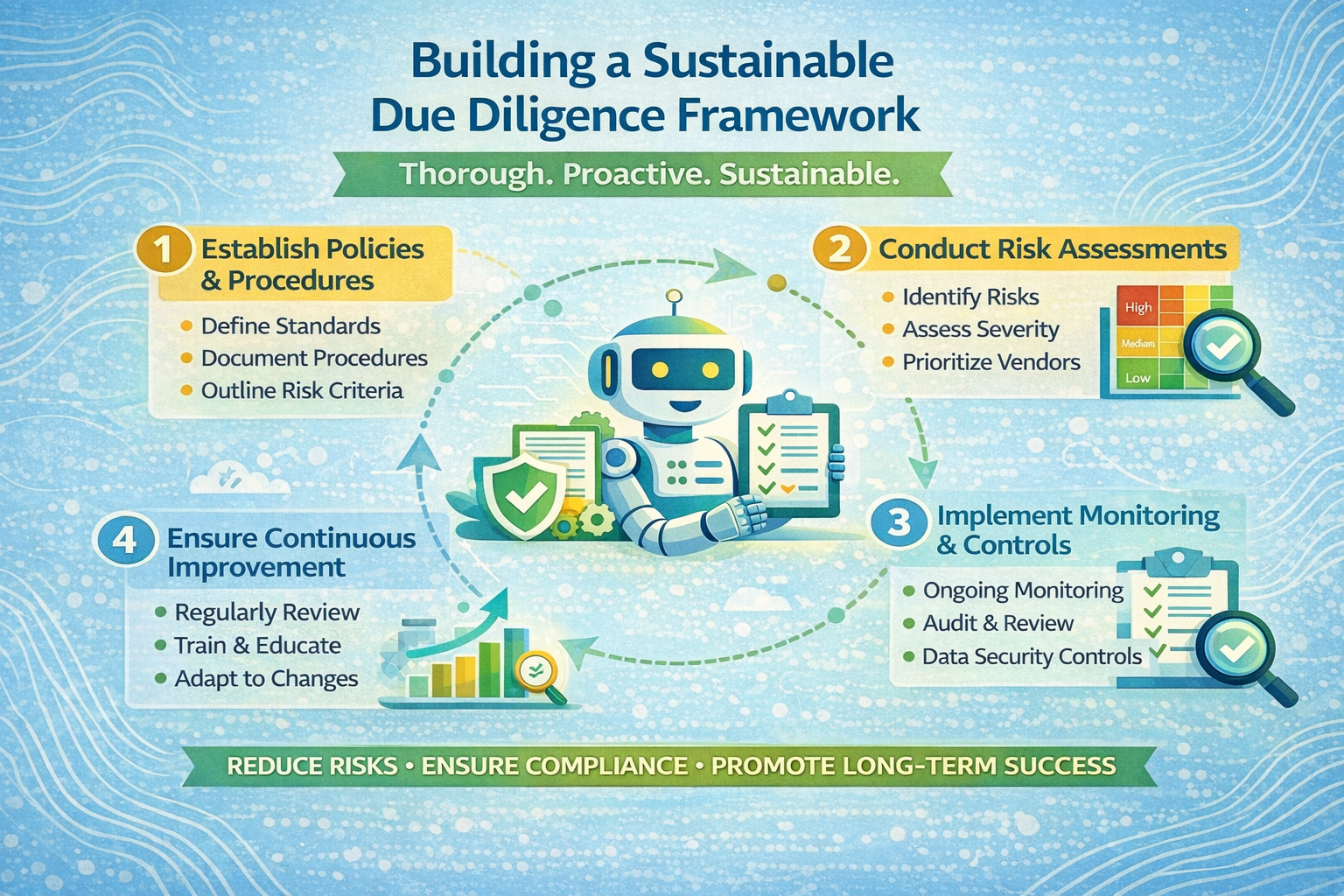
Executing these five checks individually is important. Integrating them into a structured due diligence framework is even more powerful.
Create standardized assessment templates covering financial, legal, operational, reputational, and strategic criteria. Assign responsibility to specific teams finance, legal, procurement, compliance to ensure accountability. Use digital risk management tools to centralize documentation and track evaluations.
Due diligence should not end after contract signing. Ongoing monitoring, periodic reassessments, and performance reviews are essential. Markets evolve, regulations change, and organizations transform. Continuous oversight ensures that risks are identified early rather than discovered during crises.
Technology can support this effort. Automated compliance screening tools, credit monitoring services, and cybersecurity assessment platforms reduce manual workload and increase accuracy. However, human judgment remains indispensable. Contextual understanding and relationship insights cannot be fully automated.
Strengthen Your Vendor Risk Strategy Today
Build a structured, future-ready due diligence framework that protects your business, reputation, and long-term growth.
Conclusion
Vendor and partner due diligence is not merely a protective measure it is a strategic investment in resilience and growth. Financial stability protects operational continuity. Legal compliance shields against penalties. Operational capability ensures performance reliability. Ethical integrity safeguards reputation. Strategic alignment fosters long-term collaboration.
In a world where businesses are deeply interconnected, your organization’s strength is intertwined with the reliability of those you choose to work with. Careful, structured, and ongoing due diligence transforms partnerships from potential liabilities into competitive advantages.
By executing these five essential checks thoroughly and consistently, you position your company to grow confidently, innovate responsibly, and navigate uncertainty with greater assurance.
FAQs
1. Why is vendor due diligence important?
It helps identify financial, legal, and operational risks before partnering, protecting your business from losses and reputational damage.
2. How often should due diligence be conducted?
At onboarding and regularly afterward typically annually or based on the vendor’s risk level.
3. What financial information should be reviewed?
Audited financial statements, credit reports, cash flow, debt levels, and profitability trends.
4. What are common red flags?
Ongoing lawsuits, financial instability, poor reviews, compliance violations, and lack of transparency.
5. Can vendor non-compliance impact my company?
Yes. Regulators like the U.S. Securities and Exchange Commission may hold companies accountable for third-party misconduct.
6.Is due diligence necessary for small businesses?
Yes. Even basic checks reduce risk and prevent costly disruptions.
7. What tools support vendor due diligence?
Risk management software, credit monitoring services, sanctions screening tools, and compliance platforms.