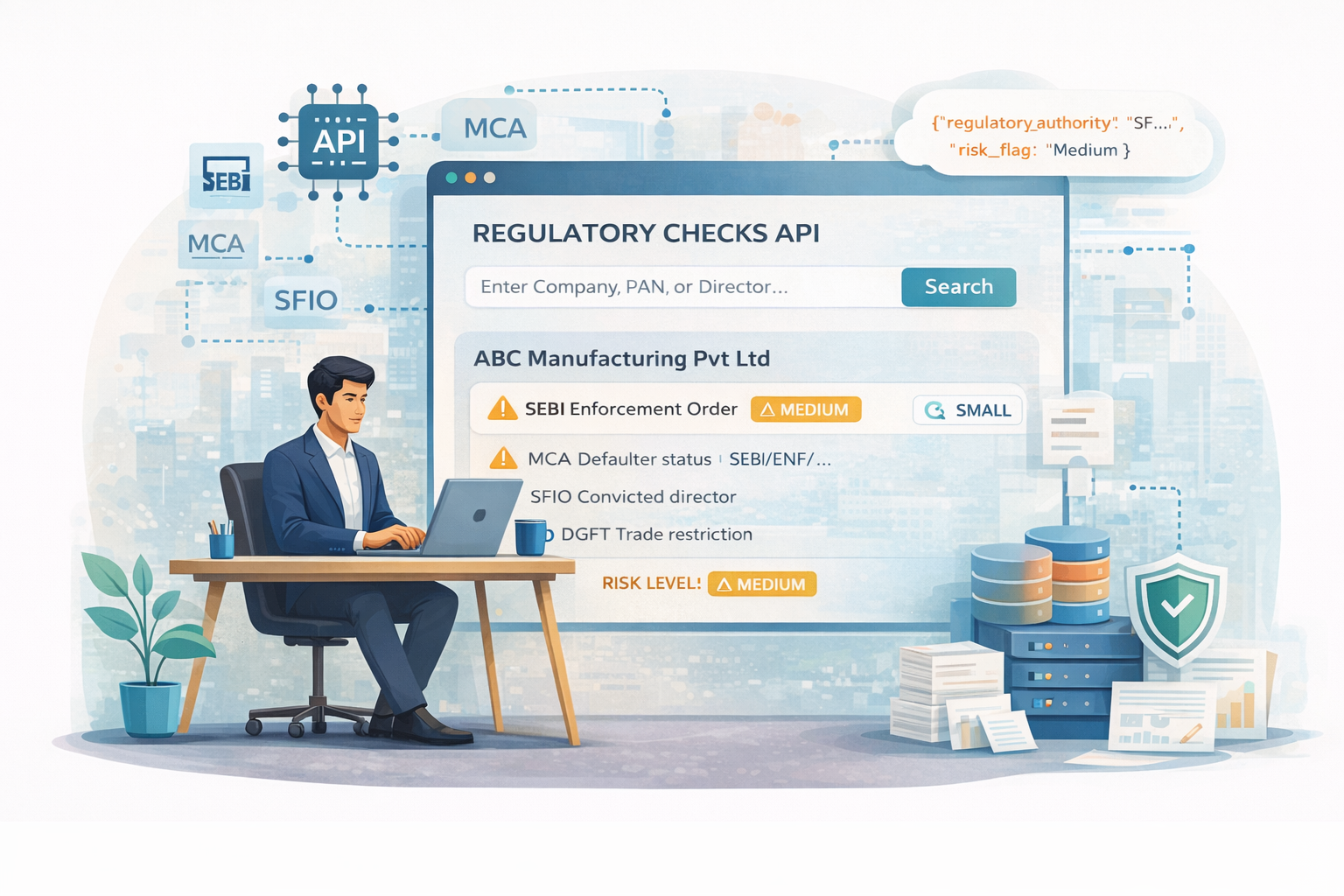

Regulatory Checks API
The Regulatory Checks API enables organizations to automatically detect regulatory exposure related to companies, directors, and counterparties before onboarding vendors, approving credit, or executing strategic transactions.
With a single API integration, businesses can retrieve structured regulatory intelligence from authorities such as SEBI, CCI, SFIO, MCA, CBI, DGFT, and other enforcement bodies.
How does it work?
Input Identifier
Provide a company name, director name, PAN, or CIN as the identifier for the entity or individual you want to screen for regulatory exposure.
Multi-Regulatory Data Screening
SignalX automatically scans multiple regulatory and enforcement databases including authorities such as SEBI, MCA, SFIO, CCI, CBI, DGFT, and SAT, along with other enforcement and risk lists.
Normalized Intelligence Output
The API returns a clean, structured JSON response highlighting regulatory actions, enforcement orders, debarments, investigations, and defaulter listings.
API Response Includes:
- ✓ entity_name – Name of the company or individual screened
- ✓ identifier – CIN / PAN / Director Name used for the search
- ✓ regulatory_authority – Source authority (SEBI / MCA / SFIO / CCI / CBI / DGFT / SAT / ATFP)
- ✓ case_reference_number – Official case number or order reference where available
- ✓ risk_flag – High / Medium / Informational regulatory risk indicator
- ✓ case_reference_number – Official case number or order reference where available
- ✓ regulatory_status – Active / Closed / Under Investigation / Appealed
- Â
- Â
Use Cases
For Compliance & Risk Teams
Automatically screen companies and directors against regulatory enforcement lists, defaulter databases, and investigation records across authorities like SEBI, MCA, CCI, and SFIO. Reduce manual research and strengthen compliance monitoring.

For Credit, Investment & Underwriting Systems
Identify borrowers, investee companies, or counterparties that appear in regulatory enforcement actions, shell company lists, or fraud investigations. Helps lenders and investors avoid exposure to high-risk entities before approving transactions.

For Vendor & Partner Due Diligence
Screen suppliers, distributors, and strategic partners against regulatory sanctions, trade restrictions, and defaulter lists. Integrate regulatory risk checks directly into onboarding workflows and third-party risk management systems.

Benefits of Using Our API
Plug and Play Integration
A REST API with predictable request/response structure and clear documentation enables fast integration into compliance, risk, and due diligence workflows.

Comprehensive Regulatory Screening
Instantly screen companies and directors against enforcement orders, defaulter lists, investigation records, and regulatory actions across multiple authorities through a single API call.

Reduce Compliance & Regulatory Risk
Automate regulatory screening to detect entities involved in fraud, enforcement actions, or sanctions, helping organizations avoid high-risk partnerships and compliance violations.

Accurate & Trusted Data
Responses are sourced from official regulatory bodies and enforcement authorities, ensuring reliable insights for risk assessment and due diligence decisions.

Built for Scale
Handles both single queries and high-volume screening workflows with low latency and high reliability, supporting enterprise-grade compliance and risk monitoring systems.

Seamless Workflow Automation
Embed regulatory checks into onboarding, credit underwriting, vendor risk management, and investment due diligence workflows to automate risk screening at scale.
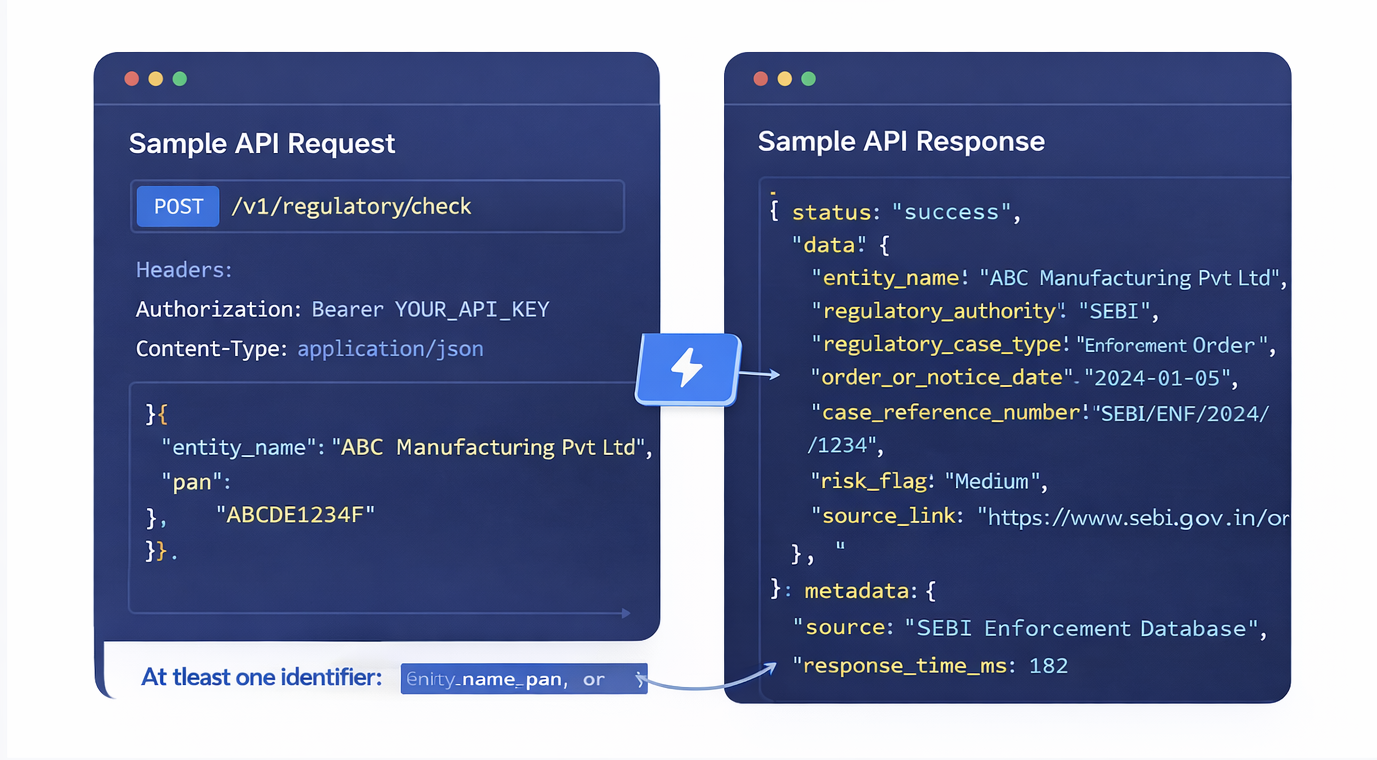
Sample API Request
FAQs
A Regulatory Checks API allows businesses to automatically screen companies and individuals against enforcement orders, defaulter lists, and investigation records published by regulators such as SEBI, MCA, CCI, and SFIO. It enables automated compliance screening and risk assessment directly within internal systems.
Businesses can check regulatory defaulter lists by using a regulatory screening API that scans public enforcement records from authorities such as SEBI, MCA, and DGFT. The API returns structured data indicating whether the company has been flagged, penalized, or restricted by any regulator.
Yes. The API can identify companies or individuals mentioned in SEBI enforcement orders, market bans, debarred lists, and shell company alerts, helping organizations detect securities law violations and market participation restrictions.
Yes. Regulatory screening can detect directors linked to investigations, convicted fraud cases, or proclaimed offender lists issued by authorities such as the Serious Fraud Investigation Office (SFIO) or other enforcement agencies.
Coverage typically includes regulatory and enforcement data from authorities such as SEBI, MCA, CCI, SFIO, CBI, DGFT, and Securities Appellate Tribunal (SAT), depending on the integration scope and available public records.
Banks and NBFCs use regulatory screening APIs to evaluate borrower risk, detect entities under regulatory scrutiny, and strengthen compliance checks during credit underwriting and counterparty due diligence.
Yes. Procurement and supply chain teams use regulatory screening APIs to identify vendors that appear on enforcement lists, defaulter records, or regulatory watchlists before onboarding them.
The API enables automated screening against enforcement actions, investigation records, and restricted entity lists. This helps organizations strengthen AML, governance, and compliance monitoring processes.
Yes. Regulatory screening APIs are designed for seamless integration into internal risk engines, onboarding platforms, compliance dashboards, and due diligence workflows using standard REST API architecture.
Regulatory screening helps investors and acquirers identify enforcement actions, regulatory bans, or ongoing investigations that may expose them to financial, legal, or reputational risks during transactions.
Ready to integrate Regulatory Risk Checks?
Screen companies, directors, and counterparties against enforcement orders, defaulter lists, and investigation records from major Indian regulators, all through a single API.
