Customer Identification Program (CIP): The Complete Guide






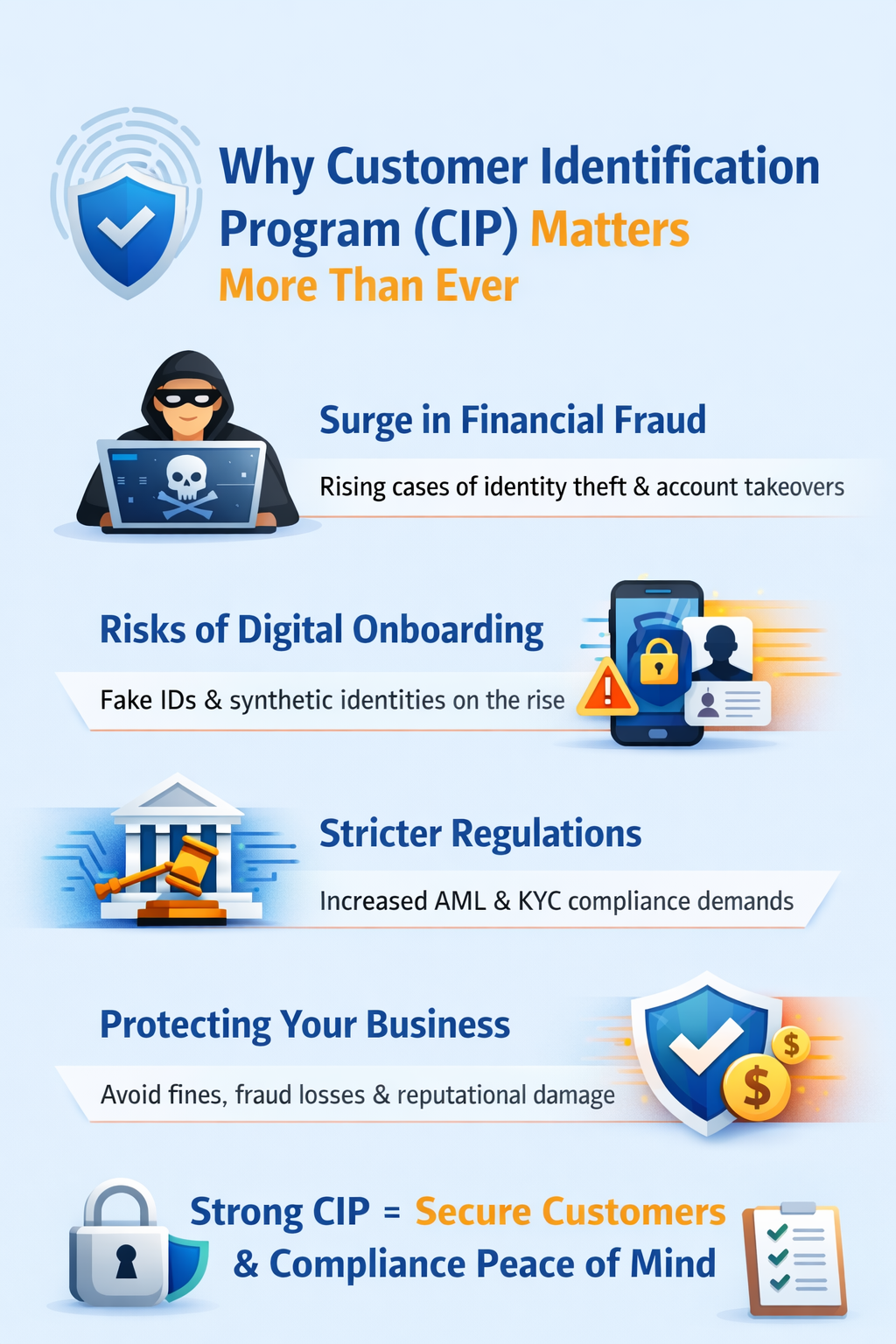
Financial fraud is evolving at an unprecedented pace. From synthetic identities to AI-generated deepfake documents, criminals are exploiting digital onboarding channels faster than ever. At the same time, regulators across the globe are tightening compliance standards, increasing scrutiny on financial institutions, fintech startups, and crypto platforms.
In this high-risk environment, a strong Customer Identification Program (CIP) is no longer optional; it is foundational.
A Customer Identification Program is a regulatory requirement that mandates financial institutions to verify the identity of customers before opening accounts. It serves as the first line of defense against money laundering, terrorist financing, fraud, and financial crime.
Weak identity verification can lead to regulatory penalties, reputational damage, and even business shutdowns. In this comprehensive guide, you’ll learn what CIP is, its legal foundation, who must comply, the four core requirements, implementation steps, common challenges, best practices, and what the future holds.
What Is a Customer Identification Program (CIP)?
A Customer Identification Program is a set of risk-based procedures that financial institutions use to verify the identity of customers when establishing a relationship.
Its core purpose is straightforward: to ensure that institutions know the true identity of the individuals or entities they are doing business with.
CIP is not just general identity verification. While identity verification can occur in many business contexts, CIP is specifically a regulatory requirement embedded within Anti-Money Laundering (AML) compliance frameworks.
CIP operates as the foundation of broader AML programs. Without verifying who a customer truly is, institutions cannot effectively assess risk, monitor transactions, or detect suspicious activity. In short, CIP is the gateway to compliant onboarding.

Legal Foundation of Customer Identification Program
The Customer Identification Program requirement was introduced under the USA PATRIOT Act in response to heightened national security concerns. Section 326 of the Act mandated that financial institutions implement procedures to verify customer identities.
The implementation and enforcement of CIP regulations fall under the oversight of the Financial Crimes Enforcement Network (FinCEN), a bureau of the U.S. Department of the Treasury responsible for safeguarding the financial system from illicit use.
CIP requirements are closely tied to the Bank Secrecy Act (BSA), which forms the backbone of AML compliance in the United States. Together, these laws require institutions to establish written procedures, maintain records, and screen customers against government lists.
Globally, similar identity verification requirements exist under AML directives in the European Union, FATF recommendations, and regulations in jurisdictions such as the UK, Singapore, and Australia. While terminology may differ, the core objective remains consistent: prevent financial systems from being exploited.
Who Must Comply with CIP Requirements?
CIP requirements apply broadly across regulated financial sectors. Traditional banks and credit unions were the original focus, but the scope has expanded significantly.
Fintech companies offering financial services must implement compliant identity verification processes. Money Service Businesses (MSBs), including remittance providers and currency exchangers, are also subject to CIP obligations.
Investment firms, broker-dealers, and mutual funds must adhere to identity verification standards. In recent years, cryptocurrency exchanges and digital asset platforms have increasingly come under regulatory scrutiny, requiring robust onboarding and verification controls.
In essence, any regulated financial institution that opens accounts or establishes customer relationships must comply with CIP requirements.
The Four Core Requirements of a Customer Identification Program
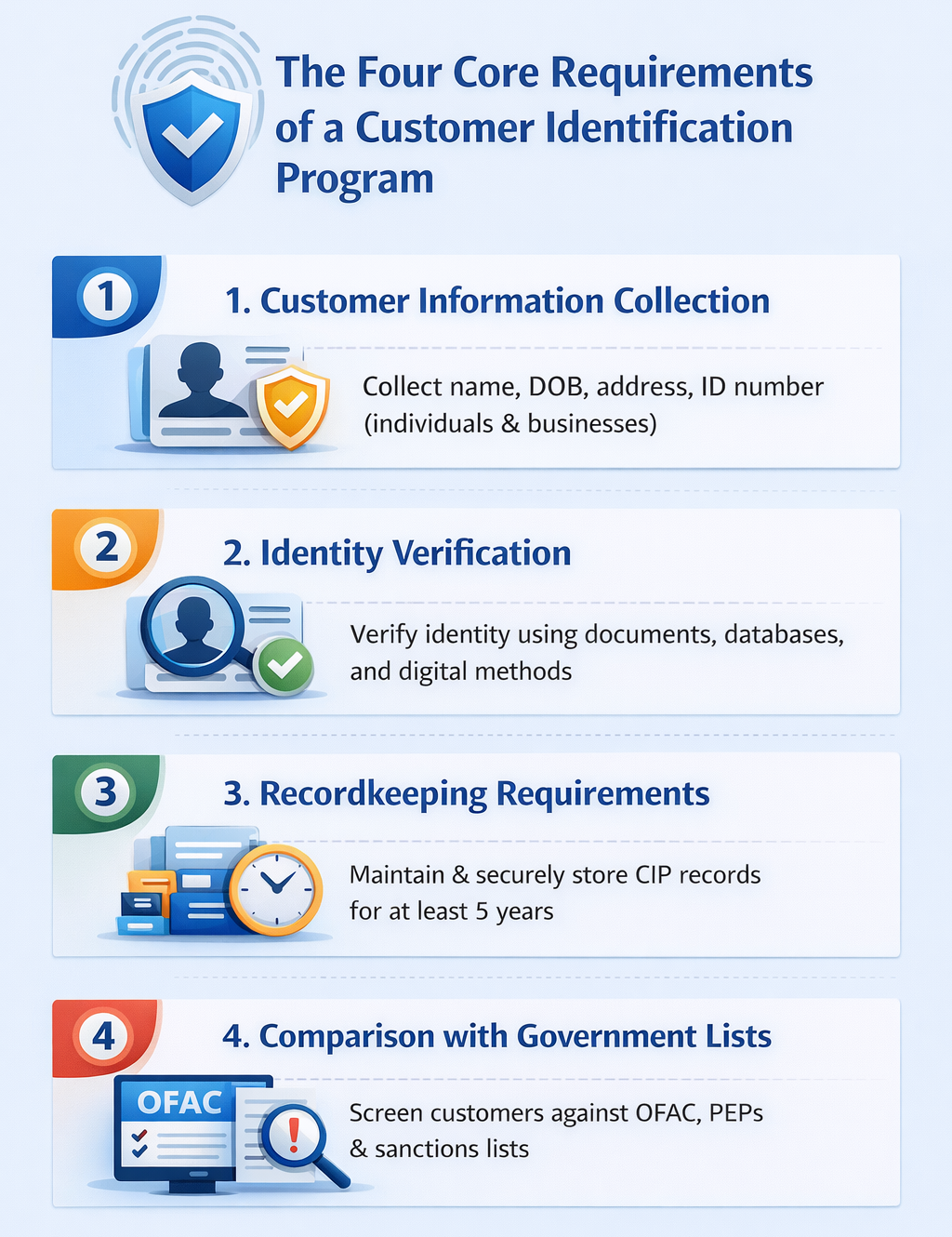
Customer Information Collection
At the heart of CIP lies customer data collection. Institutions must obtain specific identifying information before opening an account.
For individuals, required data typically includes full legal name, date of birth, residential or business address, and an identification number such as a Social Security Number or government-issued ID number.
For legal entities, additional documentation may be required, including business registration documents, Employer Identification Numbers, and information about beneficial owners.
The information collected must be sufficient to form a reasonable belief that the institution knows the true identity of the customer.
Identity Verification
Collecting information is only the first step. Institutions must verify that information using reliable methods.
Documentary verification may include reviewing government-issued identification such as passports or driver’s licenses. Non-documentary methods can include database checks, credit bureau verification, or third-party identity services.
In digital environments, advanced verification methods now include biometric checks, liveness detection, AI-powered document authentication, and device intelligence analysis.
The verification method chosen should align with the institution’s risk profile and the type of account being opened.
Recordkeeping Requirements
CIP regulations require institutions to maintain detailed records of the information collected and the verification methods used.
Records must include identifying data and a description of documents reviewed or methods used to verify identity. Retention timelines typically require records to be maintained for at least five years after the account is closed.
Proper documentation ensures audit readiness and regulatory transparency.
Comparison with Government Lists
Institutions must check customers against government-issued lists of known or suspected terrorists and sanctioned individuals.
This includes screening against sanctions programs administered by the Office of Foreign Assets Control (OFAC) and other relevant watchlists. Politically Exposed Persons (PEPs) screening is also common as part of enhanced due diligence.
Failure to screen customers adequately can expose institutions to significant legal and financial risk.
CIP vs KYC vs CDD: Understanding the Differences
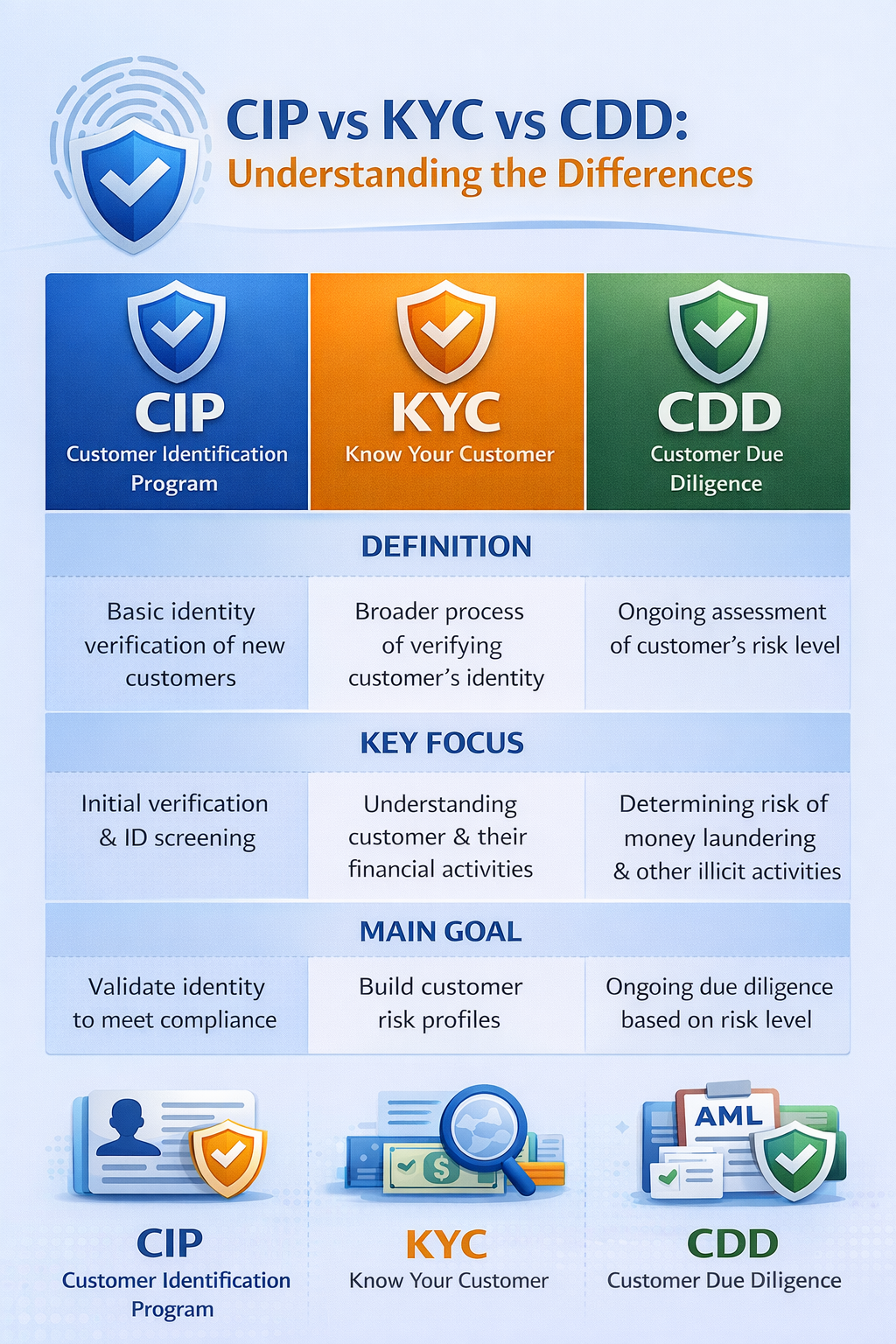
Although often used interchangeably, CIP, KYC, and Customer Due Diligence (CDD) are distinct concepts.
CIP focuses specifically on identity verification at account opening. Know Your Customer (KYC) is a broader framework that includes identity verification, risk assessment, and ongoing monitoring. Customer Due Diligence (CDD) expands further to include beneficial ownership identification and risk profiling.
In simple terms, CIP is the first step. KYC builds on it. CDD deepens the analysis. Together, they form a layered defense against financial crime.
See Smarter Customer Due Diligence in ActionDiscover how SignalX helps compliance teams streamline Customer Due Diligence, uncover hidden risks, and accelerate decision-making with AI-powered intelligence. |
Step-by-Step Process to Implement a Customer Identification Program
Implementing an effective CIP begins with a comprehensive risk assessment. Institutions must evaluate customer types, product offerings, geographic exposure, and delivery channels to understand risk levels.
Next, a written CIP policy must be drafted and approved by senior management. This document outlines procedures, verification standards, escalation protocols, and recordkeeping practices.
Technology integration is critical in digital environments. Automated identity verification tools can reduce manual errors and improve onboarding speed.
Staff training ensures employees understand regulatory obligations and can identify red flags. Ongoing monitoring and periodic internal audits help maintain compliance and adapt to regulatory updates.
A well-structured implementation plan ensures consistency and regulatory defensibility.
Common Challenges Businesses Face with CIP
Modern financial institutions face significant challenges in maintaining effective CIPs.
Digital onboarding fraud has surged, with criminals using stolen or synthetic identities to bypass verification systems. Synthetic identity fraud, where real and fake information are blended, is particularly difficult to detect.
Cross-border verification introduces complexity due to varying documentation standards and language differences. Manual verification processes can cause onboarding delays, frustrating customers and increasing abandonment rates.
Additionally, regulatory updates require institutions to continually refine policies and procedures to stay compliant.
Best Practices for an Effective Customer Identification Program
Automation is key to scalability. Leveraging technology to verify identities in real time reduces human error and accelerates onboarding.
Multi-layered identity checks, including document authentication, biometric verification, and database screening, strengthen fraud prevention.
AI-powered fraud detection tools can identify behavioral anomalies and suspicious patterns beyond static document checks.
Regular compliance reviews and internal audits ensure that procedures remain aligned with evolving regulations.
Finally, institutions must balance compliance with customer experience. Seamless onboarding processes improve conversion rates while maintaining regulatory integrity.
How SignalX Supports Customer Identification Programs
SignalX empowers financial institutions with advanced identity verification and compliance solutions designed for modern regulatory environments.
Its automated identity verification capabilities streamline onboarding while maintaining compliance standards. Real-time document validation ensures authenticity, while AI-powered fraud detection identifies suspicious activity early in the customer lifecycle.
SignalX integrates sanctions and watchlist screening into onboarding workflows, reducing operational friction. Risk-based onboarding allows institutions to apply enhanced due diligence where necessary without slowing low-risk customers.
With seamless API integration and audit-ready reporting, SignalX supports scalable growth for fintech platforms, banks, and crypto exchanges alike.
See Smarter Customer Due Diligence in ActionBook Your Demo Now
|
Penalties for Non-Compliance with CIP Regulations
Failure to comply with CIP regulations can result in substantial regulatory fines and enforcement actions.
Beyond financial penalties, non-compliance can damage institutional reputation and erode customer trust. Regulatory investigations often lead to costly remediation efforts and operational disruptions.
In severe cases, institutions may face license revocation or restrictions on business activities. The cost of non-compliance far exceeds the investment required to build a robust identification program.
Future Trends in Customer Identification Programs (2026 & Beyond)
The future of CIP is increasingly technology-driven.
AI-powered identity verification systems will continue to improve fraud detection accuracy. Biometric authentication methods such as facial recognition and fingerprint verification are becoming more common.
Digital identity wallets may allow customers to store verified credentials securely and share them across institutions. Regulatory frameworks are gradually converging internationally, promoting standardized compliance practices.
Zero-trust financial architectures are emerging, where every transaction and identity claim is continuously verified rather than assumed trustworthy.
Institutions that adopt forward-thinking identity solutions today will be better positioned to navigate tomorrow’s regulatory and fraud landscape.
Frequently Asked Questions
What is the purpose of a Customer Identification Program?
The primary purpose is to verify customer identities and prevent financial crimes such as money laundering and terrorist financing.
Is CIP mandatory for fintech companies?
Yes, if they provide regulated financial services and open customer accounts.
What information is required under CIP?
Typically, full name, date of birth, address, and identification number for individuals, plus additional documentation for businesses.
How long must CIP records be kept?
Generally, at least five years after account closure, depending on jurisdiction.
What is the difference between CIP and KYC?
CIP focuses on identity verification at onboarding, while KYC encompasses broader risk assessment and ongoing monitoring.
Conclusion: Building a Strong, Compliant, and Scalable CIP
A Customer Identification Program is more than a regulatory requirement it is a strategic safeguard for financial institutions operating in an increasingly digital and high-risk world.
By implementing structured policies, leveraging advanced verification technologies, and maintaining audit-ready documentation, institutions can protect themselves from fraud, penalties, and reputational damage.
As financial crime grows more sophisticated, so must compliance strategies. Modern, automated solutions like SignalX enable organizations to build strong, compliant, and scalable CIPs that support both regulatory requirements and business growth.
Investing in a robust Customer Identification Program today is not just about compliance it is about securing the future of your financial operations.