The TPRM WorkFlow Problem: Why Enterprises Are Rebuilding Risk Intelligence Around SignalX





Introduction: The Hidden Breakdown in Modern TPRM workflow
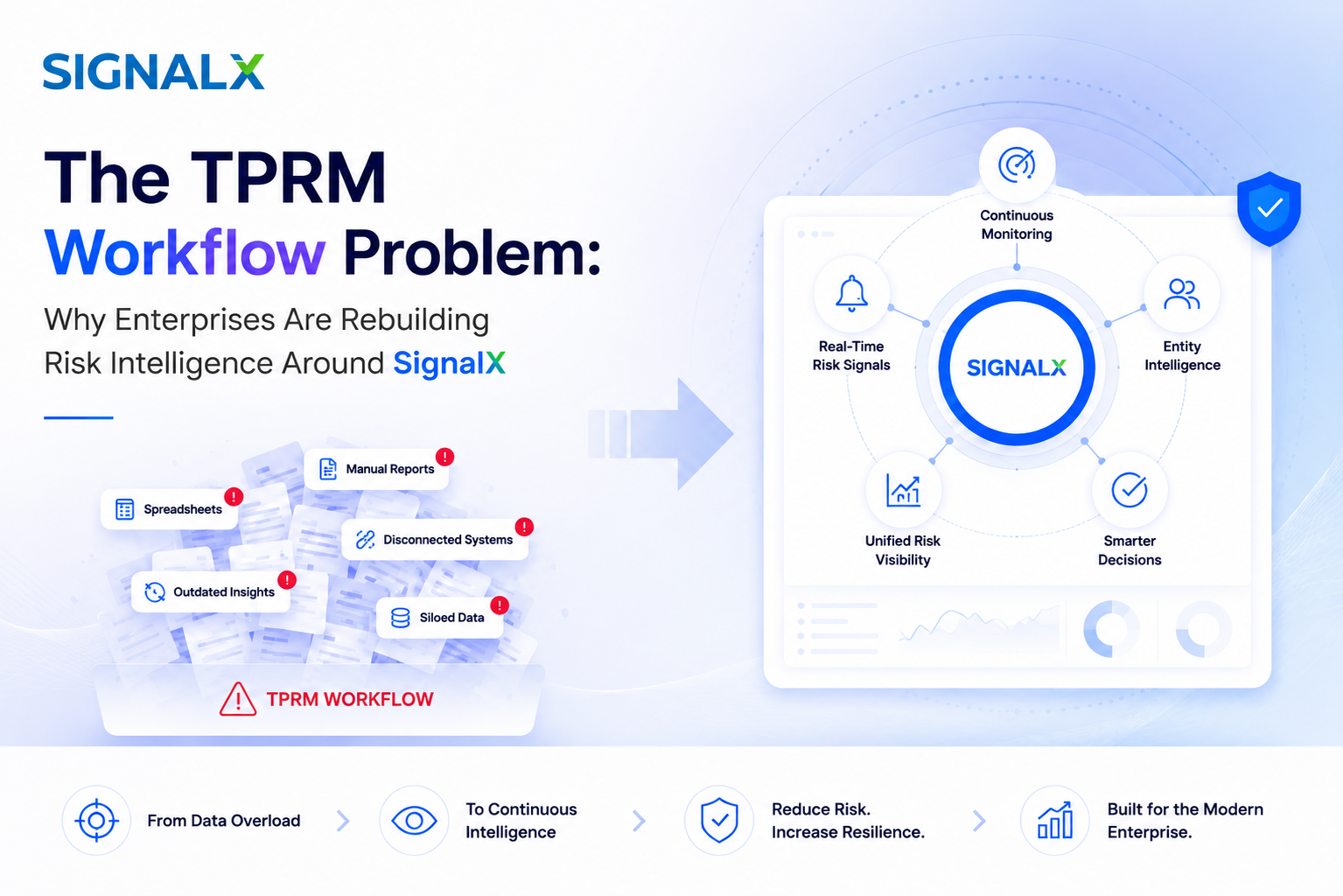
Enterprises today are not struggling to collect risk data.
They are struggling to understand it fast enough to act on it.
Across industries banking, fintech, manufacturing, healthcare, SaaS, and investment ecosystems organizations are managing an expanding universe of third-party relationships. Every vendor introduces its own layer of operational dependency, compliance exposure, and cybersecurity risk.
Yet despite massive investments in governance tools, most enterprises still rely on fragmented systems:
- periodic due diligence reports
- manual risk questionnaires
- disconnected compliance workflows
- static dashboards that age quickly
The result is a growing operational condition many risk leaders quietly recognize:
TPRM workflow where risk signals exist everywhere, but clarity exists nowhere.
Enterprises are not lacking data.
They are lacking continuous intelligence that connects the data into decisions.
This is where platforms like SignalX are redefining how modern organizations think about risk infrastructure.
Why Traditional TPRM Models Are Reaching Their Limit
Traditional Third-Party Risk Management systems were designed for a different era one where vendor ecosystems were smaller, slower, and more predictable.
Most legacy programs still operate around:
- annual or quarterly assessments
- static vendor onboarding workflows
- spreadsheet-based tracking systems
- reactive incident reporting
But the modern enterprise environment no longer behaves in cycles it behaves in real time.
A vendor’s risk posture can change instantly due to:
- regulatory investigations
- financial instability
- cyber incidents
- sanctions exposure
- reputational events in global media
- downstream supplier failures
The core limitation of traditional TPRM is not effort it is timing.
Risk is continuous, but governance is periodic.
That mismatch creates blind spots that are often discovered only after an incident has already escalated.
The Real Problem: Risk Fragmentation, Not Risk Absence
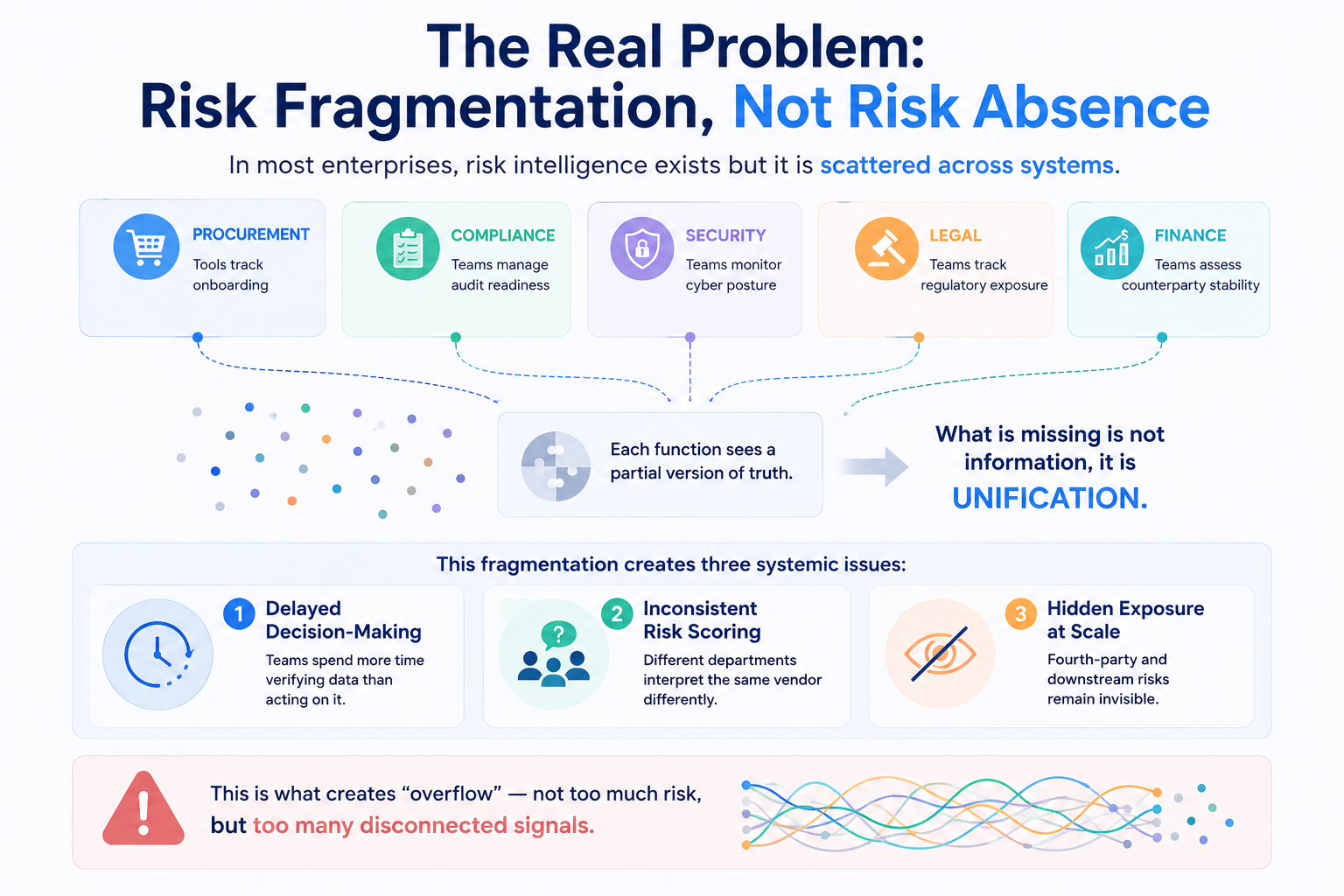
In most enterprises, risk intelligence exists but it is scattered across systems:
- procurement tools track onboarding
- compliance teams manage audit readiness
- security teams monitor cyber posture
- legal teams track regulatory exposure
- finance teams assess counterparty stability
Each function sees a partial version of truth.
What is missing is not information it is unification.
This fragmentation creates three systemic issues:
1. Delayed decision-making
Teams spend more time verifying data than acting on it.
2. Inconsistent risk scoring
Different departments interpret the same vendor differently.
3. Hidden exposure at scale
Fourth-party and downstream risks remain invisible.
This is what creates “workflow” not too much risk, but too many disconnected signals.
SignalX Approach: Building Risk as Infrastructure, Not Reports
SignalX is designed around a fundamentally different idea:
Risk should not be reported periodically it should be continuously available as infrastructure.
SignalX platform’s architecture unifies:
- data ingestion
- intelligence processing
- monitoring systems
- workflow automation
- decision support layers
into a single continuous risk infrastructure.
Instead of producing static outputs, the system focuses on:
- real-time entity visibility
- continuous monitoring of risk signals
- structured intelligence across financial, legal, and compliance domains
- automated workflows for due diligence and governance
This allows enterprises to shift from:
“checking vendor risk”
to
“operating with live risk intelligence.”
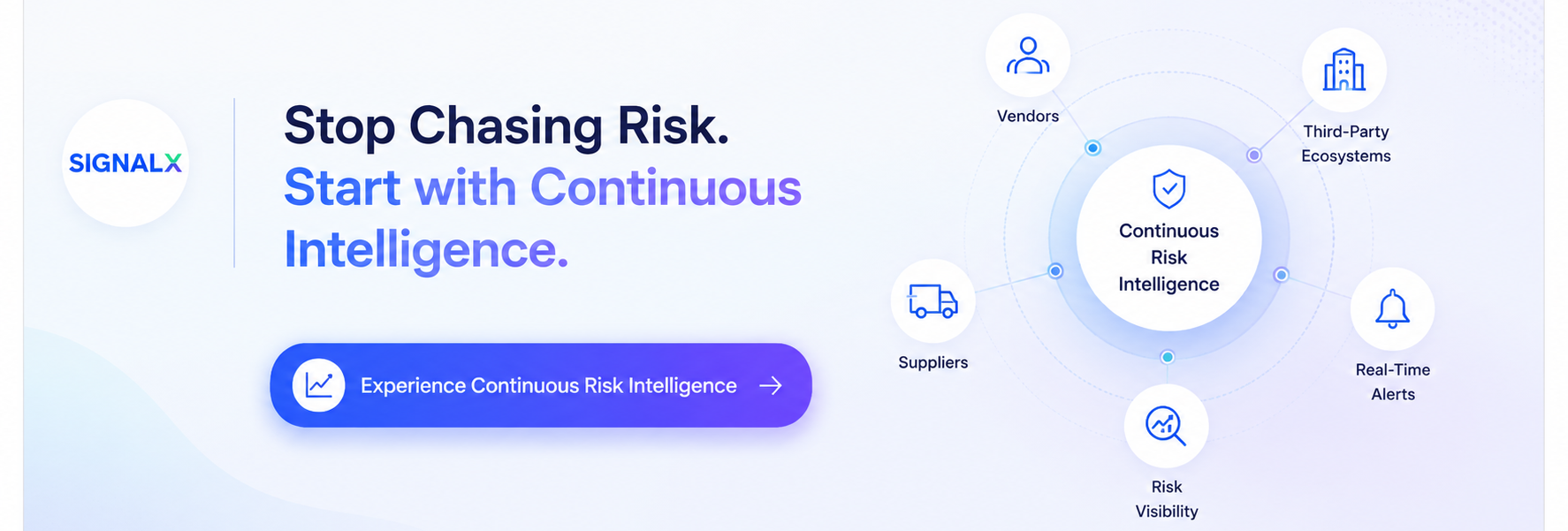
Continuous Intelligence vs Traditional TPRM
The most important transformation in modern risk management tool is not tooling it is operating philosophy.
| Dimension | Traditional TPRM | SignalX Approach |
|---|---|---|
| Risk view | Point-in-time | Continuous |
| Data model | Documents & questionnaires | Entity-based intelligence |
| Monitoring | Manual / periodic | Always-on signals |
| Decision flow | Reactive | Real-time |
| Risk visibility | Fragmented | Unified |
The shift is subtle in wording but significant in impact.
Enterprises are no longer asking:
“Is this vendor compliant today?”
They are asking:
“Is there any change in this vendor’s risk profile right now?”
The Intelligence Layer: Turning Signals Into Decisions
One of the core challenges in enterprise risk systems is not collecting data it is interpreting it.
SignalX addresses this through an intelligence-driven architecture that:
- aggregates structured and unstructured risk data
- identifies relationships between entities
- tracks changes across financial, legal, and compliance indicators
- surfaces meaningful signals instead of raw noise
This is critical because modern enterprises do not suffer from lack of alerts.
They suffer from alert overload without prioritization.
A well-designed intelligence layer does not show more data.
It shows what matters most right now.
Why Continuous Monitoring Is Becoming a Board-Level Requirement
Risk is no longer an operational concern alone.
It has become a governance and board-level issue because third-party ecosystems now directly impact: 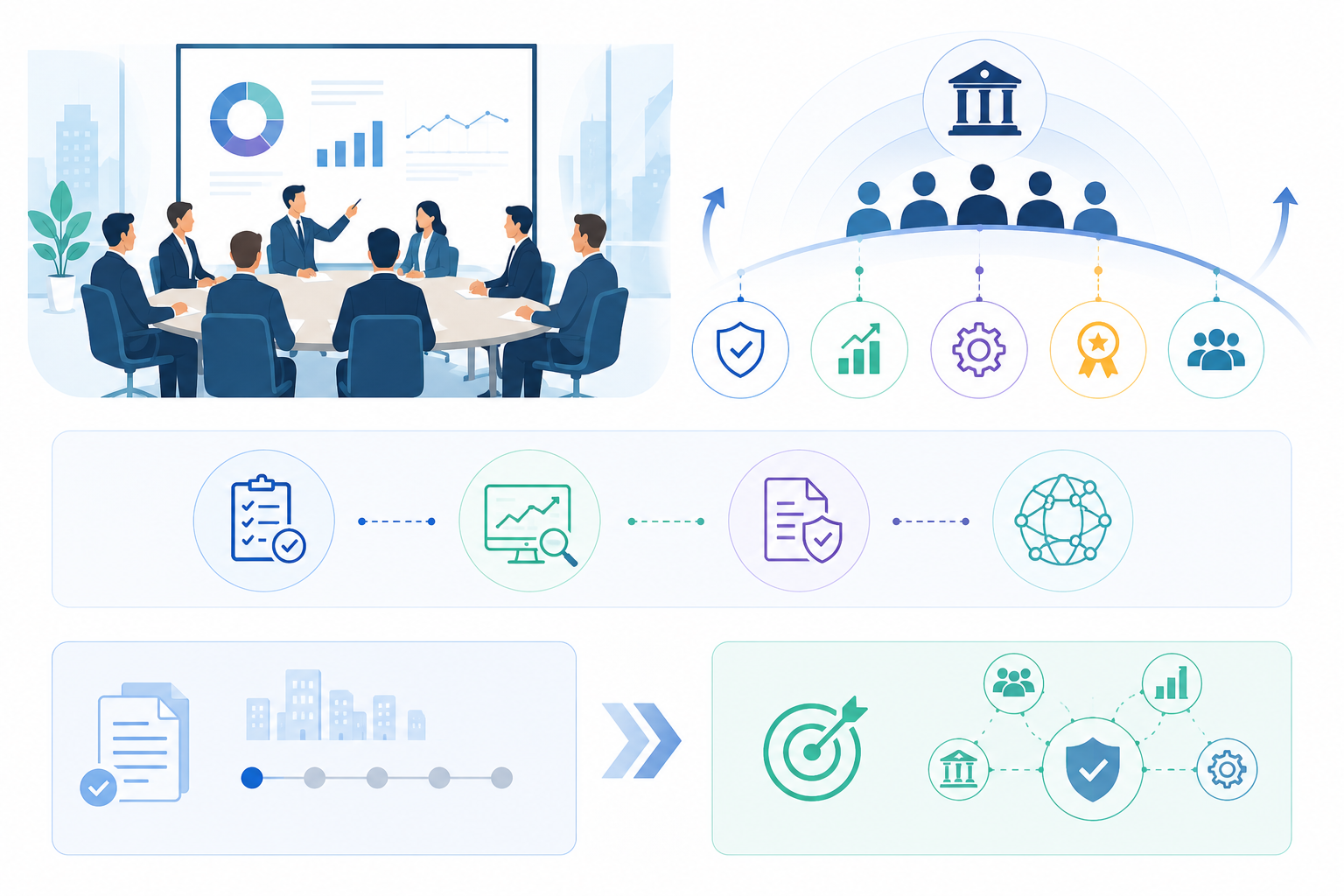
- regulatory exposure
- financial stability
- operational resilience
- brand reputation
- investor confidence
Regulators across jurisdictions are increasingly expecting enterprises to demonstrate:
- vendor oversight
- ongoing monitoring
- audit-ready risk governance
- supply chain transparency
This has shifted TPRM from a compliance function into a strategic risk discipline.
The New Enterprise Reality: From Vendor Lists to Risk Networks
One of the most important changes in modern risk thinking is the move away from “vendor lists” toward risk networks.
Each vendor is not an isolated entity.
It is connected to:
- subcontractors
- infrastructure providers
- financial institutions
- regulatory environments
- geographic risk zones
This interconnected structure means that risk spreads across relationships, not just individual companies.
SignalX’s entity-based approach reflects this reality by focusing on:
- relationship mapping
- interconnected risk signals
- continuous exposure tracking
This allows enterprises to understand not just who they work with, but what they are indirectly exposed to.
What High-Maturity Enterprises Are Doing Differently
Organizations that are advancing in TPRM maturity are now focusing on:
1. Centralized risk visibility
Moving all vendor intelligence into a unified system.
2. Continuous monitoring frameworks
Replacing periodic reviews with live updates.
3. Risk prioritization models
Focusing attention on high-impact vendors rather than treating all vendors equally.
4. Cross-functional governance
Aligning procurement, legal, compliance, and security under shared intelligence.
5. Decision-ready reporting
Moving from raw reports to action driven insights for leadership.
FAQs
What is TPRM?
Third-Party Risk Management is the process of identifying, assessing, and continuously monitoring risks introduced by external vendors, suppliers, and partners.
What is TPRM workflow?
TPRM workflow refers to the condition where enterprises have more vendor risk data than they can effectively interpret or act upon, leading to fragmented visibility and delayed decisions.
How is SignalX different from traditional TPRM tools?
SignalX focuses on continuous risk intelligence infrastructure rather than static assessments, enabling real-time monitoring, entity intelligence, and unified risk visibility.
Why is continuous monitoring important?
Because vendor risk profiles change constantly due to financial, regulatory, cyber, and operational factors that cannot be captured through periodic reviews.
Final Perspective: The Future of Enterprise Risk Intelligence
The future of TPRM Workflow will not be defined by more questionnaires or larger compliance checklists.
It will be defined by intelligence orchestration at scale.
Enterprises that continue relying on static models will increasingly struggle with:
- delayed risk detection
- fragmented visibility
- reactive governance
Whereas organizations adopting continuous intelligence systems will gain:
- faster decisions
- unified risk visibility
- stronger operational resilience
- improved regulatory readiness
In this shift, SignalX represents a broader transformation in enterprise risk thinking from managing documents to managing live intelligence systems.
Because in modern enterprises, risk is no longer something you review.
It is something you continuously understand.