Issues Management Process: How to Manage Third-Party Vendor Risks
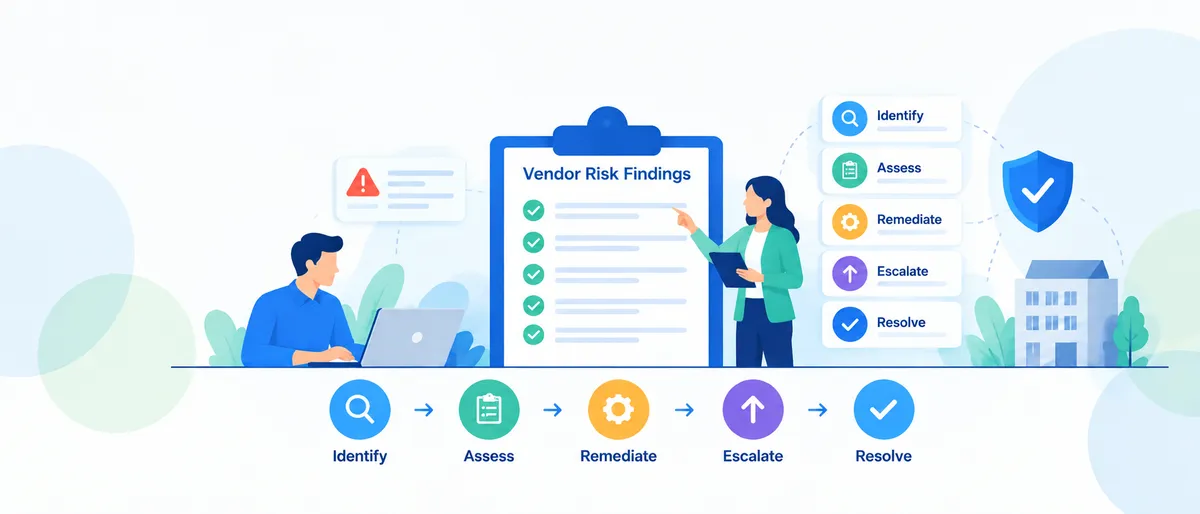





The seriousness of a vendor risk assessment is clear when a supplier’s security certification expires, a new lawsuit involves a vendor, a compliance document becomes invalid, or a monitoring system identifies a significant change in a vendor’s risk profile. Therefore, effective Issues Management becomes important here. Subsequently, the risk team discovers the problem and emails the vendor owner. Then nothing happens. However, the vendor promises to respond, procurement follows up, and someone updates a spreadsheet. A couple of weeks later, the issue is still open, sitting alongside dozens of other findings.
This is where third-party risk issues management becomes important. Identifying a vendor risk is only the beginning. To effectively manage a Third-Party Risk Management (TPRM) program, organizations need a structured process to evaluate the finding, assign ownership, establish remediation plans, escalate overdue issues, verify the solution, and finally resolve the problem. This guide explains how to manage vendor risk issues, common mistakes to avoid, and how continuous monitoring can help organizations better manage third-party risks.
How Does Issues Management Work in TPRM?
Issues management involves the process of identifying, verifying, and ultimately closing vendor risks.
A finding can come from several sources, including:
- Third-party risk assessments
- Security or compliance reviews
- Internal audits
- Continuous monitoring
- Vendor self-disclosures
- Regulatory changes
- Litigation or legal events
- Financial risk indicators
The distinction between identifying a risk and managing it is important. Risk assessment may identify a potential problem, but issues management focuses on what happens next—how the issue is assessed, assigned, remediated, verified, and ultimately closed.
An assessment might tell you, “This vendor’s required certification is no longer valid.” Issues management addresses the questions that follow:
- How serious is the issue?
- Who is responsible for resolving it?
- What obligations does the vendor have?
- When must it be completed?
- What happens if the deadline is missed?
- How can we determine whether the problem has been resolved?
In simple terms:
Risk assessment identifies the problem. Issues management ensures that something happens about it.
Why Is Issues Management Important for Vendor Risk?
a TPRM program may identify numerous vendor risks and still struggle with risk management if those findings are not properly addressed. Consider an organization with 500 vendors and 200 open findings. When findings are spread across spreadsheets, emails, assessment reports, and procurement systems, even basic questions become difficult to answer.
- How many high-risk issues remain unresolved?
- Which findings are overdue?
- Who owns each issue?
- Which vendors have recurring findings?
- Which issues require verification?
This creates two major problems.
An unresolved security, compliance, financial, or operational issue remains an exposure until it is properly addressed. Simply recording the problem does not diminish the risk.
Risk teams may identify findings, procurement may manage the vendor relationship, and business teams may control the service. When nobody is clearly accountable for bringing an issue to closure, remediation may not proceed. A successful issues management process therefore needs both visibility and accountability.
The Vendor Risk Issue Life cycle
There are four main stages for managing vendor risk issues:
Flag → Assess → Remediate → Close
Continuous monitoring can then provide a fifth activity that helps identify future changes.
Issues Management Step 1: Flag and Document the Issue
The first step is determining whether a finding requires formal issue management.
Potential triggers include:
- Expired certifications
- Compliance gaps
- Security concerns
- Litigation
- Regulatory developments
- Financial deterioration
- Contractual breaches
- Sanctions or watch list alerts
- Vendor disclosures
- Monitoring alerts
Not every new piece of information needs to become an issue.
The important question is:
Does this finding require action?
If it does, the finding should move into a workflow-based approach rather than remaining in an email or assessment report.
What Should a Vendor Issue Record Include?
At minimum, the issue record should contain:
- Vendor name
- Issue description
- Source of finding
- Date identified
- Risk category
- Severity
- Accountable owner
- Remediation requirement
- Due date
- Status
- Supporting evidence
This provides a common view for everyone involved in managing the issue.
Issues Management Step 2: Assess Severity and Ownership
After identifying an issue, the organization needs to determine what should happen next.
Severity may consider:
- Potential business impact
- Regulatory implications
- Vendor criticality
- Data involved
- Likelihood of harm
- Duration of exposure
- Recurrence of the issue
- Existing compensating controls
A straightforward structure could look like this:
| Severity | Example | Typical Response |
| Low | Minor documentation gap | Routine remediation |
| Medium | Non-critical certification issue | Defined remediation deadline |
| High | Significant compliance or financial concern | Risk escalation |
| Critical | Significant security or legal problem | Immediate review |
The organization’s risk management approach should be tailored to its own risk categories.
Assign One Accountable Owner
Remediation may involve multiple teams, but there should be a single accountable owner. The risk team identifies and monitors the problem, procurement manages the vendor relationship, the business owner manages the business impact, and the vendor performs the corrective action. Without someone accountable for moving the issue forward, responsibility can quickly become unclear.
Issues Management Step 3: Remediate Vendor Risk Issues
A remediation plan should clearly state what the vendor is required to do.
Compare two approaches:
Weak Remediation Requirement
“The vendor confirms that the matter is being resolved.”
Stronger Remediation Requirement
“The renewed certificate is provided by the vendor, and the responsible department evaluates and verifies it.”
The second approach provides an objective measure of resolution.
A remediation plan should define:
- Required corrective action
- Responsible party
- Evidence required
- Target completion date
- Verification owner
- Escalation conditions
Match Remediation Timelines to Risk
The remediation SLA should reflect the level of vendor risk. A minor documentation problem may require more time to resolve, while a critical security, legal, or compliance issue may require prompt action. Applying a uniform remediation period to every finding can result in unnecessary delays for issues carrying greater risk.
Issues Management Step 4: Verify and Close Vendor Issues
Evidence is necessary before an issue should be considered resolved.Evidence is necessary before an issue should be considered resolved. A vendor saying, “It’s fixed,” does not necessarily mean that the underlying risk has been fully addressed. The required evidence should be reviewed and verified before the issue is formally closed.
For example:
| Issue | Evidence | Verification |
| Expired certification | Updated certificate | Validity confirmed |
| Security gap | Updated control documentation | Reviewed |
| Compliance issue | Corrective action evidence | Verified |
A useful workflow is:
Open → Remediation → Verification → Closed
This is different from closing an issue simply because the vendor has provided a response.
The responsible team should verify the evidence against the original finding.
If there is not enough evidence to support closure, the issue should remain open until the required evidence is provided and verified.
Issues Management Escalation: When Should Vendor Risks Be Escalated?
The original issues management framework should incorporate escalation rather than treating it as an afterthought.
A practical escalation model considers:
Severity + Deadline + Business Impact + Vendor Criteria
For example:
| Severity | Example | Escalation Approach |
| Low | Minor administrative issue | Routine follow-up |
| Medium | Compliance or documentation gap | Escalate if overdue |
| High | Significant risk exposure | Senior risk escalation |
| Critical | Urgent security, legal or penalty-related matter | Immediate escalation |
Exact thresholds should reflect the organization’s risk appetite and governance framework.
What Should Trigger Escalation?
common triggers include:
- Remediation deadline missed
- Vendor does not respond
- Required evidence is not provided
- Issue becomes more severe
- Same finding occurs repeatedly
- Vendor provides inadequate remediation
- Risk exceeds defined tolerance
When significant or recurring problems occur, organizations may need to assess whether maintaining the vendor relationship remains appropriate within their governance framework. This may include considering additional controls, formal risk acceptance or other actions.
Free Download: Third-Party Risk Assessment Checklist
Identifying vendor issues is only the first step. A consistent process is needed to assess severity, assign ownership, track remediation, manage escalation, and verify closure.
What’s Included?
- Third-party risk assessment checklist
- Vendor risk assessment and issue management checklist
- Issue severity classification framework
- Remediation and SLA framework
- Vendor risk escalation matrix
- Issue closure and verification checklist
- Evidence verification checklist
- Vendor exit considerations
Download the free Third-Party Risk Assessment Checklist to bring more structure and consistency to your vendor risk management process.
This free resource is designed for TPRM, risk, procurement, and compliance teams managing third-party vendor risks.
Common Mistakes in Vendor Risk Issues Management
Even well-established TPRM programs can encounter persistent issues.
1. Tracking Issues in Spreadsheets and Emails
As the number of issues increases, spreadsheets become increasingly difficult to manage. Important information can become scattered across multiple trackers, mailboxes, and reports, making it harder for teams to maintain a clear view of issue status, ownership, remediation progress, and closure.
2. No Single Accountable Owner
When multiple departments are involved but nobody is accountable, remediation may not proceed as planned.
3. Treating Vendor Confirmation as Evidence
The vendor’s response does not necessarily resolve the underlying problem.
4. Using the Same SLA for Every Issue
The severity of a vendor risk should determine how quickly the issue needs to be remediated. A critical issue may require immediate action, while a minor documentation gap may be addressed within a longer remediation timeline based on the level of risk involved.
5. Closing Issues Without Verification
An issue should be closed because the required remediation has been verified, not simply because the vendor has responded.
6. Stopping Monitoring After Closure
As a result, some risk conditions can recur over time. For example, a vendor may renew a certification today, but the certification could expire again in the future. This is why issue closure should be combined with ongoing monitoring to identify and address recurring or newly emerging risks.
Continuous Monitoring and Third-Party Risk Issues
Traditional TPRM programs often rely on periodic evaluations. A vendor is assessed, findings are identified, remediation is tracked, and then the organization waits for the next assessment cycle. But vendors can face different risks between assessments. A certification can expire, a company can become subject to legal action, financial conditions can change, a regulatory status can shift, or a previously resolved issue can return.
Continuous vendor monitoring helps organizations identify relevant changes between regularly scheduled assessments. The workflow becomes: Monitor → Detect → Assess → Remediate → Verify → Close → Continue Monitoring. This makes third-party risk management more continuous. Closing an issue means that the specific issue has been addressed. It does not necessarily mean that the vendor should stop being monitored.
For additional guidance on strengthening vendor risk assessments, organizations can refer to NIST’s Enhanced Vendor Risk Assessments, which outlines practices such as analyzing vendor information, using third-party assessment and security-rating platforms where appropriate, and obtaining vendor or third-party attestations.
How Risk Terminal Supports Vendor Issue Management
As more third parties become involved, manually tracking vendor risk and remediation can become difficult. SignalX’s Risk Terminal can integrate continuous vendor monitoring, risk intelligence, and workflow visibility into the vendor risk management process.
A standard workflow can look like:
New Risk Signal → Review → Determine Whether It Is an Issue → Assess Severity → Assign Owner → Track Remediation → Verify Evidence → Close → Continue Monitoring
This connects risk detection with the actions required after a finding has been identified. Rather than treating monitoring alerts, vendor assessments, and remediation as separate tasks, teams can view them as connected components of a broader TPRM workflow.
Maintain Visibility Over Vendor Issues
Teams can maintain visibility over questions such as:
- Which vendor issues are open?
- Which findings require attention?
- Which remediation deadlines are approaching?
- Which issues are overdue?
- Which vendors have recurring findings?
- Which issues are awaiting verification?
Technology does not make the risk decision for the organization.
It provides information and workflow visibility to help teams make those decisions more systematically.
A Practical Vendor Risk Issues Management Workflow
A TPRM team can execute the following process.
Step 1: Detect
Locate evidence through an assessment, audit, vendor disclosure or continuous monitoring.
Step 2: Flag
Evaluate whether the finding requires formal issue management.
Step 3: Assess
Determine severity, impact and priority.
Step 4: Assign
Give one individual explicit accountability for monitoring remediation.
Step 5: Remediate
Define the corrective action, evidence requirements and deadline.
Step 6: Escalate
Escalate according to predetermined thresholds when deadlines are missed or risks increase.
Step 7: Verify
Examine evidence that indicates the problem has been resolved.
Step 8: Close
Formally document the resolution.
Step 9: Continue Monitoring
Continue monitoring when the underlying risk may recur or change substantially.
The complete cycle becomes:
Detect → Manage → Verify → Monitor
Rather than:
Spreadsheet → Email → Follow-up → Discard
Third-Party Risk Issues Management Checklist
Firstly, before resolving a vendor risk issue, ask:
- Is there a clear record of the original finding?
- Does the finding have a documented source?
- Has severity been assigned?
- Is there one accountable owner?
- Is the remediation requirement clear?
- Has a deadline been established?
- Is the required evidence available?
- Has the evidence been verified?
- Were missed deadlines escalated?
- Has closure been formally documented?
- Would continued monitoring be beneficial?
- Is it possible for the same issue to occur again?
Using this checklist can help risk and procurement teams develop a consistent vendor risk remediation process.
Frequently Asked Questions
What is third-party risk issues management?
Third-party risk issues management involves monitoring a vendor risk finding from initial identification through remediation, verification and final closure.
How is a finding different from an issue?
A finding is the recognition of a risk or gap. A finding that requires a specific action, owner and remediation process becomes an issue.
Who should be accountable for a vendor risk issue?
The ownership structure varies by organization. Risk, procurement, business teams and vendors may all have roles, but one person should have clear accountability for managing the issue through resolution.
How should vendor risk issues be prioritized?
Priority is commonly determined using factors such as severity, business impact, vendor criticality, regulatory implications and likelihood.
When should a vendor risk issue be escalated?
Escalation should be triggered by predetermined conditions such as the severity of the problem, missed remediation deadlines, repeated findings or material changes in risk.
Should an issue be closed once the vendor says it has been addressed?
Not necessarily. Appropriate evidence should generally be reviewed and verified before formally resolving the issue.
What is the significance of continuous monitoring?
Continuous monitoring helps identify changes in a vendor’s risk profile between formal assessment cycles, allowing relevant findings to enter the issue management process.
Can vendor issue management be automated?
Parts of the process can be automated, including monitoring alerts, workflow routing, reminders and status tracking. Human review may still be required to determine significance, remediation requirements and risk treatment.
How does Risk Terminal support vendor risk management?
Risk Terminal connects continuous vendor monitoring and risk intelligence with workflow visibility, helping teams investigate vendors, identify relevant risk signals and manage emerging third-party risks more systematically.
Conclusion
Identifying vendor risk is only the beginning of effective TPRM. What happens after the risk is detected is equally important. If ownership is unclear, a finding may go unclaimed. Without a specific remediation deadline, it can drift. Without escalation, long-overdue issues may not receive adequate attention. And without verification, an issue marked “closed” may not actually be resolved.
A systematic issues management process connects the entire life cycle: Flag → Assess → Remediate → Verify → Close → Continue Monitoring. Continuous monitoring adds another layer by allowing organizations to identify changes between periodic assessments.
For organizations managing large or critical third-party ecosystems, integrating vendor risk detection with structured remediation workflows can provide better visibility into what needs attention, what remains unresolved, and what has been successfully addressed. Vendor risk does not stop changing after an assessment is completed. A certification can expire. A regulatory event can occur. Litigation can emerge. A vendor’s financial or compliance profile can change.
Risk Terminal from SignalX enables teams to integrate vendor monitoring, risk intelligence, and workflow visibility into the third-party risk management process.