Supply Chain Compliance Software: Manage Supplier Risk & Compliance
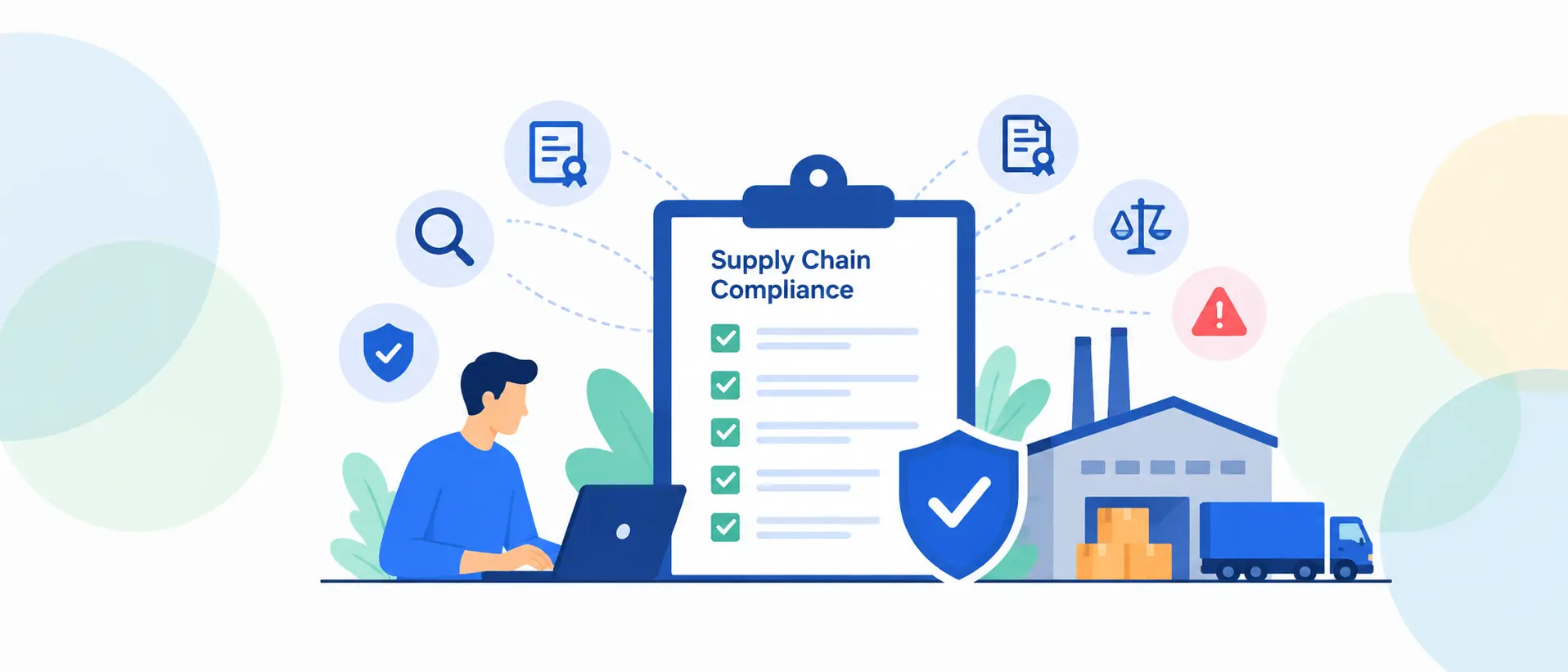





A supply chain that appears compliant on paper can still carry significant risk. This is where supply chain compliance software can help organizations continuously monitor suppliers beyond initial assessments. A supplier may have valid certifications today but fail to renew them on time. An important vendor could become involved in a legal dispute, while changes in ownership, financial position, regulatory status, or compliance standing may also affect the supplier’s risk profile.
The challenge becomes much bigger for organizations working with hundreds or thousands of suppliers. Manually monitoring these changes becomes increasingly difficult. This is where supply chain compliance software can be beneficial.
Instead of relying only on spreadsheets, emails, periodic reviews, and manual follow-ups, organizations can use technology to consolidate supplier information, monitor risk signals, identify compliance issues, and provide visibility into what needs to be addressed.
Supply chain compliance is more than just collecting supplier documents. The objective is to continuously monitor whether suppliers continue to meet expected compliance standards and take action when they do not.
What Is Supply Chain Compliance Software?
Supply chain compliance software helps companies oversee and document compliance requirements across their suppliers and external parties.
Depending on the organization’s requirements, this may involve monitoring:
- Supplier compliance documents
- Regulatory requirements
- Certifications
- KYC and KYB information
- Business registration details
- Tax and GST information
- Legal and litigation events
- Financial risk indicators
- Sanctions and watchlists
- Ownership changes
- Adverse risk signals
- Contractual requirements
- Supplier assessments
- Remediation activities
The purpose isn’t simply to save supplier information — it’s to answer a bigger question: are there any changes to this supplier that could affect its compliance or risk standing? This becomes especially important as the complexity and size of supplier networks increase.
Why Does Supply Chain Compliance Become More Challenging at Scale?
1. Supplier Information Becomes Fragmented
There is a major difference between managing compliance for 20 suppliers and managing it for 2,000. At a smaller scale, a procurement or compliance team may be able to manage spreadsheets, send email reminders, and review documents manually. As the number of suppliers increases, several problems can appear.
Supplier information often exists across procurement systems, spreadsheets, emails, shared folders, contract management systems, compliance databases, and assessment forms. When information is spread across so many different places, it becomes challenging to establish a consistent view of supplier risk.
2. Compliance Information Becomes Outdated
A supplier may provide a certificate during on-boarding, but what happens when that certificate expires, the supplier changes its legal structure, ownership changes, a regulatory issue appears, a lawsuit is filed, or financial conditions deteriorate? Without continuous monitoring, it’s not always clear what a supplier’s current compliance status actually is.
3. Manual Monitoring Doesn’t Scale
Teams can review suppliers manually from time to time, but as the number of suppliers grows, it becomes increasingly difficult to monitor all of them consistently. This creates a common gap: supplier risk can change continuously, while supplier assessments are only conducted periodically.
4. Compliance Issues Can Remain Unresolved
Identifying a compliance issue is only the starting point — someone still needs to assess the issue, determine its severity, assign an owner, contact the supplier, track remediation, collect evidence, verify that evidence, close the issue, and continue monitoring. Without an established process for resolving issues, they can remain open for weeks or months.
What Does Supply Chain Compliance Software Actually Do?
A useful supply chain compliance program typically covers multiple stages of the supplier life cycle.
1. Supplier On-boarding
Before working with a supplier, organizations need to understand that supplier and its compliance with internal standards — covering business identity, registration information, ownership, tax information, certifications, licenses, compliance documents, financial information, and risk indicators. The objective is to establish a basic understanding of the supplier.
2. Supplier Compliance Assessment
After a supplier is on boarded, organizations can assess it against specific compliance requirements.
For example:
| Requirement | Supplier Status |
| Business registration | Verified |
| GST information | Verified |
| Required certification | Valid |
| Compliance document | Expiring |
| Assessment questionnaire | Pending |
| Legal screening | Requires review |
This provides clearer visibility into supplier status for procurement, compliance, and risk teams.
3. Continuous Supplier Monitoring
Supply chain compliance software becomes particularly useful when it supports ongoing supplier monitoring, since a supplier’s risk profile can change even after an assessment has already been completed. Continuous monitoring helps identify relevant changes such as legal events, regulatory developments, changes in business information, ownership changes, financial risk signals, compliance changes, and negative business events. Teams can then investigate relevant changes as they arise, rather than waiting for the next supplier review — turning the workflow into a simple cycle: Monitor → Detect → Evaluate → Act.
4. Compliance Issue Management
The presence of a risk signal doesn’t automatically mean there’s a compliance issue — it needs to be reviewed first. For example, if a supplier is linked to legal proceedings, the compliance team needs to determine whether the event actually relates to the supplier, whether it could affect the organization’s risk exposure, whether the matter is significant enough to require action, whether the supplier needs to provide additional information, and whether the supplier’s risk classification should change. This is why supply chain compliance software shouldn’t focus only on alerts — it should help teams move from identifying a potential issue to taking appropriate action.
5. Remediation and Evidence Tracking
Identifying a compliance issue is only the next step in dealing with it. A useful workflow should let teams track what the issue is, who owns it, what action is required, who needs to provide evidence, when that action is due, whether evidence has been received, whether it’s been substantiated, and whether the issue can be resolved. In practice, this looks like: supplier certification expires → supplier contacted → certificate updated → verification completed → issue resolved. Without this workflow, organizations may know an issue exists but have limited visibility into whether it’s actually been resolved.
Supply Chain Compliance Software vs. Spreadsheets
Spreadsheets are useful for a great many everyday tasks, but problems arise when businesses use them as their primary method of keeping track of supplier risk over time.
| Spreadsheets | RiskTerminal (SignalX) |
| Information is entered manually | Supplier information is consolidated in one place |
| Reviews happen at certain times | Monitoring happens continuously |
| Follow-ups are done by email | Tasks follow a structured workflow |
| Updates need to be done manually | Issues and status are easier to track |
| Responsibility can be unclear | Responsibilities are clearly assigned |
| Deadlines are tracked manually | Deadlines are tracked through the workflow |
| Repeated issues are hard to spot | Repeated issues are easier to identify |
| Monitoring and fixing problems are separate | Monitoring and remediation are connected |
| Limited visibility into past issues | Previous issues can be reviewed |
It’s not that spreadsheets are never sufficient. The issue is whether the process you are using offers adequate visibility as your supplier network expands — and that is precisely the gap which purpose-built supply chain compliance software, such as RiskTerminal, is intended to eliminate.
What should you look for in software used for supply chain compliance?
Different companies have different requirements. Yet there are a number of capabilities that are most important, and these are the ones that RiskTerminal is based on.
Supplier Risk Visibility
The platform will enable teams to understand supplier risk without needing to consult several different systems, by bringing together supplier information, risk signals, and issue status in a single view.
Compliance Monitoring
The capacity to regularly check supplier information enables you to detect differences between scheduled assessments. Instead of having to wait until the next review cycle, RiskTerminal’s continuous monitoring picks up relevant changes as they occur.
Workflow Management
When a problem arises, teams need definite procedures for assigning it, tracking it, escalating it and resolving it; instead of relying on email threads, RiskTerminal organizes this as a workflow, from the time a new risk signal is detected until closure is achieved.
Evidence Management
Compliance decisions usually involve the need for supporting evidence and RiskTerminal keeps record of all the evidence that was requested, received, checked and confirmed for each issue.
Risk-Based Prioritization
The level of attention needed isn’t the same for all suppliers or problems. Rather than relying only on how recent an issue is, RiskTerminal enables teams to prioritize according to supplier criticality.
Audit Visibility
Teams must be able to see what had been found, when it was found, who carried out the check, what action was taken, what evidence was given, and when the issue was closed. RiskTerminal maintains this record for each supplier and for each issue.
Why Risk-Based Supplier Compliance Matters
Giving the same treatment to all suppliers may result in unnecessary work.
Consider two suppliers.
Supplier A
- Provides office paper
- Has low impact on the business
- Has no access to sensitive data
Supplier B
- Provides a key technology service
- Handles important company data
- Is difficult to replace quickly
- Is heavily relied upon by the business
Although both of them are suppliers, the effects of a compliance issue can be quite different.
A risk-based approach can consider:
- Importance of the supplier
- Industry
- Location
- Access to sensitive data
- Legal risks
- Financial reliance
- Services provided
- Previous problems
- Signs of possible issues
Risk Terminal enables this type of prioritization by linking supplier risk data to the workflow, so that teams can direct their attention to the areas where supplier risk is actually present, rather than carrying out the same checks on every supplier by default.
Supply chain due diligence helps organizations identify and address potential risks across their suppliers and business relationships. The OECD Due Diligence Guidance for Responsible Business Conduct provides a risk-based framework for implementing due diligence across supply chains.
Common Mistakes in Supply Chain Compliance
1. Stopping the Compliance Work after Onboarding
The need for supplier checks should not end after onboarding since a supplier’s situation can change.
2. Gathering documents without verifying that they are still valid
The fact that you have a document does not mean that it remains valid forever.
3. Sending Alerts and Not Following Up
The problem will stay open if no one looks at the alert or takes action.
4. Treating each supplier in the same way
The level of attention required for some suppliers depends on their risk and how important they are.
5. Closing issues without first verifying that they have been fixed
Just stating that a problem has been solved isn’t sufficient; in that case, some supporting evidence would be required.
6. Once a problem has been resolved, losing sight of the suppliers
Suppliers might change once more, so further inspections could still be necessary.
A Practical Supply Chain Compliance Workflow
A working supplier compliance process can follow these steps:
Step 1: Identify
Find out who the supplier is and get some basic details.
Evaluate whether the supplier meets the relevant requirements and ascertain its risks.
Step 3: Monitor
Keep an eye on any changes that could have an impact on supplier risk.
Step 4: Detect
Spot signs that could point to compliance or risk problems.
Step 5: Review
Check if the signal indicates a real problem.
Step 6: Assign
Allocate the issue to the person who is responsible.
Step 7: Remediate
Establish and monitor the steps needed to correct the problem.
Step 8: Verify
Make sure to check the evidence before closing the issue.
Step 9: Close
You should record the result and then close the issue once the requirements have been met.
Step 10: Continue Monitoring
You should continue to monitor the suppliers even after an issue has been closed.
The entire process is as follows:
Identify → Assess → Monitor → Detect → Review → Remediate → Verify → Close → Monitor.
RiskTerminal is designed to support this specific workflow throughout the entire process, not having each step handled by a separate spreadsheet, inbox, or reminder.
Free Download: Supply Chain Due Diligence Checklist
It is easier to manage supplier compliance if teams adhere to a consistent process.
The Supply Chain Due Diligence Checklist can help your team review:
- Supplier onboarding requirements
- Supplier compliance documents
- Risk assessment requirements
- Monitoring requirements
- Compliance issue tracking
- Remediation ownership
- Evidence verification
- Escalation requirements
- Issue closure
- Ongoing supplier monitoring
How Risk Terminal Supports Supply Chain Compliance
The more supplier networks expand, the more difficult it becomes to handle supplier monitoring, risk information, assessments, and remediation manually. That is the kind of gap that dedicated supply chain compliance software is designed to eliminate – and precisely what RiskTerminal from SignalX was created to achieve.
Rather than treating monitoring, assessments, and remediation as separate tasks spread across spreadsheets and inboxes, Risk Terminal brings them into one connected supplier risk process:
New Risk Signal → Review → Determine Relevance → Assess Risk → Assign Owner → Track Remediation → Verify Evidence → Close → Continue Monitoring
That is to say, instead of merely asking “what changed with this supplier?” teams can also ask:
- Which suppliers require attention?
- What issues are still open?
- What remediation deadlines are due soon?
- What issues are still waiting to be dealt with?
- What suppliers have had repeated problems?
- What results still need verifying?
The technology will not carry out the compliance decision for the organization. Instead, RiskTerminal supplies the information and visibility regarding the workflow that enables the team to make—and record—those decisions clearly.
Supply Chain Compliance Checklist
Before reviewing your current supplier compliance process, ask:
- Is there a complete record of each active supplier?
- Do we know which suppliers are critical?
- Are the requirements relating to compliance with the suppliers clearly stated?
- Shall we know the date by which important documents expire?
- Are the suppliers being kept under observation between the regular evaluations?
- Can we notice important changes in supplier risk?
- Is there an owner for each compliance issue?
- Do the deadlines for remediation get recorded?
- Has evidence been gathered to support it?
- Is evidence checked before an issue is closed?
- Is it possible to identify compliance issues that are overdue?
- Is it possible to identify repeated problems with suppliers?
- Do we have a clear understanding of the present state of supplier compliance?
The problem could possibly be not only the lack of data from suppliers but also the lack of visibility and a clear workflow—this precisely what RiskTerminal is intended to offer.
Frequently Asked Questions
What would be considered supply chain compliance software?
Software for complying with supply chain requirements helps organizations to manage information about their suppliers, carry out assessments, monitor matters, deal with issues, maintain evidence, and handle ongoing supplier risk. RiskTerminal, which is offered by SignalX, includes this feature as part of a more extensive third-party risk process.
What is the importance of complying with supply chain requirements?
Suppliers are capable of posing operational, regulatory, financial, legal, and reputational risks and a systematic compliance process aids companies in identifying and dealing with the supplier risks that are relevant.
Is supplier compliance the same as supplier risk management?
They overlap yet they are not identical; supplier compliance is concerned with whether suppliers meet specific requirements, whereas supplier risk management examines the wider range of risks associated with suppliers and third parties.
What benefit does continuous monitoring provide with regard to supplier compliance?
It is possible to detect changes between the supplier assessments that are scheduled by means of continuous monitoring, so that the teams can look at possible problems earlier rather than having to wait until the next review.
Can supply chain compliance be automated?
Certain tasks can be assisted by technology, for example in the areas of supplier monitoring, information collection, alerts, workflow management, issue tracking, and evidence management; however, decisions regarding risk and compliance still have to be made by humans.
Does SignalX provide software for supply chain compliance?
SignalX does not offer supply chain compliance as a standalone product; rather, Risk Terminal provides the same fundamental capabilities—continuous supplier monitoring, risk intelligence, and workflow visibility—as part of its connected third-party risk management platform.
Conclusion
Compliance in the supply chain involves more than simply gathering the supplier’s documents and ticking off the onboarding steps.
Suppliers do change; the information about their business may change; their compliance status may change; legal and financial events can occur; certifications can expire; and new risk signals can emerge.
It therefore means that supplier compliance must extend beyond routine assessments. A structured approach includes:
Supplier Onboarding → Assessment → Monitoring → Detection → Remediation → Verification → Closure → Continuous Monitoring
For organizations which manage large or important supplier networks, supply chain compliance software provides real value—specifically, RiskTerminal from SignalX has been designed to offer this kind of visibility and workflow.
The objective is simple: get to know your suppliers, identify any relevant changes, take action when problems arise, check that the necessary corrections have been made, and continue with ongoing monitoring.