Third-Party Vendor Management: AI-Driven Solutions for Faster, Safer Vendor Decisions
In today’s business ecosystem, companies rely on a growing network of third-party vendors to support almost every operational function. Cloud platforms host critical infrastructure, SaaS tools run day-to-day operations, logistics companies manage distribution, external agencies handle marketing, and IT partners oversee digital systems. This widespread dependency has transformed third-party vendor management from a simple procurement function into a strategic pillar of business continuity, cybersecurity, compliance, and operational resilience.
However, with this dependency comes an equal and pressing need to evaluate and manage vendor risks in real time.
A single failure or oversight from a vendor can cause significant disruptions:
- A cybersecurity breach at a supplier can compromise customer data.
- A financially unstable vendor can halt operations.
- A non-compliant partner can trigger regulatory penalties.
These realities place enormous pressure on organizations to not only choose reliable vendors but also monitor and govern them with precision.
Traditional vendor management methods simply cannot keep pace with the increasing scale, speed, and complexity of modern vendor ecosystems. Most organizations still rely on spreadsheets, emails, and manual document reviews, which result in inefficiencies, delays, and incomplete risk insights. This is precisely where AI-driven solutions are transforming the landscape. AI introduces automation, intelligence, and continuous monitoring into the vendor lifecycle, enabling companies to make decisions that are as fast as they are safe.
The Increasing Importance of Third-Party Vendor Management
The role of third-party vendors has expanded significantly in the last decade. Organizations now outsource not just secondary services but core business functions that directly influence customer experience, regulatory compliance, and operational quality. This expansion has raised the stakes for vendor governance, as any disruption originating from a vendor automatically becomes an internal business risk.
Modern outsourcing has created multiple layers of dependencies. Businesses that once handled processes internally now rely on external partners for:
- Cloud services and IT infrastructure
- Human resources and payroll
- Logistics and supply chain operations
- Cybersecurity monitoring and management
These external partners often gain access to sensitive data, critical infrastructure, and confidential business workflows. The deeper the vendor integration, the higher the potential impact of any vendor failure.
Regulators have also recognized this increased dependency. In India, frameworks issued by RBI, SEBI, IRDAI, and CERT-In explicitly require organizations to evaluate and monitor third-party risks. Regulatory requirements include:
- Conducting risk assessments and vendor tier classification
- Implementing ongoing monitoring practices
- Maintaining audit documentation and evidence of governance
- Ensuring compliance with cybersecurity, data protection, and operational standards
Non-compliance is no longer an option; the penalties and reputational damage associated with vendor failures are too significant to ignore.
Yet, beyond regulatory pressure, operational challenges remain. Many organizations simply do not have the capacity to manually evaluate the sheer number of vendors they work with. Vendor ecosystems grow every year, making manual processes increasingly inefficient and risky. Emails pile up, spreadsheets become outdated, and risk assessments take far too long, leading to delayed onboarding and poor oversight.
AI enters this landscape as a transformative driver of efficiency and accuracy, providing businesses with the tools they need to manage vendor ecosystems at scale.

How AI Transforms Third-Party Vendor Management
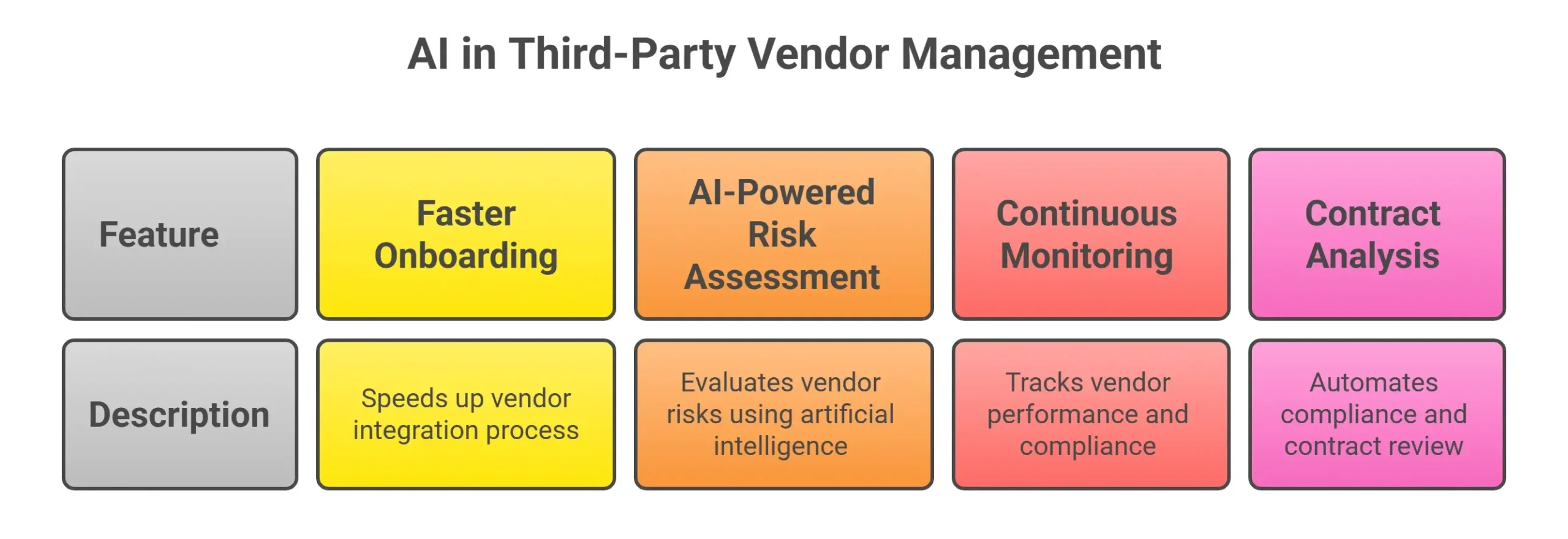
AI-driven vendor management introduces an entirely new way of handling vendor risk, onboarding, due diligence, contract analysis, and performance monitoring. Instead of relying on human-driven processes, AI automates complex tasks, identifies risk patterns, provides predictive insights, and ensures continuous oversight.
Faster Onboarding and Risk Classification
Vendor onboarding, which traditionally takes days or weeks, can now be completed in a fraction of the time. AI can:
- Automatically gather and verify vendor information
- Classify vendors based on risk tier and service type
- Pre-fill questionnaires and identify missing documentation
- Recommend risk assessment workflows tailored to vendor profiles
This not only reduces operational workload but also accelerates time-to-value for business teams.
AI-Powered Risk Assessment
Artificial Intelligence is redefining how organizations evaluate and manage vendor-related risks. Traditionally, teams had to manually review policies, compliance certificates, financial records, audit reports, and cybersecurity documentation a process that was time-consuming and often inconsistent. AI eliminates these inefficiencies by rapidly analysing vast volumes of structured and unstructured data with precision.
Advanced AI systems can instantly interpret complex documents, identify inconsistencies, and flag potential weaknesses in cybersecurity frameworks or compliance controls. They benchmark vendor practices against regulatory requirements and industry standards, generating standardized and objective risk scores. This ensures that risk assessments are not only faster but also more comprehensive, reliable, and scalable across large vendor ecosystems.
Continuous Monitoring and Proactive Risk Intelligence
Vendor risk does not remain static. A financially stable vendor today may face liquidity challenges tomorrow. A secure IT infrastructure can become vulnerable overnight. Regulatory requirements evolve, and reputational risks can arise unexpectedly due to media exposure.
AI-powered systems provide ongoing surveillance across multiple data streams to address this dynamic risk environment. These include internal performance indicators, external financial disclosures, cybersecurity intelligence feeds, threat databases, and media reporting platforms. By continuously evaluating these signals, AI identifies emerging concerns in real time.
Instead of reacting after damage has occurred, organizations receive early alerts that enable preventive action. This proactive approach significantly reduces exposure to operational disruptions, financial losses, and compliance violations.

Intelligent Contract Analysis and Compliance Automation
Vendor contracts contain numerous critical clauses related to liability, indemnification, service levels, confidentiality, and data protection. Manual contract reviews are labour – intensive and prone to oversight, especially when managing large volumes of agreements.
AI-driven contract analytics streamline this process by automatically reviewing contractual language and comparing it against approved templates and regulatory standards. The system can highlight deviations, detect missing provisions, and identify clauses that may introduce legal or operational risk.
In addition, AI tools generate structured, audit-ready documentation to support governance and regulatory inspections. This strengthens contractual integrity while reducing legal exposure and administrative burden.
Strategic Advantages of AI-Enabled Vendor Management
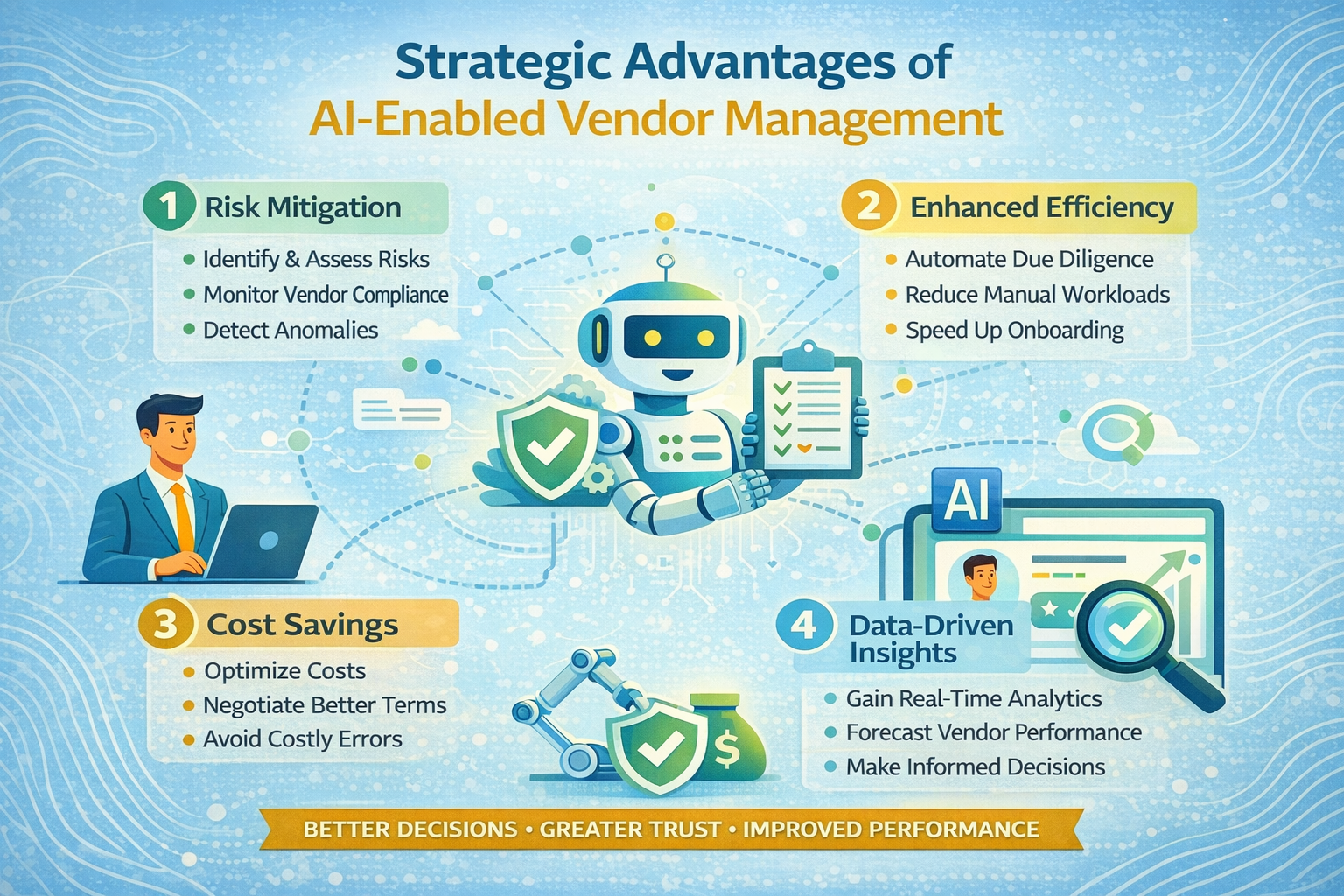
The implementation of AI in vendor management extends beyond automation. It fundamentally enhances organizational performance across several key dimensions:
Accelerated Decision-Making: Vendor onboarding, due diligence, and risk evaluations that previously required weeks can now be completed in significantly shorter timeframes, improving both efficiency and vendor experience.
Advanced Risk Visibility: Predictive analytics and continuous monitoring uncover potential threats before they escalate into critical incidents.
Robust Regulatory Compliance: AI maintains comprehensive records, risk classifications, and documentation that align with governance standards and regulatory expectations.
Greater Vendor Accountability: Automated monitoring of service-level agreements, delivery commitments, and performance metrics ensures vendors consistently meet contractual obligations.
Operational Scalability: As vendor networks expand, AI enables organizations to manage increasing complexity without proportionally increasing staffing or administrative costs.
By embedding AI capabilities throughout the vendor lifecycle from onboarding to performance monitoring organizations build a more resilient, responsive, and intelligent vendor governance framework.
Relevance for Indian Enterprises
India’s corporate landscape is experiencing rapid digital expansion alongside evolving regulatory frameworks. Industries such as banking and financial services, fintech, healthcare, information technology, telecommunications, manufacturing, and retail are increasingly dependent on third-party vendors for critical operations.
This dependence brings heightened exposure to cyber threats, regulatory scrutiny, and operational vulnerabilities. AI-powered vendor management systems help Indian enterprises navigate this complexity by strengthening risk oversight and compliance alignment.
Organizations can more effectively adhere to evolving regulatory requirements, enhance cybersecurity across vendor networks, reduce manual inefficiencies, and foster greater transparency with stakeholders. In a competitive market, businesses that adopt intelligent vendor governance frameworks gain operational agility and strategic advantage. Those that rely solely on manual processes risk delays, compliance gaps, and reputational harm.
Conclusion: The Future of Intelligent Vendor Governance
Vendor management has evolved into a strategic function central to organizational resilience and growth. As third-party ecosystems become larger and more interconnected, businesses require systems that deliver precision, speed, continuous oversight, and regulatory assurance.
AI-powered vendor management solutions provide this capability. By shifting from reactive processes to proactive intelligence-driven decision-making, organizations strengthen risk management, enhance compliance, and improve operational performance.
Enterprises that integrate AI into vendor governance will be better equipped to make informed, timely, and secure decisions positioning themselves for sustained success in an increasingly digital and regulated business environment.
Frequently Asked Questions:
1. What is a third-party vendor?
A third-party vendor is an external company or individual that provides products or services to an organization. They operate independently but support business operations such as IT services, logistics, marketing, software, or manufacturing.
2. Why do companies use third-party vendors?
Companies use third-party vendors to save costs, improve efficiency, access specialized expertise, and scale their business faster without hiring full-time employees for every role.
3. What are the risks of working with third-party vendors?
Common risks include data breaches, compliance issues, poor service quality, operational downtime, financial instability, and reputational damage if the vendor fails to meet expectations.
4. How can businesses manage third-party vendor risks?
Businesses use vendor risk management practices such as background checks, performance monitoring, contract reviews, audits, service-level agreements (SLAs), and cybersecurity assessments.
5. What should be included in a third-party vendor contract?
Key elements include scope of work, pricing, timelines, confidentiality clauses, data-protection policies, SLAs, penalties for non-compliance, and termination conditions.
6. How do you choose the right third-party vendor?
Evaluate their experience, expertise, pricing, certifications, client reviews, security practices, service quality, and ability to meet your business requirements.
7. What is third-party vendor management?
Vendor management refers to the process of selecting, monitoring, and maintaining relationships with third-party providers to ensure they deliver consistent quality and align with business goals.
8. How often should vendor performance be reviewed?
Depending on the criticality of the service, reviews can be monthly, quarterly, or annually. High-risk vendors typically require more frequent evaluations.
9. What is a vendor risk assessment?
It is a process of evaluating a vendor’s potential risks such as cybersecurity, financial stability, and compliance to determine whether they are safe and reliable to work with.
10. Are third-party vendors responsible for data protection?
Yes. Vendors must follow data protection laws and the requirements stated in the contract. However, the hiring company is still responsible for ensuring compliance and monitoring vendor practices.


Samruddhi Kulkarni
Samruddhi is a marketing professional who creates content that simplifies complex topics such as third-party risk management, compliance, and vendor governance. By combining market research, insights, and domain understanding, she develops blogs, e-books, and best-practice guides that help organizations strengthen their risk posture and build long-term resilience.
