How to Prevent Third-Party Vendor Data Breaches: A Practical Vendor Risk Management Guide
A Third-Party Vendor Data Breaches occurs when an external company with access to your systems, data, or infrastructure becomes the entry point for attackers. Instead of breaking through your defenses, threat actors exploit weaker links in your vendor ecosystem.
Vendor breaches are rising even as organizations invest heavily in internal security. The reason is simple: modern businesses rely on dozens or hundreds of SaaS tools, service providers, contractors, and supply-chain partners, many of which operate outside direct security oversight.
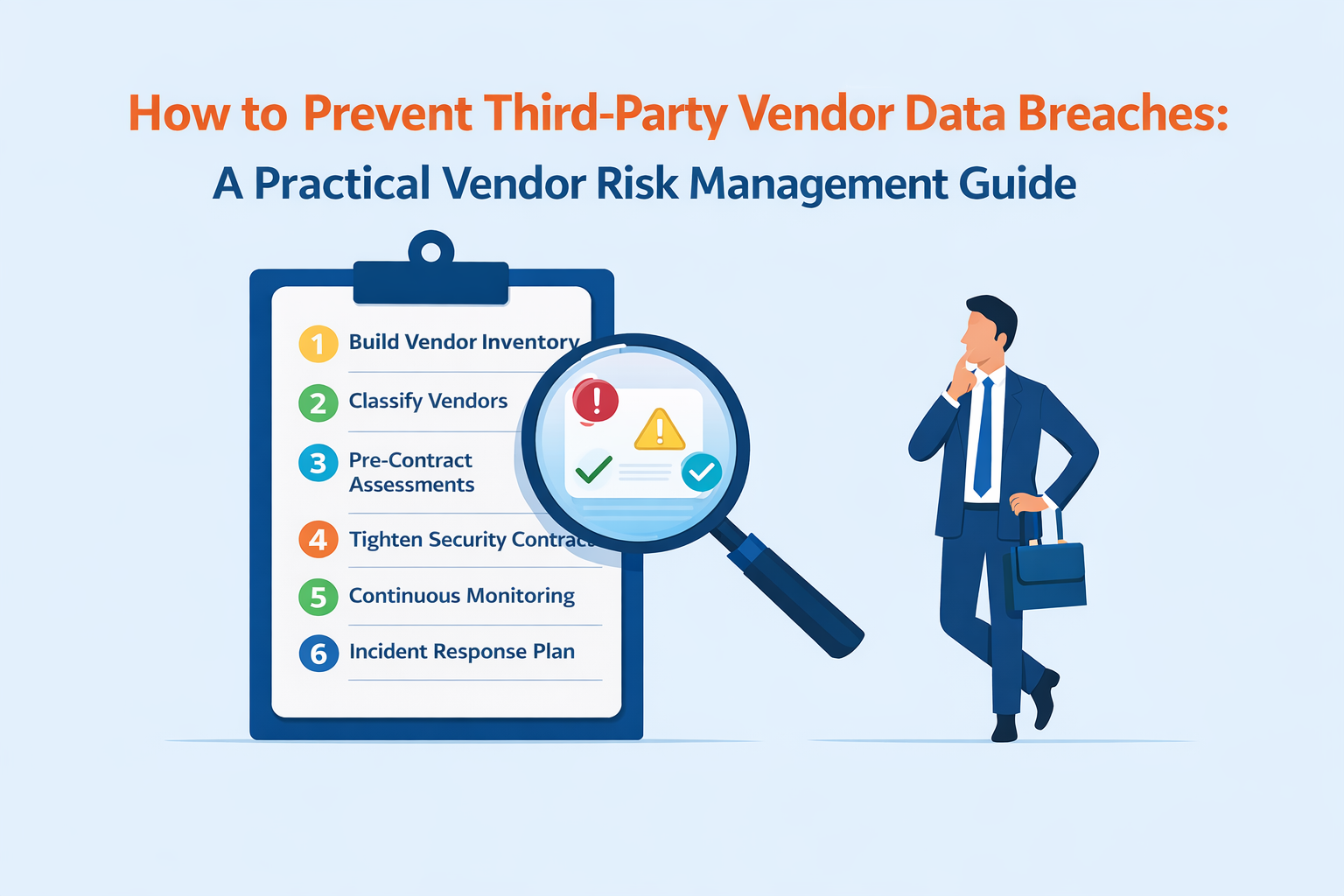
This guide walks through a practical, repeatable vendor risk management (VRM) framework focused on prevention, not paperwork. You’ll learn how to inventory vendors, classify risk, assess security, enforce controls, monitor continuously, and respond effectively when vendors are compromised.
What Is a Third-Party Vendor Data Breach?
A third-party vendor data breach happens when a supplier, service provider, or partner with authorized access to your organization’s data or systems is compromised, exposing your sensitive information.
Real-world examples include payroll processors leaking employee data, SaaS integrations exposing customer records through misconfigured APIs, or IT service providers being breached and used to deploy ransomware across multiple clients. In each case, the victim organization may have strong internal security but still suffers damage due to vendor access.
Vendors are a prime attack surface because they often have broad, persistent access, inconsistent security maturity, and limited monitoring from their customers. Attackers know that compromising one vendor can unlock many downstream targets.
Why Third-Party Vendors Are One of the Biggest Security Risks Today
Modern organizations operate within sprawling SaaS and supply-chain ecosystems. Each new tool or partner increases operational efficiency but also expands the attack surface beyond traditional security perimeters.
Visibility into vendor security posture is limited. Most organizations rely on questionnaires or annual reviews, which provide static snapshots rather than real-time insight. Security conditions can deteriorate quickly due to staff turnover, misconfigurations, or new vulnerabilities.
One-time assessments fail because vendor risk is dynamic. A vendor that passed review last year may be breached today, and you won’t know until data is exposed or regulators come calling.
The impact of vendor breaches extends beyond technical damage. Regulatory penalties, contractual violations, customer churn, and brand erosion often fall on the organization that owns the data, not the vendor that lost it.
Common Causes of Third-Party Vendor Data Breaches
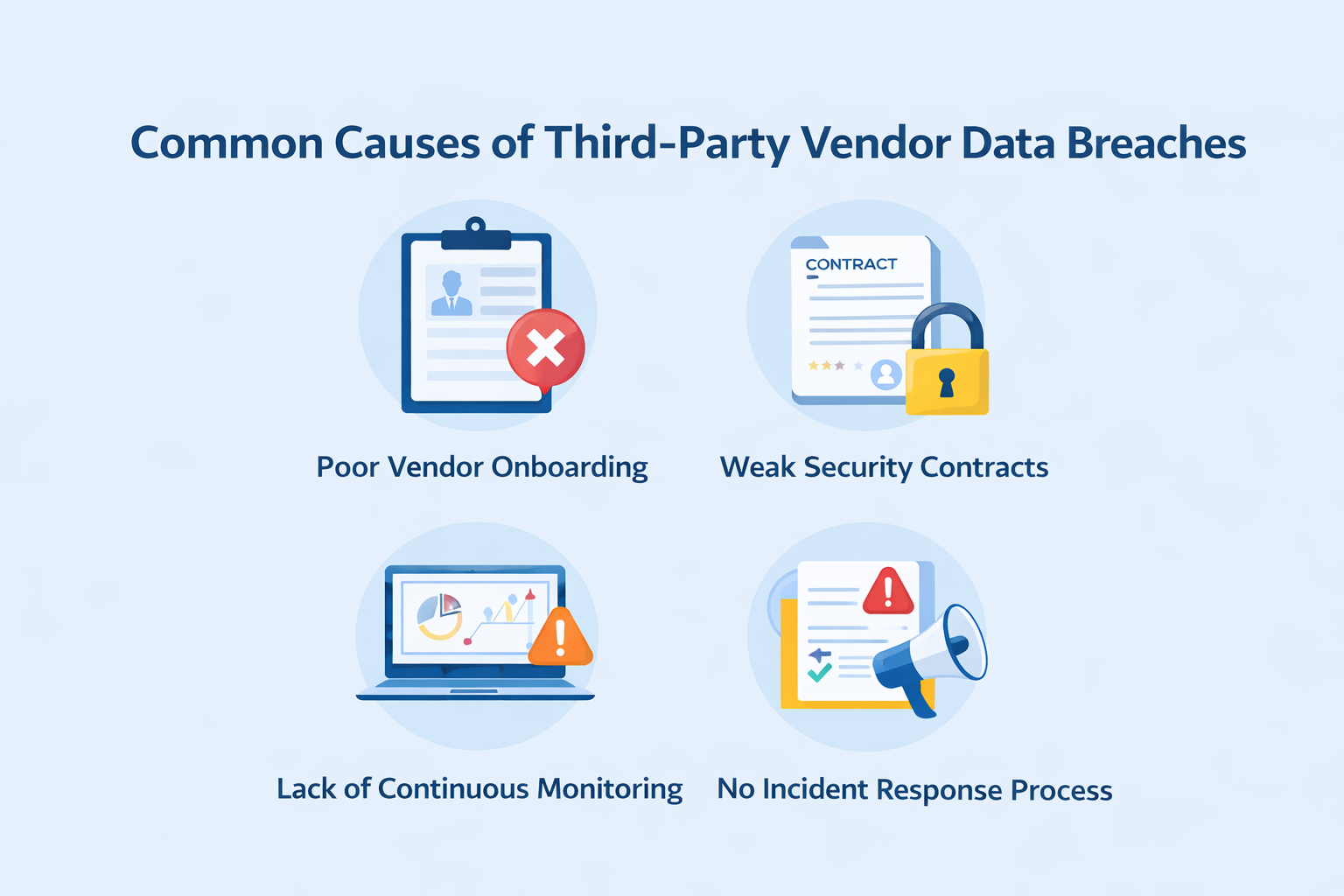
Poor vendor onboarding and due diligence allow high-risk vendors into the environment without adequate scrutiny. Speed to deploy often outweighs security considerations.
Excessive or unmanaged access permissions give vendors more access than they need, increasing blast radius when credentials are compromised.
Weak contractual security requirements fail to define expectations around controls, monitoring, breach notification, and accountability.
Lack of continuous vendor monitoring means security teams are blind to emerging risks, new exposures, or vendor-side incidents.
No defined vendor incident response process leads to confusion, delays, and miscommunication when a breach occurs.
Step 1 — Build a Complete Vendor Inventory
A vendor is any third party that stores, processes, transmits, or can access your data or systems. This includes SaaS tools, cloud providers, consultants, managed service providers, contractors, and data processors.
Understanding what data vendors can access is critical. Personal data, financial information, intellectual property, and authentication credentials all carry different risk profiles.
Vendors should be mapped to the business processes they support so risk can be evaluated in context. A breach at a marketing tool is different from a breach at a payment processor.
Subcontractors and fourth parties must also be identified. Many vendors outsource services, and risk often flows through these hidden relationships.
Step 2 — Classify Vendors by Risk Level
Vendor risk classification should consider data sensitivity, access level, and business criticality. A vendor with read-only access to public data carries less risk than one with privileged system access.
Risk tiers such as Critical, High, Medium, and Low help standardize decision-making and prioritize resources.
Classification directly drives security requirements. Higher-risk vendors require deeper assessments, stricter contracts, more frequent monitoring, and stronger access controls.
Step 3 — Perform Pre-Contract Vendor Security Assessments
Security questionnaires provide insight into policies and processes but rely heavily on self-attestation. Automated assessments and external intelligence can validate claims and reveal unknown exposures.
Evidence requests should align with vendor risk tier. Common artifacts include SOC 2 or ISO certifications, penetration test summaries, incident response policies, and data protection documentation.
A minimum security baseline ensures consistency. Vendors that cannot meet baseline requirements introduce unacceptable risk regardless of business value.
Red flags include refusal to provide evidence, outdated certifications, vague answers, or a history of unreported incidents. These should pause or block onboarding until resolved.
Step 4 — Enforce Strong Vendor Security Contracts
Security and privacy clauses formalize expectations and provide leverage. Contracts should clearly define data protection standards and security responsibilities.
Breach notification timelines must be explicit and short enough to support regulatory and customer obligations.
Right-to-audit and continuous assessment language enables ongoing oversight rather than annual check-ins.
Subprocessor and data handling obligations ensure vendors cannot silently transfer risk to unknown third parties.
Step 5 — Continuously Monitor Vendor Security Posture
Point-in-time assessments fail because vendor security changes constantly. New vulnerabilities, exposed assets, and breaches can occur at any time.
External attack surface monitoring helps identify misconfigurations, leaked credentials, and exploitable vulnerabilities without relying on vendor disclosure.
Tracking changes in vendor risk over time allows teams to respond before incidents escalate into breaches.
Automated alerts and remediation workflows reduce manual effort and ensure risks are addressed consistently and promptly.
Step 6 — Limit Vendor Access and Reduce Blast Radius
Least-privilege access ensures vendors only have the permissions necessary to perform their role.
Just-in-time and time-bound access reduce the window of opportunity for attackers using stolen credentials.
Network segmentation and zero-trust principles prevent vendors from moving laterally if compromised.
Data minimization and tokenization limit exposure by ensuring vendors never access more sensitive data than required.
Step 7 — Prepare for Vendor Security Incidents
A vendor-specific incident response plan defines how to act when a third party is breached, not if.
Roles and responsibilities should be clearly assigned across security, legal, procurement, communications, and executive teams.
Clear communication paths with vendors, customers, and regulators reduce confusion and reputational damage during high-pressure situations.
Post-incident reassessment ensures lessons are learned, controls are improved, and vendor risk is recalibrated.
Key Metrics to Track for Vendor Breach Prevention
The percentage of vendors under continuous monitoring reflects visibility maturity.
Time to identify and remediate vendor risks measures operational effectiveness.
Risk distribution across vendor tiers highlights concentration of exposure.
Vendor compliance and remediation rates indicate whether vendors take security obligations seriously.
90-Day Vendor Risk Management Implementation Roadmap
Days 1–30 focus on building a complete inventory, classifying vendors, and addressing obvious high-risk gaps.
Days 31–60 prioritize security assessments and contract updates for critical and high-risk vendors.
Days 61–90 establish continuous monitoring, access controls, and incident readiness to sustain long-term protection.
Tools and Platforms That Help Prevent Vendor Data Breaches
Effective vendor risk management platforms centralize inventory, assessments, monitoring, and workflows.
Key features include automation, continuous security intelligence, integrations with IT and procurement systems, and risk-based reporting.
Build versus buy decisions depend on scale, internal expertise, and the need for real-time visibility versus manual processes.
Vendor Data Breach Prevention Checklist
This one-page checklist consolidates inventory management, risk classification, assessments, contracts, monitoring, access controls, and incident response into a practical reference for security, IT, and procurement teams.
Vendor risk will never be static but with the right framework, it can be controlled.
Learn how to identify, assess, and continuously monitor third-party risks before they turn into costly data breaches.
Frequently Asked Questions
How often should vendors be reassessed?
Vendors should be reassessed based on risk tier. High-risk vendors need continuous monitoring or annual reviews, while lower-risk vendors can be reviewed less frequently or when changes occur.
Can security ratings replace questionnaires?
No. Security ratings complement questionnaires but cannot replace contextual assessments and evidence-based reviews.
What regulations require vendor risk management?
Regulations like GDPR, HIPAA, SOC 2, and ISO standards require organizations to assess and manage third-party security risks.
Who owns vendor security-security or procurement?
Vendor security is shared. Security sets standards, and procurement enforces them during vendor onboarding and contracts.
Conclusion
Preventing third-party vendor data breaches requires more than annual questionnaires and compliance checkboxes. The most effective programs combine inventory, risk-based controls, continuous monitoring, and clear accountability.
Start with visibility by understanding who your vendors are and what they access. From there, enforce security expectations, monitor continuously, and be prepared to act when vendors fail.
Vendor risk will never be static, but with the right framework, it can be controlled.


Samruddhi Kulkarni
Samruddhi is a marketing professional who creates content that simplifies complex topics such as third-party risk management, compliance, and vendor governance. By combining market research, insights, and domain understanding, she develops blogs, e-books, and best-practice guides that help organizations strengthen their risk posture and build long-term resilience.
