The Ultimate Guide to Risk Mitigation in Modern Businesses

Business in 2026 operates in a state of constant disruption. Cyberattacks are more sophisticated, regulatory scrutiny is tightening across industries, supply chains remain fragile, and market volatility can erase years of growth in weeks. From geopolitical uncertainty to AI-driven fraud, the modern organization faces a broader and faster-moving risk landscape than ever before.
Recent global studies consistently show that enterprise risk exposure is rising year over year, particularly in cybersecurity, regulatory compliance, and operational resilience. Yet many companies still treat risk as a compliance checkbox instead of a strategic priority.
Risk mitigation is the structured process of reducing the likelihood or impact of potential threats to a business. It is not about eliminating all risk that is impossible. It is about building resilience so that when disruption occurs, the organization absorbs the shock and continues operating.
Companies that ignore risk management don’t fail because of one single event. They fail because they were unprepared. In this guide, you will learn what risk mitigation really means, the types of risks businesses must address, proven strategies and frameworks, the role of technology, and how modern solutions like SignalX are transforming risk intelligence.
What Is Risk Mitigation?
Risk mitigation refers to the actions organizations take to reduce the probability of a risk occurring or to minimize its impact if it does. It is a key component of broader risk management.
Risk management is the overarching discipline that includes identifying, analyzing, evaluating, and responding to risks. Risk mitigation is specifically about implementing measures to control those risks. In simple terms, risk management is the strategy; risk mitigation is the action.
It is also important to distinguish between risk avoidance and risk reduction. Risk avoidance means eliminating the activity that creates the risk. Risk reduction means continuing the activity but putting controls in place to lessen its potential damage. For example, a company may avoid risk by exiting a volatile market entirely, or reduce risk by diversifying its suppliers.
Risk mitigation is not a one-time exercise. It is a continuous process that evolves as markets, regulations, and technologies change. Consider a mid-sized e-commerce company that identifies the risk of data breaches. Rather than stopping online operations, it mitigates risk by implementing encryption, multi-factor authentication, and regular security audits. The business continues to grow, but with stronger protection in place.

Types of Business Risks You Must Mitigate
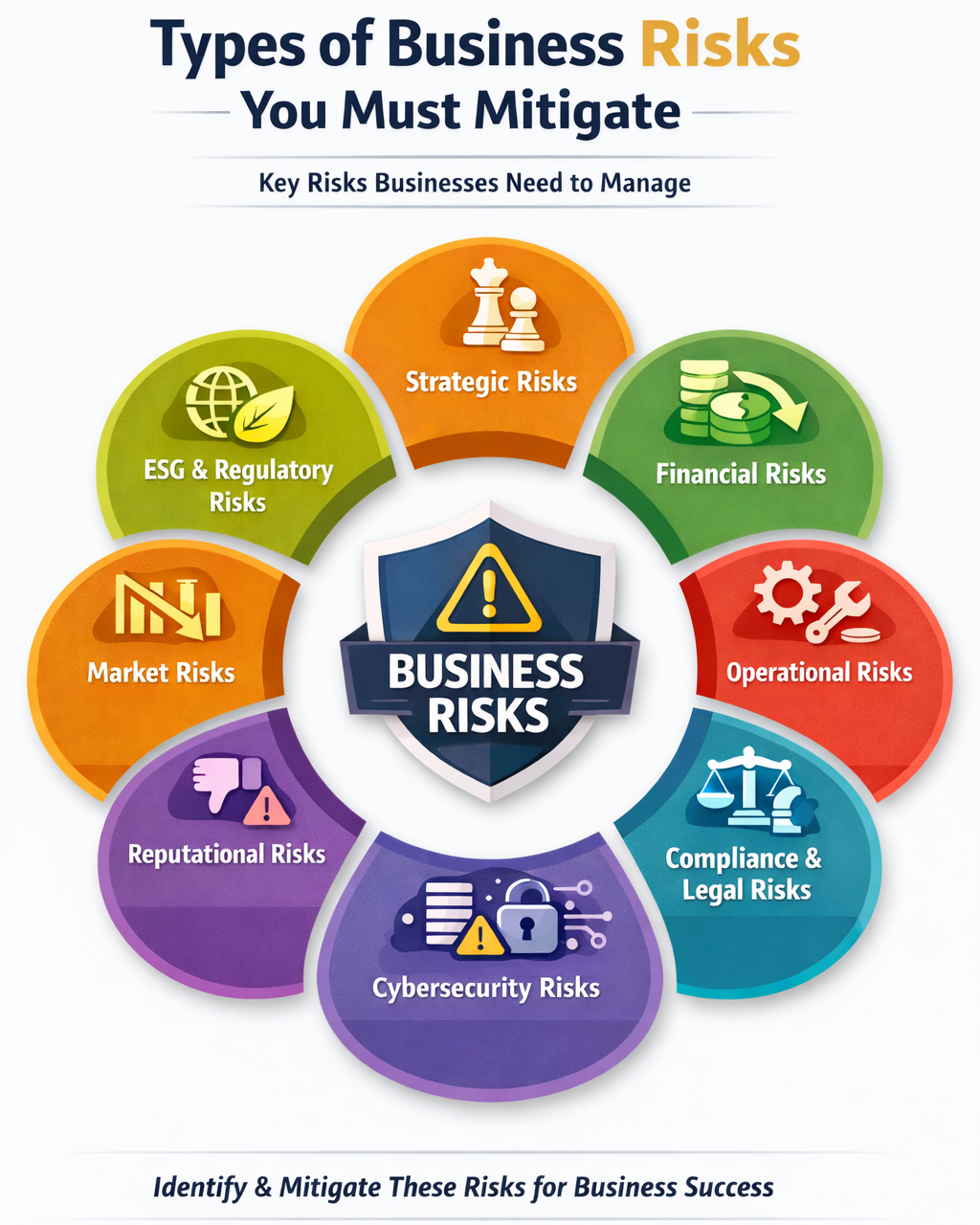
Every organization faces multiple layers of risk, and understanding these categories is the first step toward effective mitigation.
Strategic risks arise from high-level business decisions. Expanding into a new market without proper research, launching an untested product, or acquiring another company can introduce uncertainty that threatens long-term goals.
Financial risks involve cash flow instability, credit exposure, market fluctuations, inflation, and interest rate volatility. Poor liquidity planning can quickly escalate into solvency issues.
Operational risks stem from internal processes, systems, or people. Supply chain breakdowns, system failures, employee errors, and production delays all fall into this category.
Compliance and legal risks emerge when organizations fail to meet regulatory requirements. Increasingly complex data protection, financial reporting, and environmental regulations make compliance a moving target.
Cybersecurity risks have become one of the most critical threats in the digital era. Ransomware, phishing, insider threats, and data leaks can result in financial losses and reputational damage.
Reputational risks are often the consequence of other failures but can also arise from public relations missteps, ethical issues, or negative social media exposure.
Market risks relate to economic downturns, changing consumer preferences, and competitive pressures that can undermine revenue stability.
Finally, ESG and regulatory risks are expanding rapidly as governments introduce sustainability mandates and investors demand transparency around environmental and social impact.
Modern risk mitigation requires addressing all these categories holistically rather than in isolation.
The 5 Core Risk Mitigation Strategies
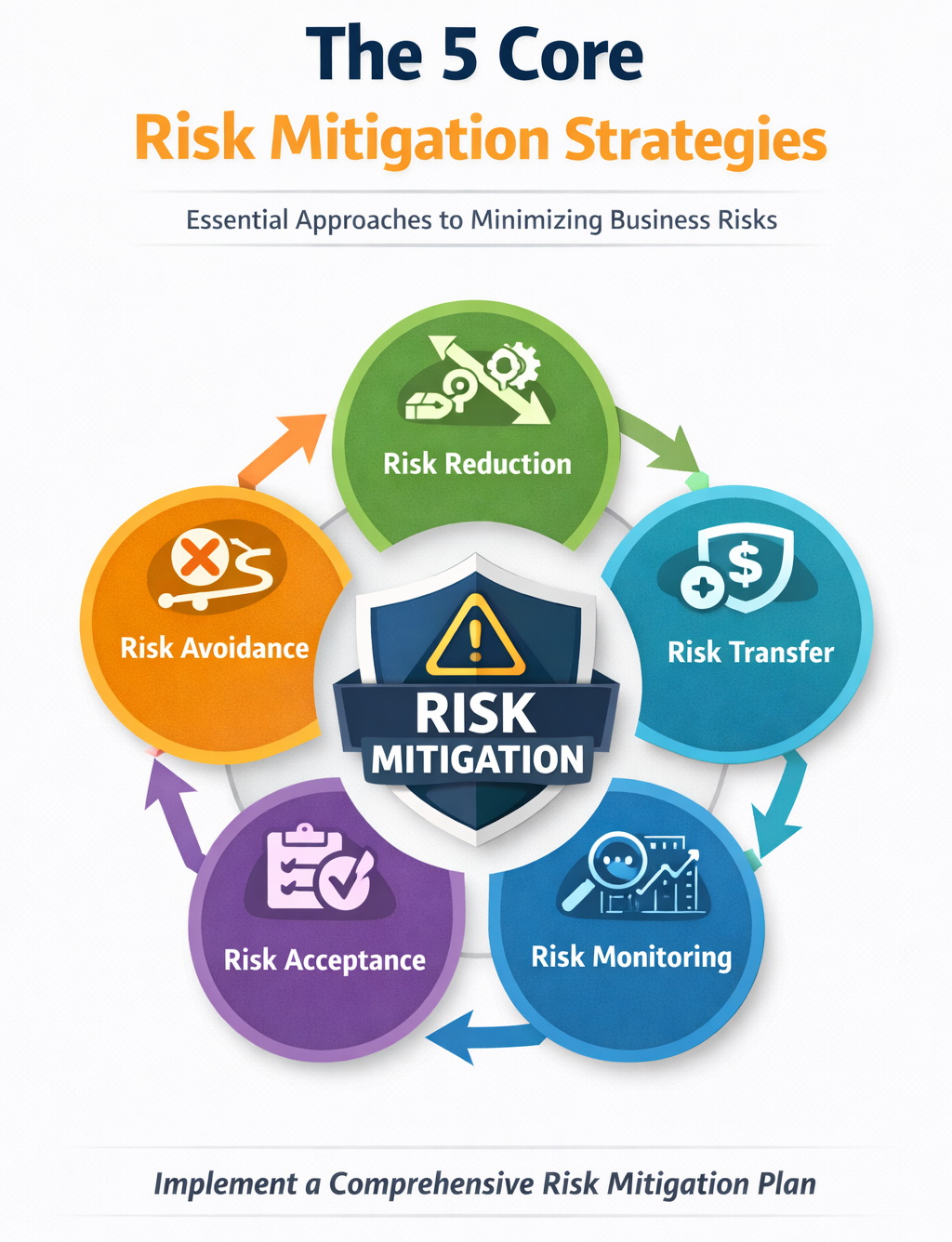
At the heart of risk mitigation are five core strategies that organizations use to manage uncertainty effectively.
Risk avoidance involves eliminating exposure entirely. A company might choose not to operate in a politically unstable region to avoid geopolitical risk. While this strategy offers maximum protection, it may limit growth opportunities.
Risk reduction focuses on lowering either the likelihood or the impact of a risk. Installing cybersecurity defenses or diversifying revenue streams are common examples. This approach balances opportunity and protection.
Risk transfer shifts the financial impact of risk to a third party. Insurance policies, outsourcing certain operations, or contractual risk-sharing agreements are common mechanisms. Although transfer reduces direct exposure, it often comes at a cost.
Risk acceptance acknowledges that some risks are tolerable. Low-impact or low-probability risks may not justify the expense of mitigation. However, acceptance should always be deliberate and documented.
Risk monitoring ensures ongoing oversight. Even after mitigation strategies are implemented, continuous tracking is necessary to detect changes in risk levels. This is especially important in industries where risks evolve rapidly.
The right strategy depends on the organization’s risk appetite, industry, and regulatory environment. In most cases, businesses apply a combination of these approaches.

Step-by-Step Risk Mitigation Process
Creating an effective risk mitigation plan requires a structured approach.
The first step is risk identification. Organizations must systematically map out potential internal and external threats through workshops, audits, data analysis, and scenario planning.
Next comes risk assessment and impact analysis. Each identified risk is evaluated based on its likelihood and potential impact. This is often visualized using a risk matrix, where risks are plotted across probability and severity axes.
Risk prioritization follows. High-likelihood, high-impact risks demand immediate attention, while lower-level risks can be monitored.
After prioritization, organizations develop mitigation strategies tailored to each critical risk. This includes defining responsibilities, allocating resources, and setting measurable targets.
Implementation transforms strategy into action. Controls are deployed, policies are updated, and teams are trained.
Finally, continuous monitoring and reporting ensure that mitigation measures remain effective. Risk scoring models, key performance indicators (KPIs), and periodic reviews help track progress and identify emerging threats.
A dynamic risk register updated in real time forms the backbone of this process.
Risk Mitigation Frameworks & Standards
Established frameworks provide structure, consistency, and credibility to risk management efforts.
The internationally recognized International Organization for Standardization developed ISO 31000, a comprehensive guideline for risk management principles and implementation. It emphasizes integration with organizational processes and leadership involvement.
The Committee of Sponsoring Organizations of the Treadway Commission created the COSO ERM Framework, widely used for enterprise risk management and internal controls.
The National Institute of Standards and Technology offers the NIST Risk Management Framework, particularly influential in cybersecurity and government sectors.
In banking, Basel III regulations shape capital adequacy and financial risk practices globally.
SOC 2 and similar compliance frameworks help organizations demonstrate strong data security and operational controls.
Adopting recognized frameworks strengthens governance, improves investor confidence, and ensures regulatory alignment.
Technology’s Role in Modern Risk Mitigation
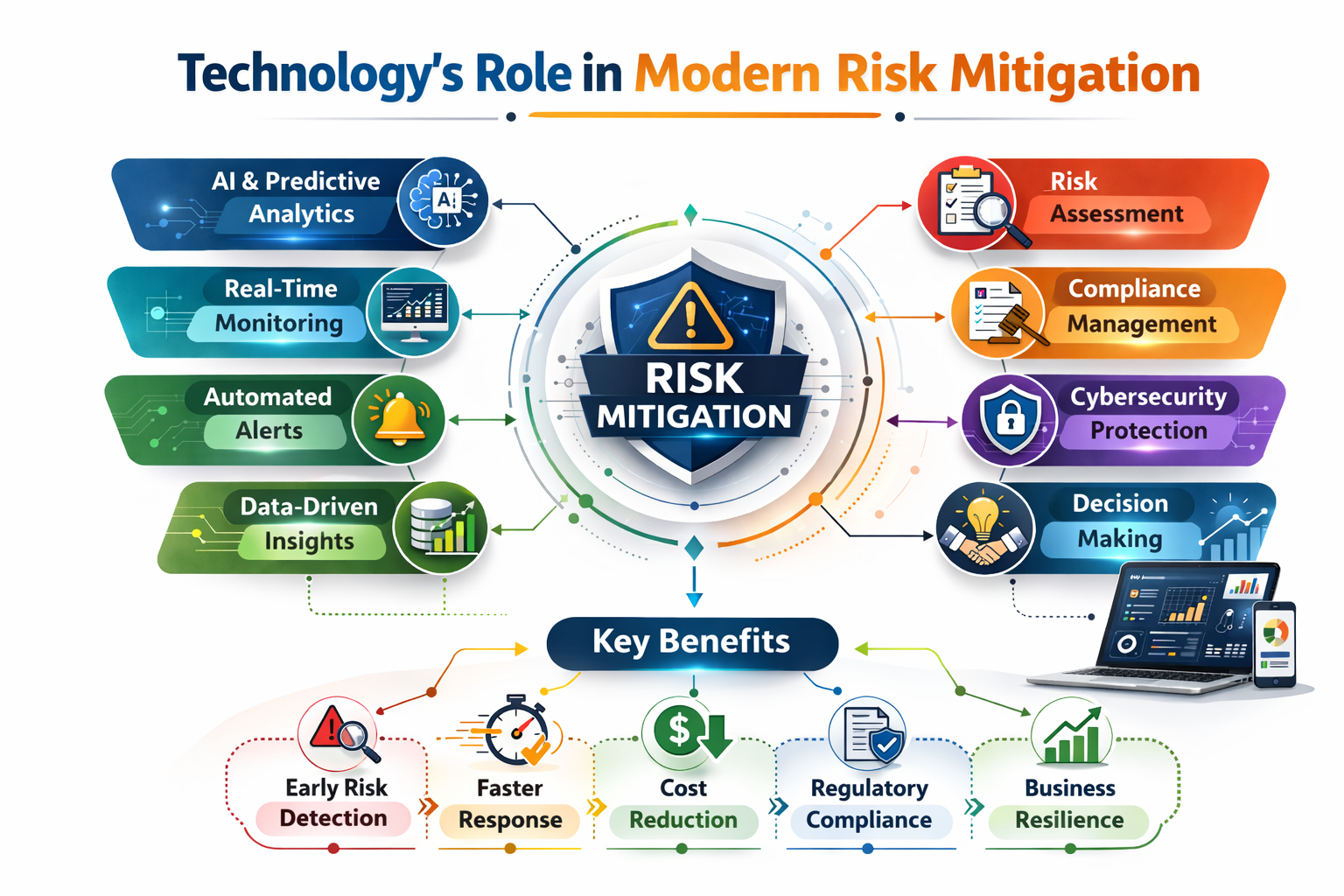
Manual spreadsheets and siloed reporting systems are no longer sufficient. Risk signals now emerge from vast streams of structured and unstructured data.
Artificial intelligence and automation enable organizations to detect anomalies, flag unusual transactions, and predict potential disruptions before they escalate. Real-time monitoring replaces reactive crisis management.
Predictive risk analytics leverage historical and behavioral data to forecast potential failures. Instead of asking what went wrong, organizations can ask what might go wrong next.
Centralized dashboards provide leadership with a unified view of enterprise risk exposure. Automated alerts ensure rapid response.
In 2026, technology is not just supporting risk mitigation it is redefining it.
How SignalX Plays a Critical Role in Risk Mitigation
One of the biggest challenges businesses face is fragmented risk data. Critical signals are scattered across departments, tools, and external sources. By the time risks become visible, damage may already be done.
SignalX addresses this gap through real-time risk intelligence powered by advanced analytics. It consolidates structured and unstructured data into a unified platform, enabling early detection of potential threats.
With automated monitoring and predictive alerts, organizations gain proactive insights rather than reactive reports. Customizable dashboards provide decision-makers with clarity across operational, financial, and compliance risks.
In banking and fintech, SignalX can detect emerging credit or fraud risks before they escalate. For enterprises, it strengthens compliance monitoring and operational resilience.
Consider a financial institution relying on periodic risk reports. Emerging warning signs may go unnoticed for weeks. After implementing SignalX, risk indicators are tracked continuously, and alerts are triggered instantly. Decision-makers move from delayed reaction to informed anticipation.
The result is faster decision-making, reduced losses, improved regulatory compliance, and a more resilient organization.
Stay Ahead of Risk Before It Impacts Your Business
Common Risk Mitigation Mistakes to Avoid
Many organizations undermine their own efforts through avoidable mistakes. Ignoring emerging risks, especially technology-driven threats, leaves businesses exposed. Over-reliance on historical data can blind leaders to new patterns of disruption.
Poor documentation weakens accountability and audit readiness. Lack of cross-department collaboration creates blind spots. Without continuous monitoring, mitigation strategies become outdated.
Perhaps the most critical mistake is failing to leverage modern technology. In a real-time risk environment, delayed insights are costly insights.
Risk Mitigation Best Practices
Building a strong risk culture starts at the top. Executive involvement signals that risk management is strategic, not optional.
Centralized risk intelligence eliminates silos and improves transparency. Continuous assessment ensures that risk registers remain relevant.
Scenario planning and stress testing prepare organizations for extreme but plausible events. Automation and AI adoption accelerate detection and response times.
Organizations that embed these practices into daily operations build long-term resilience rather than temporary protection.
Risk Mitigation Plan Template
An effective risk mitigation plan includes a comprehensive risk register listing identified risks, likelihood scores, impact assessments, and assigned owners.
A risk scoring table standardizes evaluation criteria, ensuring consistency across departments. The mitigation action plan defines specific controls, deadlines, and responsible teams.
A monitoring checklist tracks review frequency, performance indicators, and reporting requirements. When updated regularly, this framework becomes a living document that guides strategic decisions.
Industry-Specific Risk Mitigation Examples
In banking and financial services, risk mitigation focuses heavily on credit risk, liquidity management, fraud detection, and regulatory compliance.
Fintech companies prioritize cybersecurity, data privacy, and third-party integration risks.
Healthcare organizations mitigate patient safety risks, data breaches, and regulatory exposure.
Manufacturing firms concentrate on supply chain continuity, equipment reliability, and workplace safety.
SaaS and technology companies emphasize uptime reliability, data security, and reputational protection.
Each industry applies the same principles, but the risk landscape differs significantly.
FAQs on Risk Mitigation
1. What are the primary approaches to risk mitigation?
Risk mitigation typically includes four primary approaches:
- Risk Avoidance: Eliminating the activity or situation that causes risk
- Risk Reduction: Implementing measures to reduce the likelihood or impact of risk.
- Risk Transfer: Shifting the risk to a third party, such as through insurance or outsourcing.
- Risk Acceptance: Acknowledging and accepting the risk if it is within acceptable limits or too costly to mitigate.
2. What is a risk mitigation plan?
A risk mitigation plan is a documented strategy that outlines how an organization identifies, assesses, and reduces potential threats. It includes detailed steps for mitigating risks, assigning responsibilities, and measuring progress.
3. What’s the difference between risk management and risk mitigation?
Risk management is the overall framework for handling uncertainty and potential threats in a business. It involves identifying, evaluating, and responding to risks. Risk mitigation, on the other hand, specifically focuses on reducing or controlling the identified risks through various strategies and actions.
4. Why is risk mitigation important in finance?
In finance, risk mitigation is crucial for protecting assets, ensuring compliance with regulations, and maintaining the stability of financial institutions. By managing risks effectively, financial institutions can avoid losses, protect stakeholders, and maintain investor confidence.
5. How does AI help in risk mitigation?
AI enhances risk mitigation by enabling predictive analytics, anomaly detection, and real-time monitoring. It can identify patterns in data, predict potential risks before they occur, and automatically trigger alerts, allowing businesses to respond more quickly and efficiently to emerging threats.
Conclusion: Building a Future-Ready Risk Mitigation Strategy
Risk is unavoidable, but vulnerability is not. Organizations that treat risk mitigation as a strategic priority gain a competitive advantage in uncertain markets.
By understanding risk categories, applying core mitigation strategies, adopting established frameworks, and leveraging advanced technology, businesses can move from reactive crisis management to proactive resilience.
In 2026 and beyond, future-ready companies will be those that integrate intelligent platforms like SignalX into their risk ecosystem. The question is no longer whether to mitigate risk—but how quickly you can evolve your strategy to stay ahead of it.


Samruddhi Kulkarni
Samruddhi is a marketing professional who creates content that simplifies complex topics such as third-party risk management, compliance, and vendor governance. By combining market research, insights, and domain understanding, she develops blogs, e-books, and best-practice guides that help organizations strengthen their risk posture and build long-term resilience.
