What Is an Audit Report? Types, Examples, and a Complete Guide





Financial information drives decisions. Investors decide where to put their money, banks determine whether to approve loans, regulators assess compliance, and business owners evaluate performance. But for financial information to be useful, it must be trustworthy. This is where an audit report becomes essential.
An audit report is not just a regulatory formality or a document prepared once a year and forgotten. It is an independent assessment that tells readers whether a company’s financial statements can be relied upon. Understanding how audit reports work, what different opinions mean, and how to interpret them is a valuable skill for anyone involved in business or finance.
This guide explains audit reports in clear, practical terms. You’ll learn what an audit report really represents, how it is structured, the different types you may encounter, and how to read one without getting lost in technical language.
Understanding the Meaning of an Audit Report
An audit report is a written conclusion issued by an independent auditor after reviewing an organization’s financial records and statements. Its main role is to communicate the auditor’s opinion on whether the financial statements fairly reflect the organization’s financial position and performance.
What makes an audit report powerful is independence. Auditors are not part of the company’s management, and they do not prepare the financial statements. Their role is to examine evidence, test controls, and evaluate whether the numbers follow recognized accounting standards.
It is important to note that an audit report does not guarantee perfection. Auditors provide reasonable assurance, not absolute certainty. This means the report reduces risk for users of financial statements, but it does not eliminate it entirely.
Why Audit Reports Exist and What They Aim to Achieve
The core purpose of an audit report is confidence. When financial information is audited, stakeholders gain confidence that the numbers have been reviewed by a qualified and independent professional.
Audit reports also exist to create accountability. Management is responsible for preparing financial statements, but the audit report holds management responsible by subjecting those statements to external scrutiny.
Another key objective is transparency. Audit reports help ensure that financial information is presented honestly, without hiding material issues that could mislead users. This transparency supports healthier markets and better decision-making.
In many countries, audit reports are also a legal requirement. Certain companies must submit audited financial statements to regulators, tax authorities, or stock exchanges.
Who Uses Audit Reports and Why They Matter
Audit reports serve multiple audiences, each with different interests. Investors rely on audit reports to assess risk and decide whether to buy, hold, or sell shares. Lenders use them to evaluate a company’s ability to repay debt. Regulators review audit reports to ensure compliance with laws and financial reporting standards.
Business owners and management teams also benefit from audit reports. While the report itself is addressed to external users, the audit process often highlights weaknesses in controls or reporting practices that management can improve.
Because audit reports influence so many decisions, their wording and conclusions carry significant weight.
How an Audit Report Is Structured
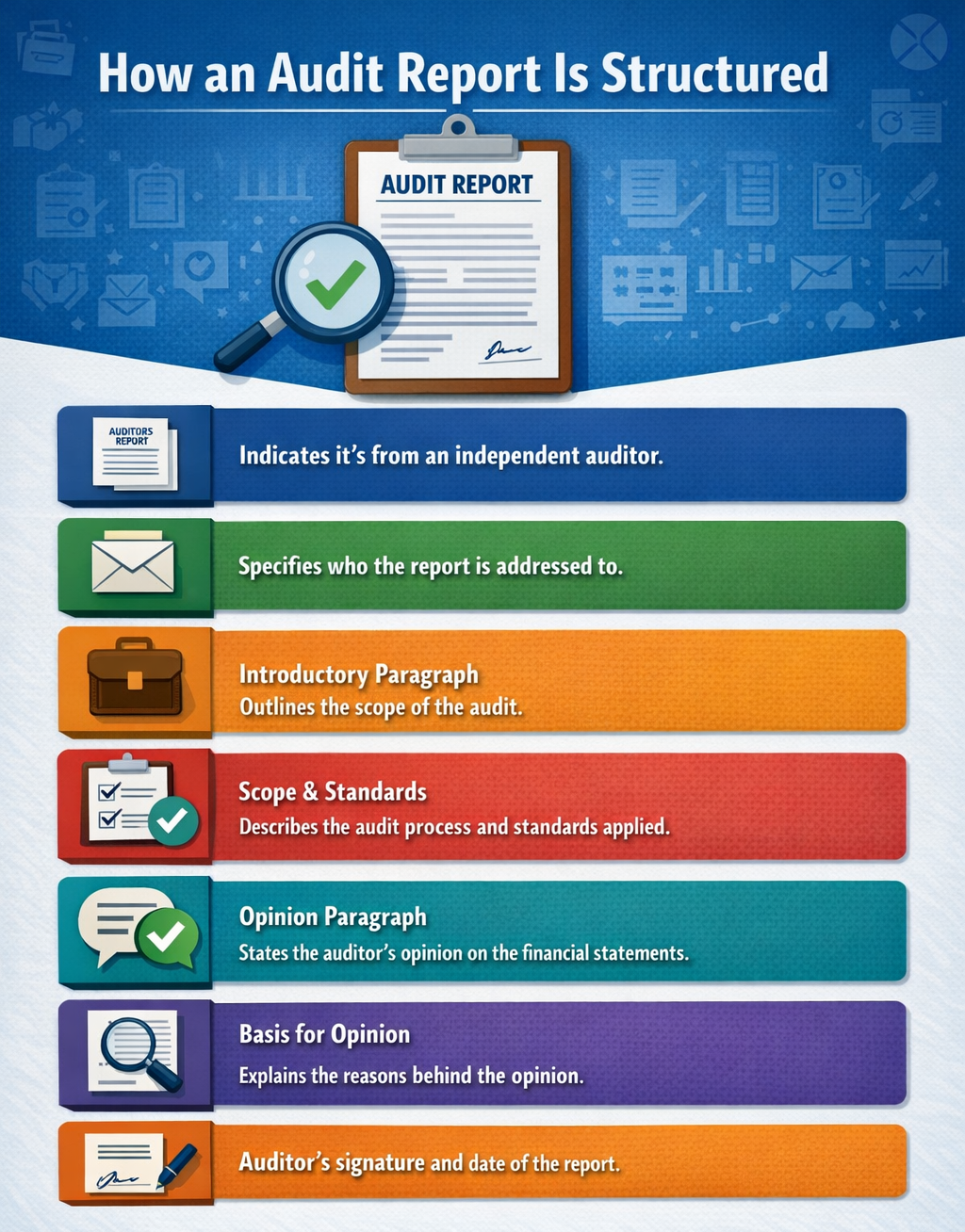
Although audit reports may look complex at first glance, they follow a logical structure designed to guide readers through the auditor’s conclusion.
The report begins by clearly identifying itself as an independent auditor’s report and stating who it is addressed to. This establishes credibility and clarifies the intended audience.
The most critical section is the auditor’s opinion. This is where the auditor states their conclusion about the financial statements. Many readers focus on this section first, but it should not be read in isolation.
Following the opinion is the explanation of how the audit was conducted. This section confirms that recognized auditing standards were followed and that sufficient evidence was obtained to support the opinion.
The report also explains the responsibilities of management and the responsibilities of the auditor. This distinction is important because it clarifies that auditors review information but do not create it.
In more detailed reports, key audit matters are discussed. These are areas that required significant professional judgment or involved higher risk during the audit. The report ends with the auditor’s signature, date, and location.
Different Types of Audit Reports and What They Signal
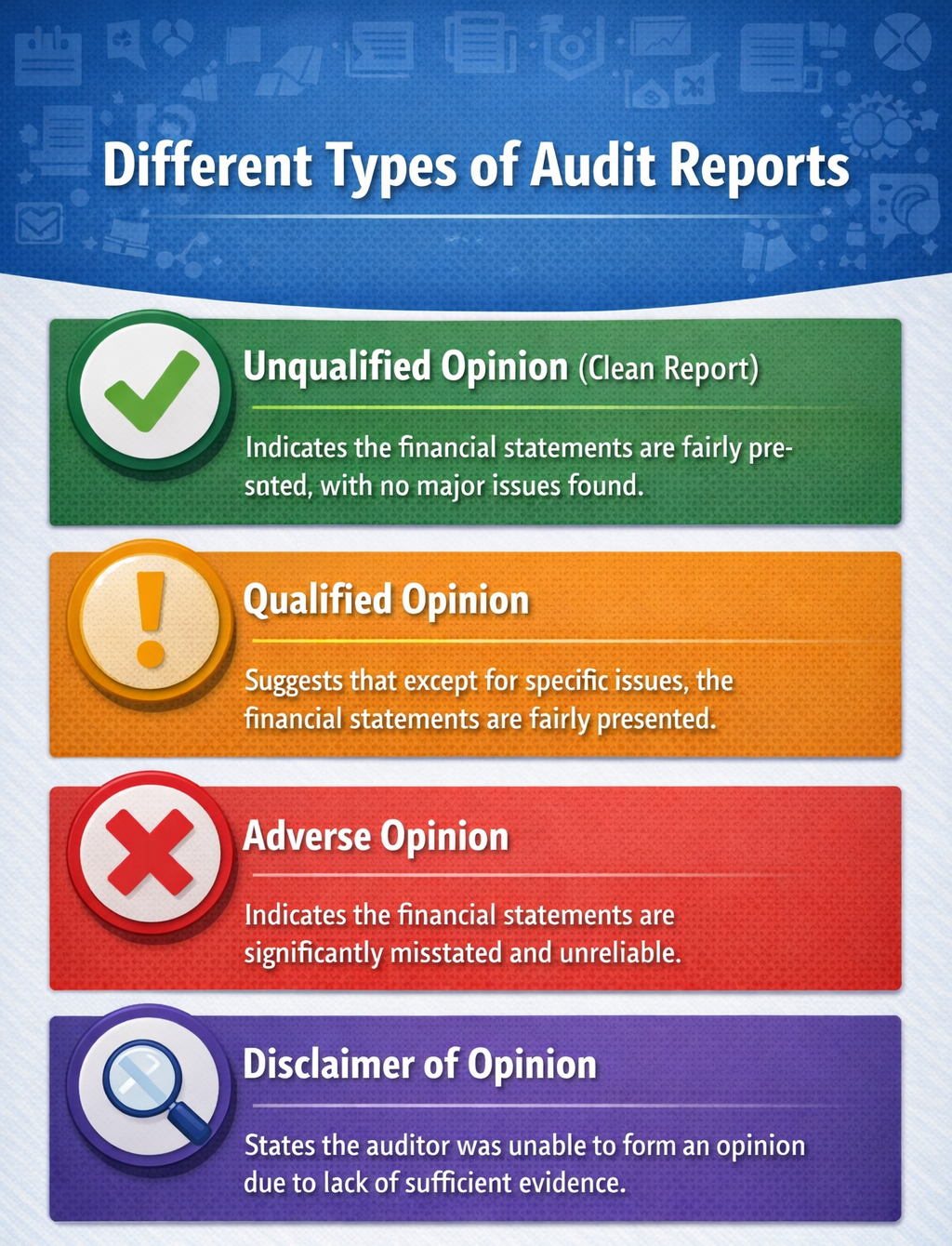
Audit reports are classified based on the opinion expressed by the auditor. Each type sends a different message to readers and should be interpreted carefully.
An unqualified audit report indicates that the auditor found no material issues with the financial statements. This does not mean the company is perfect, but it does mean the financial information follows applicable standards and fairly represents the company’s situation.
A qualified audit report suggests that most of the financial statements are acceptable, but there is a specific issue that readers should be aware of. The issue could relate to limited audit evidence or a departure from accounting standards in a particular area.
An adverse audit report is far more serious. It means the auditor believes the financial statements are materially incorrect or misleading. This type of report often raises serious concerns for investors and regulators.
A disclaimer of opinion occurs when the auditor cannot form an opinion at all. This usually happens when records are incomplete, access is restricted, or uncertainty is too high to reach a conclusion.
Beyond external audits, organizations may also produce internal audit reports and forensic audit reports. These serve different purposes and are typically not issued to the public in the same way.
Why Audit Reports Influence Business Decisions
Audit reports have a direct impact on how businesses are perceived. A clean audit report can improve credibility, reduce borrowing costs, and attract investors. On the other hand, a negative audit opinion can raise doubts, trigger regulatory scrutiny, or even affect a company’s ability to operate.
For growing businesses, audit reports often play a role in expansion plans. Banks and investors frequently require audited financial statements before providing funding. In mergers and acquisitions, audit reports help buyers assess financial risk.
Because of this influence, audit reports are not just compliance documents. They are strategic assets that affect reputation and opportunity.

How to Read an Audit Report Without Getting Overwhelmed
Many people assume audit reports are only for accountants, but anyone can learn to read them effectively by focusing on key areas.
Start with the auditor’s opinion to understand the overall conclusion. Then read the explanation that follows to see how the auditor arrived at that conclusion. Pay close attention to any qualifications, limitations, or references to uncertainty.
If key audit matters are included, review them carefully. These sections often reveal which areas of the business required the most attention and judgment during the audit.
Finally, consider the context. Compare the audit report with prior years and look for patterns or recurring issues. Consistency often signals stability, while frequent changes may signal deeper problems.
Warning Signs That Deserve Attention
Certain elements in an audit report should prompt closer review. A qualified opinion that appears year after year may indicate unresolved issues. Sudden changes from a clean opinion to a qualified or adverse opinion can signal new risks.
A disclaimer of opinion is particularly concerning because it means the auditor could not verify the financial information. References to doubts about the company’s ability to continue operating are also serious and should not be ignored.
Audit reports are designed to communicate risk clearly. When read carefully, they often provide early warnings that numbers alone may not reveal.
Realistic Example of an Audit Report Explained
A typical audit report opens with confirmation that the auditor examined specific financial statements for a defined period. The opinion then states whether those statements fairly represent the company’s financial position.
The report explains the scope of the audit and confirms adherence to professional standards. It clarifies that management prepared the financial statements and that the auditor’s role was to evaluate them.
If the auditor identified areas of higher risk, these are described in the key audit matters section. The report concludes with the auditor’s signature and date, signaling responsibility for the opinion.
Understanding this flow makes audit reports far less intimidating.
Standards and Rules That Govern Audit Reports
Audit reports are shaped by professional standards designed to promote consistency and reliability. International Standards on Auditing guide how audits are planned, performed, and reported. Accounting frameworks such as IFRS or GAAP determine how financial information should be prepared.
Local laws and regulators may impose additional requirements depending on the country or industry. As a result, audit reports can vary slightly in wording while still following the same underlying principles.
Final Thoughts
An audit report is a cornerstone of financial trust. It provides independent insight into financial information and helps users make better decisions with reduced risk. While the language may appear technical, the underlying message is straightforward: can the financial statements be trusted?
By understanding how audit reports work, what different opinions mean, and how to spot warning signs, readers gain a valuable tool for evaluating financial information. Whether you are managing a business, investing capital, or studying finance, this knowledge empowers you to look beyond the numbers and understand the story behind them.
FAQ: Audit Report Essentials
What distinguishes a clean audit report from others?
A clean or unqualified report confirms full GAAP compliance and no material issues, building strong stakeholder trust. Qualified, adverse, or disclaimer reports flag problems like misstatements or data gaps, potentially harming credibility and triggering regulatory scrutiny.
How does an audit report benefit third-party risk management?
In vendor security assessments, audit reports reveal a supplier’s financial health, internal controls, and compliance risks, aiding due diligence. Organizations use them to evaluate vendor stability, detect fraud risks, and ensure legal adherence before contracts.
What steps follow receiving an adverse audit opinion?
Management must address misstatements through restatements, process fixes, or disclosures; it may lead to litigation, stock drops, or tax reviews. Auditors recommend specific corrective actions based on identified weaknesses.
Can non-financial audits produce similar reports?
Yes, compliance, operational, or performance audits generate reports assessing processes, regulations, or efficiency, including findings and recommendations beyond finances.
How do auditors ensure report independence?
Auditors follow GAAS/GAAP, disclose limitations, and sign independently reports note any conflicts to maintain objectivity.
What role does management play post audit?
Management responds to findings with acknowledgment and action plans, demonstrating commitment to improvements like stronger controls.
Which software solutions generate audit-ready financial reports for private companies?
Tools like QuickBooks, Xero, Zoho Books, Sage Intacct, NetSuite, and Datarails help private companies generate audit-ready financial statements by automating bookkeeping, enforcing double-entry records, and producing standardized reports such as balance sheets, P&L, cash flow statements, and ledgers.
What is a due diligence audit?
A due diligence audit is an in-depth review of a company’s financial, legal, operational, and compliance information before an investment, acquisition, or partnership. It verifies facts, uncovers risks, and helps investors or buyers make informed decisions.