Automated Vendor Risk Assessment: The Complete Guide for Modern Businesses






In today’s hyperconnected digital economy, no organization operates alone. Businesses rely on cloud providers, SaaS vendors, payment processors, logistics partners, marketing platforms, and outsourced development teams to function efficiently. While this interconnected ecosystem fuels growth and innovation, it also introduces a critical vulnerability: third-party risk. One weak vendor can expose sensitive data, disrupt operations, and damage brand reputation overnight.
As cyber threats grow more sophisticated and regulatory scrutiny intensifies, traditional vendor risk assessment methods are struggling to keep pace. Spreadsheets, email-based questionnaires, and periodic reviews are no longer sufficient. This is where automated vendor risk assessment becomes essential. Automation transforms vendor risk management from a reactive compliance exercise into a proactive, continuous defense strategy.
This comprehensive guide explains what automated vendor risk assessment is, how it works, why manual processes fall short, and how organizations can implement automation to strengthen security, ensure compliance, and drive measurable business value.
Why Vendor Risk Is Rising in 2026
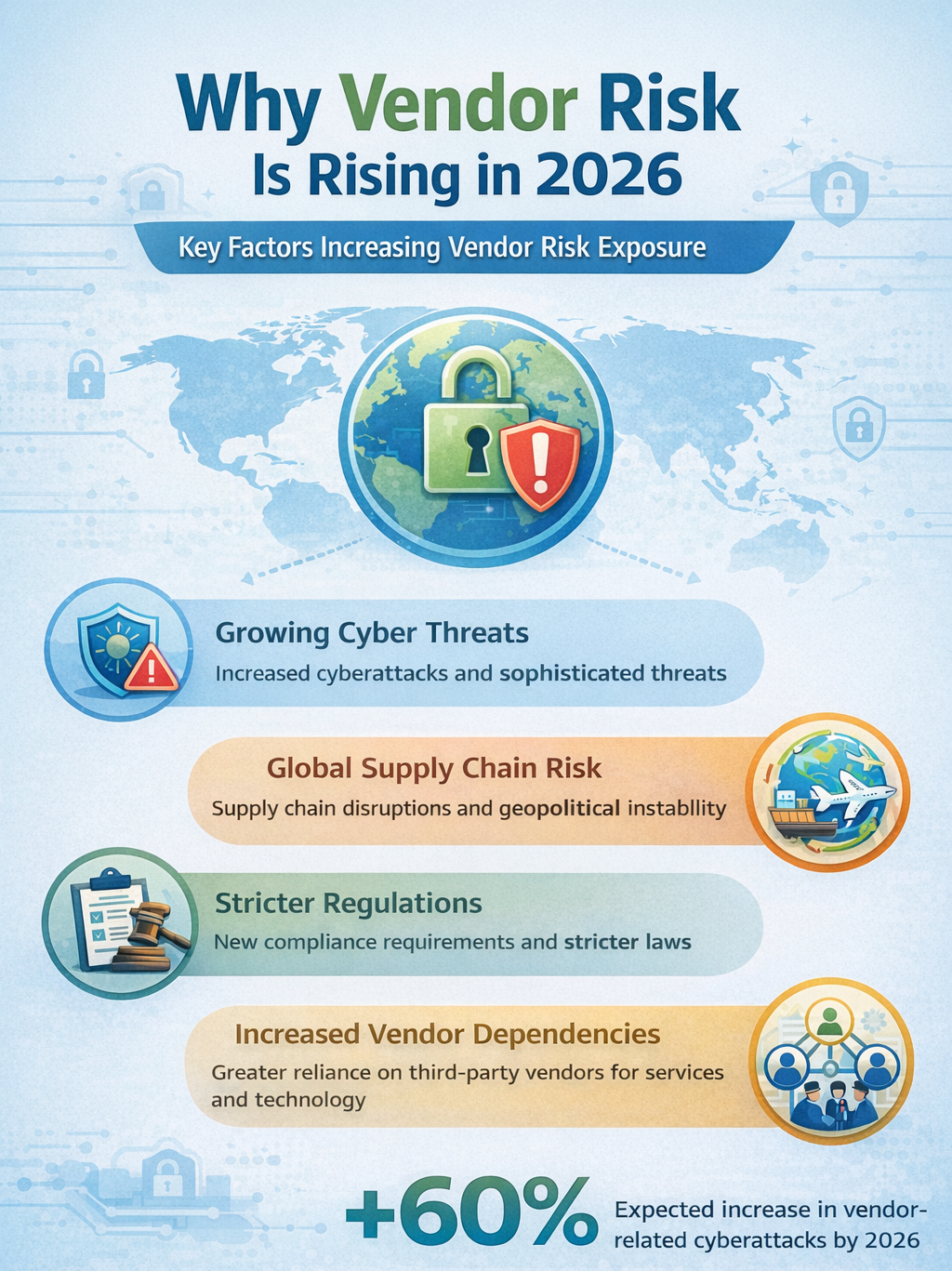
The rapid expansion of cloud computing and digital transformation has significantly increased the number of third-party relationships businesses maintain. Modern enterprises often rely on hundreds, sometimes thousands, of vendors. Each vendor introduces a potential entry point for attackers.
Cybercriminals increasingly target supply chains because compromising one vendor can provide access to multiple organizations. High-profile breaches in recent years have demonstrated that attackers often exploit weaker third parties rather than attacking well-defended enterprises directly.
At the same time, regulatory requirements have become more demanding. Data protection laws and industry frameworks require organizations to demonstrate due diligence over third-party security practices. Auditors expect documented processes, risk scoring methodologies, and continuous monitoring evidence. The pressure to maintain compliance while scaling operations has made automation not just attractive, but necessary.
What Is Automated Vendor Risk Assessment?
Automated vendor risk assessment is the use of technology platforms to evaluate, monitor, and manage risks associated with third-party vendors without relying heavily on manual processes. Instead of conducting periodic, static reviews, automation enables continuous data collection, risk analysis, and real-time visibility into vendor security posture.
Traditional vendor risk assessments often involve sending lengthy questionnaires, manually reviewing responses, and assigning risk ratings based on subjective judgment. This approach is time-intensive and inconsistent. Automated systems, by contrast, standardize workflows, apply scoring models, and integrate external intelligence sources to produce objective and scalable results.
Automation typically supports several key components. It streamlines vendor onboarding by collecting and analyzing documentation efficiently. It automates questionnaire distribution and response tracking. It incorporates external threat intelligence and security ratings to evaluate vendors beyond self-reported information. It applies consistent risk scoring methodologies and maps findings to compliance frameworks. Most importantly, it enables continuous monitoring rather than annual or quarterly reviews.

Why Manual Vendor Risk Assessments No Longer Work
Manual vendor risk management processes were designed for a different era. When organizations managed a limited number of vendors and faced fewer regulatory obligations, spreadsheets and email-based workflows were manageable. Today, those same processes create bottlenecks and blind spots.
Manual questionnaires consume significant time for both internal teams and vendors. Security and compliance professionals must chase responses, interpret inconsistent answers, and manually score risks. This leads to delays in vendor onboarding, which frustrates business units eager to move quickly.
Human error is another persistent issue. Different reviewers may interpret answers differently, leading to inconsistent risk ratings. Without standardized scoring models, assessments lack objectivity. Additionally, static assessments quickly become outdated. A vendor deemed low risk six months ago may experience a breach tomorrow, and manual systems offer no real-time visibility.
Scalability presents the most significant challenge. As organizations grow, vendor counts increase. Expanding manual review teams proportionally is costly and inefficient. Automation solves this scalability problem by handling repetitive tasks and allowing security professionals to focus on strategic decision-making.
How Automated Vendor Risk Assessment Works
Automated vendor risk assessment platforms typically follow a structured workflow that integrates data collection, analysis, scoring, and monitoring into a cohesive system.
The process begins during vendor onboarding. Vendors are categorized based on risk tiers determined by factors such as data access, system integration, and business criticality. High-risk vendors undergo deeper scrutiny, while low-risk vendors follow streamlined assessments.
Automated questionnaires are then distributed through centralized portals. These platforms often use standardized templates aligned with common compliance frameworks. Intelligent logic can adapt questions based on previous answers, reducing redundancy and improving accuracy.
Beyond self-reported data, automation incorporates external intelligence sources. These may include vulnerability scans, public breach records, domain security analysis, and threat intelligence feeds. This external validation reduces reliance on vendor claims and enhances transparency.
Risk scoring models apply weighted criteria to generate objective ratings. Instead of subjective evaluations, platforms calculate scores based on predefined metrics, ensuring consistency across assessments. Dashboards provide visual summaries, highlighting high-risk vendors and trending issues.
Continuous monitoring is perhaps the most transformative element. Rather than waiting for annual reviews, automated systems track changes in vendor security posture in real time. Alerts notify stakeholders when risk levels increase, enabling rapid response.
Finally, reporting features generate audit-ready documentation. Compliance mapping aligns vendor assessments with regulatory requirements, simplifying audits and executive reporting.
Core Benefits of Automated Vendor Risk Assessment
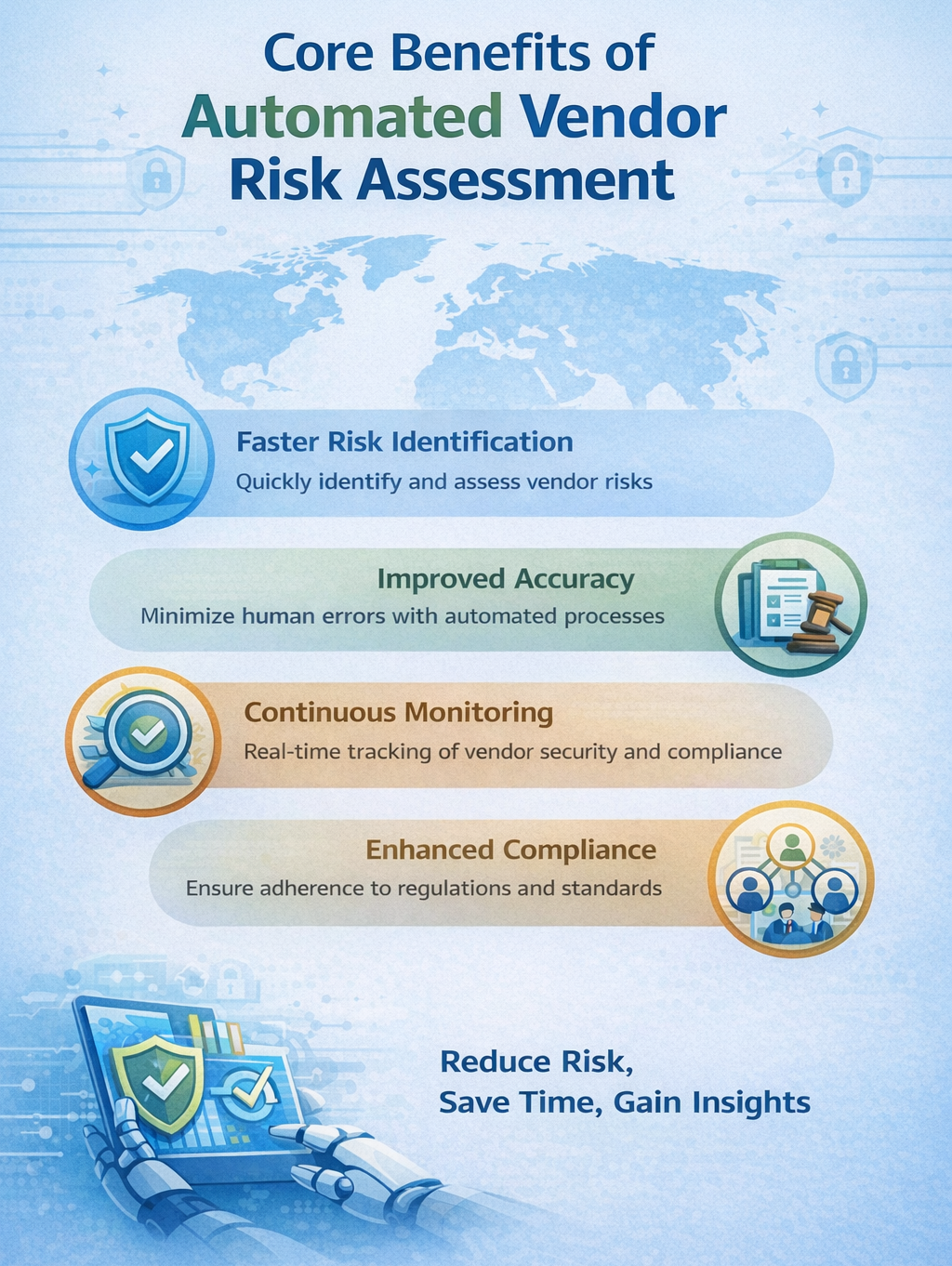
Automation dramatically accelerates vendor onboarding. What once took weeks can now be completed in days. Business units gain faster access to essential services, while security teams maintain rigorous oversight.
Continuous risk visibility improves decision-making. Real-time alerts ensure organizations can respond swiftly to emerging threats rather than discovering issues months later. This proactive approach reduces the likelihood of costly incidents.
Cost efficiency is another significant benefit. Automation reduces administrative burden, allowing security teams to manage larger vendor portfolios without expanding headcount. Resources can be redirected toward strategic initiatives rather than repetitive tasks.
Compliance readiness improves as well. Automated documentation, standardized scoring, and centralized reporting simplify audits and demonstrate due diligence. Organizations can confidently show regulators that vendor risks are systematically managed.
Perhaps most importantly, automation strengthens supply chain resilience. By identifying vulnerabilities early and maintaining continuous oversight, organizations reduce the probability of cascading disruptions caused by third-party failures.
Key Features to Look for in a Vendor Risk Automation Platform
Selecting the right platform requires careful evaluation. Effective solutions provide intelligent risk scoring models that allow customization based on organizational priorities. Real-time monitoring capabilities are essential to detect evolving threats.
Integration capabilities are equally important. Platforms should connect seamlessly with governance, risk, and compliance systems, ticketing tools, and procurement workflows. This ensures vendor risk management becomes embedded in broader enterprise processes rather than operating in isolation.
Customizable dashboards enhance executive visibility. Clear visualizations of vendor risk trends enable leadership to make informed decisions quickly. Additionally, compliance mapping features that align assessments with recognized frameworks streamline regulatory reporting.
Scalability and user experience should not be overlooked. A system that is difficult to use will face internal resistance. Intuitive interfaces encourage adoption across departments.
Automated Vendor Risk Assessment vs. Security Ratings Platforms
While security ratings platforms provide valuable insights into external risk posture, they are not a complete substitute for comprehensive vendor risk management. Security ratings typically focus on externally observable data such as open ports, patch management, and DNS configurations.
Automated vendor risk assessment platforms go further by combining external intelligence with internal documentation, questionnaires, contractual obligations, and risk tiering. They provide workflow management, remediation tracking, and compliance mapping.
In many cases, organizations benefit from integrating both approaches. Security ratings offer external validation, while automated risk assessment platforms provide structured governance and documentation.
Overcoming Common Challenges
Despite its advantages, implementing automation can present challenges. Vendors may initially resist new systems, particularly if they are accustomed to informal processes. Clear communication about expectations and standardized templates can ease this transition.
False positives from automated monitoring tools may also occur. Organizations should establish review processes to validate findings before escalating concerns. Over time, tuning risk models improves accuracy.
Integration complexity is another concern. Engaging IT and procurement stakeholders early in the implementation process helps ensure smooth alignment with existing systems.
Internal adoption requires training and executive support. Demonstrating efficiency gains and risk reduction outcomes encourages broader acceptance across the organization.
Industries That Benefit Most from Automation
While all organizations can benefit from automated vendor risk assessment, certain industries face particularly high stakes. Financial institutions manage sensitive financial data and must comply with stringent regulations. Healthcare organizations handle protected health information and rely heavily on specialized vendors. Technology companies depend on cloud-based infrastructures and third-party integrations that expand attack surfaces. Manufacturing firms with complex supply chains must ensure operational continuity. Government contractors must demonstrate strict compliance with security standards.
In each of these sectors, automation enhances visibility, reduces compliance burdens, and strengthens resilience against third-party disruptions.
The ROI of Automated Vendor Risk Assessment
Quantifying return on investment requires considering both direct and indirect benefits. Direct savings include reduced administrative labor and faster vendor onboarding. Indirect savings stem from avoided breaches, regulatory fines, and reputational damage.
A single third-party data breach can cost millions in remediation, legal fees, and lost customer trust. By identifying vulnerabilities early and enabling timely remediation, automated systems significantly reduce the probability of such events.
Operational efficiency also improves. Security teams can handle larger vendor portfolios without increasing headcount. Executives gain clearer insights into risk exposure, supporting better strategic planning.
Implementing Automated Vendor Risk Assessment in Your Organization
Successful implementation begins with assessing current maturity. Organizations should evaluate existing workflows, identify bottlenecks, and define risk tiers based on vendor criticality.
Selecting the right platform involves comparing features, scalability, integration capabilities, and vendor support. A pilot program allows teams to test functionality and refine workflows before full deployment.
Stakeholder training ensures smooth adoption. Procurement, legal, compliance, and IT teams must understand how automation fits into their responsibilities. Continuous improvement is essential. Risk models should be periodically reviewed and updated to reflect evolving threats and regulatory requirements.
Ready to Modernize Your Vendor Risk Management?
Assess maturity. Automate workflows. Strengthen compliance.
Start building a smarter, scalable vendor risk program today.
Future Trends in Vendor Risk Automation
Looking ahead, artificial intelligence will play an increasingly prominent role in predictive risk analysis. Machine learning models can identify patterns across vendor data and anticipate potential vulnerabilities before they materialize.
Continuous compliance monitoring will also become standard practice. Instead of preparing for audits reactively, organizations will maintain audit-ready documentation at all times.
Zero trust principles are extending into supply chain management. Organizations will require stronger verification mechanisms and real-time validation of vendor security posture. As technology evolves, automation will become more sophisticated, integrating broader intelligence sources and delivering deeper insights.
Conclusion: Automation Is No Longer Optional
Vendor ecosystems are expanding, threats are intensifying, and regulatory expectations continue to rise. Relying on manual processes in this environment creates unacceptable risk. Automated vendor risk assessment provides the scalability, consistency, and continuous visibility necessary to protect modern enterprises.
By embracing automation, organizations transform vendor risk management from a compliance checkbox into a strategic advantage. They accelerate business operations, strengthen security posture, and build resilient supply chains capable of withstanding evolving threats.
In 2026 and beyond, automated vendor risk assessment is not merely a technological upgrade. It is a foundational element of responsible and forward-thinking business leadership.