Why Continuous Entity Monitoring Is the Future of Business Risk Intelligence
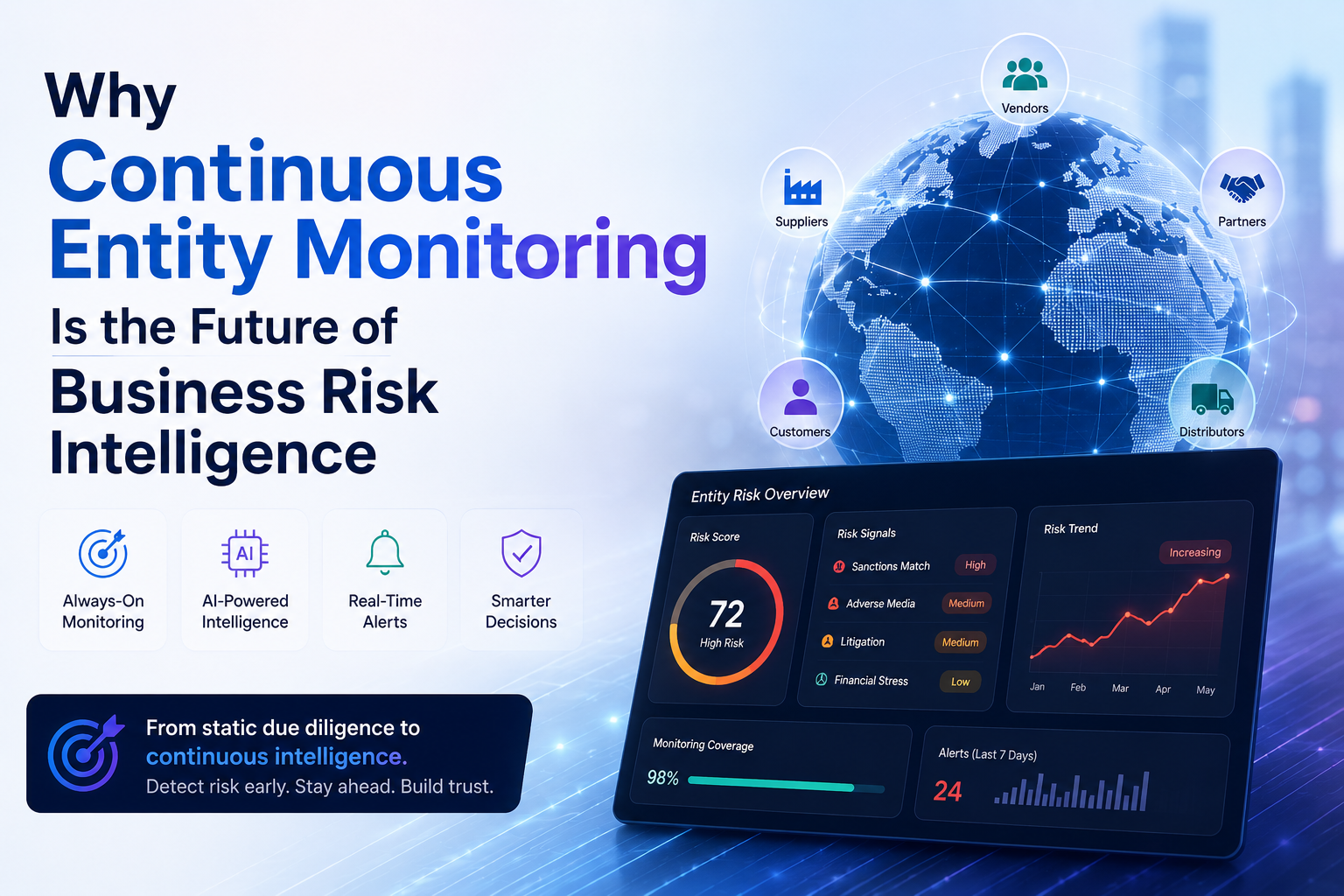





In today’s interconnected economy, businesses are no longer exposed only to their own internal risks. They are increasingly vulnerable to the actions, failures, compliance gaps, financial instability, and reputational issues of the entities they work with vendors, suppliers, merchants, distributors, portfolio companies, partners, and customers.
Yet most organizations still rely on a fundamentally outdated approach to risk:
point-in-time assessments.
A vendor may pass onboarding checks today and become non-compliant tomorrow. A financially stable supplier can suddenly face insolvency. A trusted partner may appear in litigation, sanctions lists, or adverse media overnight.
The Concern is no longer lack of data.
The problem is lack of continuous visibility.
At SignalX, we believe this is one of the biggest gaps in modern enterprise risk management today and one of the key reasons continuous entity monitoring is rapidly becoming the next evolution of business risk intelligence.
Book a Demo to see Continuous Entity Monitoring in Action →
The Problem with Traditional Risk Monitoring
For decades, enterprise risk management has largely been based on: 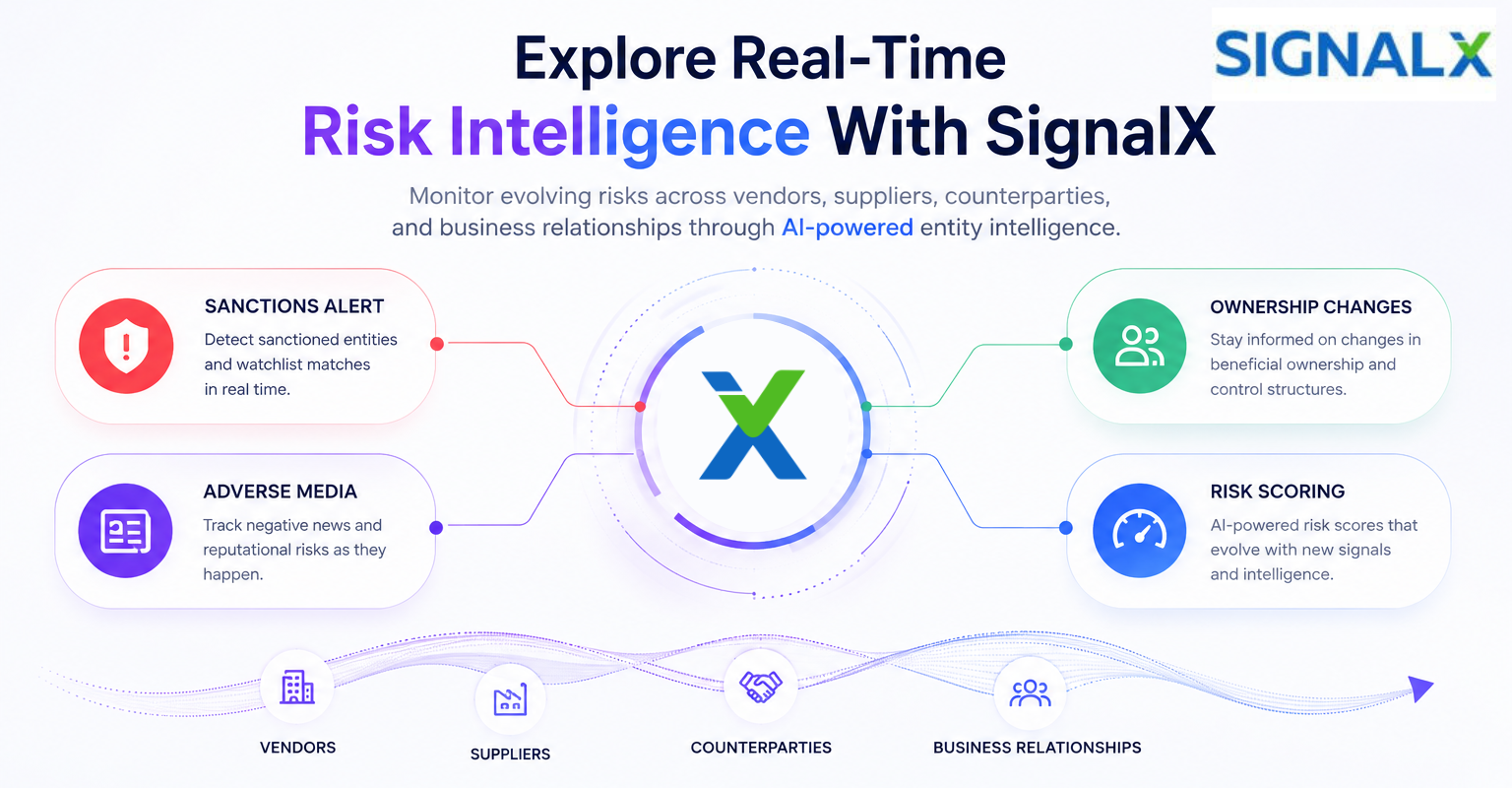
- annual audits
- periodic compliance checks
- manual investigations
- spreadsheet-based tracking
- disconnected data systems
This worked in slower business environments.
It no longer works today.
Modern business ecosystems are highly dynamic:
- supply chains evolve rapidly
- regulatory frameworks change continuously
- cyber threats emerge daily
- counterparties operate across multiple jurisdictions
- reputational damage spreads instantly through digital channels
Static assessments quickly become outdated.
From our perspective at SignalX, fragmented systems and one-time checks often create incomplete views of risk, making organizations more reactive than proactive.
Real-World Example: The SolarWinds Supply Chain Attack
One of the clearest examples of why continuous monitoring matters was the SolarWinds cyberattack.
In 2020, attackers compromised the software build environment of SolarWinds and inserted malicious code into trusted software updates distributed to thousands of organizations globally, including government agencies and enterprises.
Before
Organizations trusted:
- vendor onboarding checks
- periodic security reviews
- static trust assumptions
The vendor had already been “approved.”
After
The attack demonstrated that:
- trust is not permanent
- third-party risk evolves continuously
- risks can emerge long after onboarding
- businesses need ongoing visibility into vendor ecosystems
The incident fundamentally changed how enterprises think about third-party risk management.
At SignalX, we see this as a defining example of why businesses can no longer rely solely on periodic reviews in fast-moving risk environments.
The Shift from Due Diligence to Continuous Intelligence
Traditional due diligence answers:
“Was this entity safe at the time we checked?”
Continuous entity monitoring answers:
“Is this entity still safe today?”
That difference is critical.
Modern risk environments require organizations to continuously track:
- financial stress
- sanctions exposure
- litigation changes
- compliance defaults
- ownership changes
- reputational events
- operational disruptions
- adverse media
- cyber incidents
This is where AI-powered risk intelligence platforms are starting to reshape enterprise operations.
At SignalX, our focus has increasingly been around helping organizations move from fragmented investigations toward continuous, real-time risk visibility across entities and business relationships.
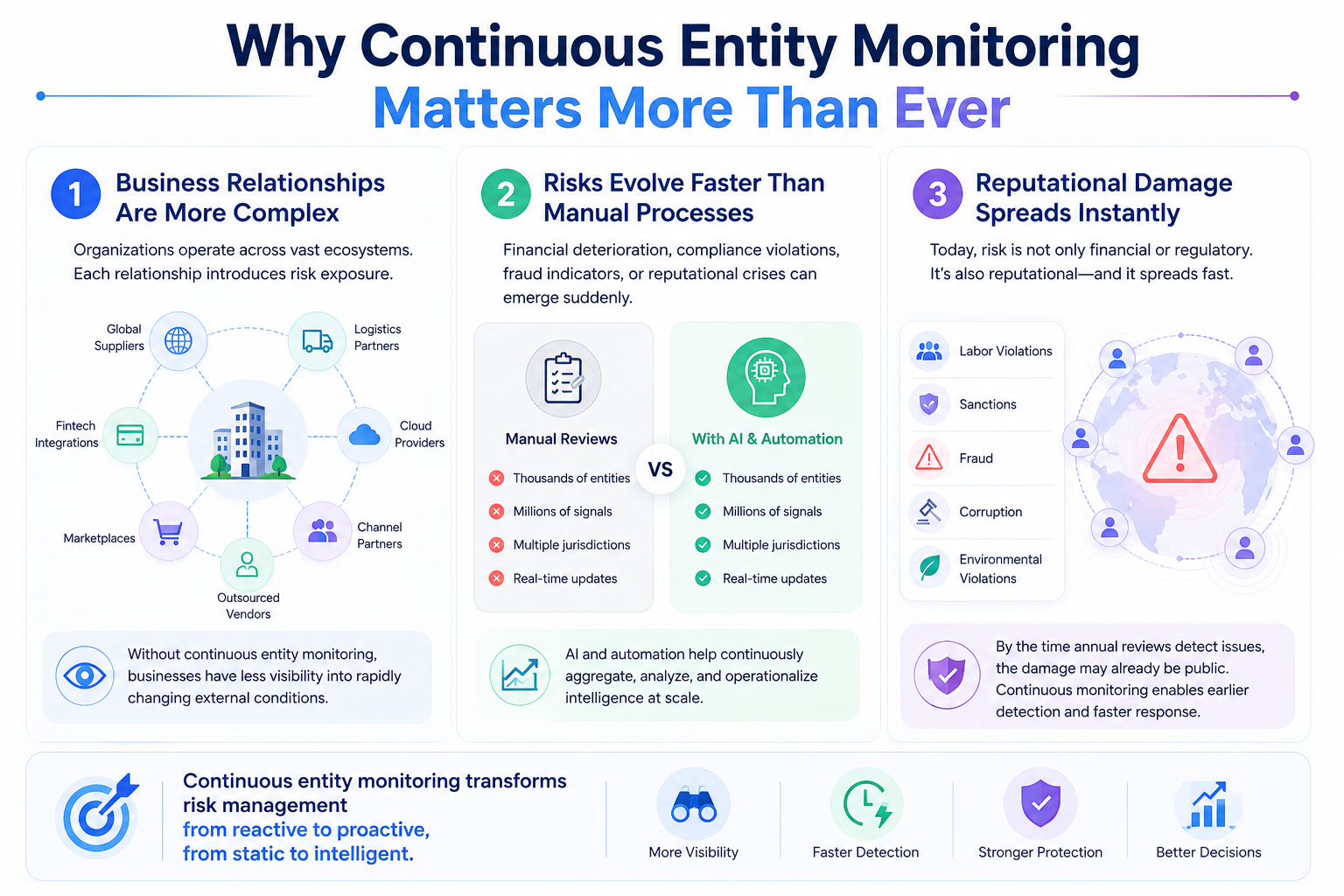
Why Continuous Entity Monitoring Matters More Than Ever
1. Business Relationships Are More Complex
Organizations today operate across vast ecosystems:
- global suppliers
- logistics partners
- fintech integrations
- cloud providers
- channel partners
- marketplaces
- outsourced vendors
Each relationship introduces risk exposure.
Without continuous Entity monitoring, businesses operate with less visibility into rapidly changing external conditions.
2. Risks Evolve Faster Than Manual Processes
Financial deterioration, compliance violations, fraud indicators, or reputational crises can emerge suddenly.
Manual reviews cannot scale to:
- thousands of entities
- millions of signals
- multiple jurisdictions
- real-time updates
This is one of the reasons AI and automation are becoming increasingly important in modern risk infrastructure.
At SignalX, we believe businesses increasingly need systems capable of continuously aggregating, analyzing, and operationalizing intelligence across fragmented data environments.
3. Reputational Damage Spreads Instantly
Today, risk is not only financial or regulatory.
A supplier linked to:
- labor violations
- sanctions
- fraud
- corruption
- environmental violations
can create immediate reputational exposure for the organizations connected to them.
By the time annual reviews detect issues, the damage may already be public.
Continuous Entity monitoring enables earlier detection and faster response.
Before vs After: Traditional Risk Operations vs Continuous Monitoring
| Traditional Risk Approach | Continuous Entity Monitoring |
| Point-in-time checks | Always-on visibility |
| Manual workflows | Automated intelligence |
| Reactive investigations | Proactive detection |
| Fragmented systems | Unified risk infrastructure |
| Delayed alerts | Real-time signals |
| Static trust assumptions | Dynamic risk scoring |
| Limited scalability | AI-powered monitoring at scale |
How AI Is Reshaping Risk Intelligence
The next generation of risk platforms is moving beyond dashboards toward:
- predictive intelligence
- automated investigations
- AI-generated risk narratives
- dynamic risk scoring
- entity relationship mapping
- real-time alerts
- workflow orchestration
This is especially important because risk signals rarely exist in isolation.
For example:
- a litigation event
- combined with declining financials
- combined with sanctions exposure
- combined with adverse media
may collectively indicate heightened risk.
AI systems can correlate these fragmented signals significantly faster than manual teams.
At SignalX, we see AI not simply as an automation layer, but as an intelligence capability that can help enterprises interpret complex risk environments more effectively.
The Emerging Importance of “Entity Intelligence”
One of the biggest shifts happening in enterprise risk today is the move toward entity-centric intelligence.
Historically, companies monitored:
- transactions
- controls
- compliance checklists
Now they are increasingly monitoring:
- the entities themselves
This includes:
- who they are connected to
- how their risk profile changes
- how relationships evolve
- whether warning signals emerge over time
This creates a more dynamic understanding of business exposure.
From our perspective, platforms focused on continuous entity intelligence are increasingly becoming operational infrastructure for:
- financial institutions
- procurement teams
- investment firms
- marketplaces
- NBFCs
- compliance teams
- enterprise risk functions
The Business Impact of Continuous Monitoring
Organizations adopting continuous monitoring frameworks are increasingly seeing improvements in:
- early risk detection
- vendor governance
- onboarding efficiency
- compliance readiness
- operational resilience
- investigation speed
- executive decision-making
At SignalX, we have seen growing enterprise interest in systems that can provide real-time visibility into evolving external risks while reducing manual investigation overhead.
Why Continuous Entity Monitoring Will Become Standard Infrastructure
The future of enterprise risk management is moving toward:
continuous, intelligence-driven decision systems.
Not because businesses want more dashboards but because modern ecosystems evolve too quickly for static assessments to remain reliable.
Organizations increasingly need:
- live risk visibility
- AI-assisted analysis
- connected intelligence layers
- automated workflows
- continuous awareness across their ecosystem
Continuous entity monitoring is no longer just a compliance enhancement.
It is becoming foundational business infrastructure.
Final Thoughts
The modern enterprise no longer operates in isolation. Every vendor, supplier, partner, customer, and portfolio company introduces dynamic risk exposure that changes continuously over time.
Point-in-time due diligence alone is no longer enough.
The future belongs to organizations that can:
- detect risk early
- monitor entities continuously
- unify fragmented intelligence
- respond proactively
- make faster, more confident decisions
As businesses navigate increasingly volatile ecosystems, continuous entity monitoring will become one of the defining capabilities of modern risk intelligence.
At SignalX, we believe this shift represents a broader transformation in how enterprises approach risk itself moving from static assessments toward continuous, intelligence-driven visibility across the entire business ecosystem.