Beyond Vendor Screening: Rise of Entity Risk Management
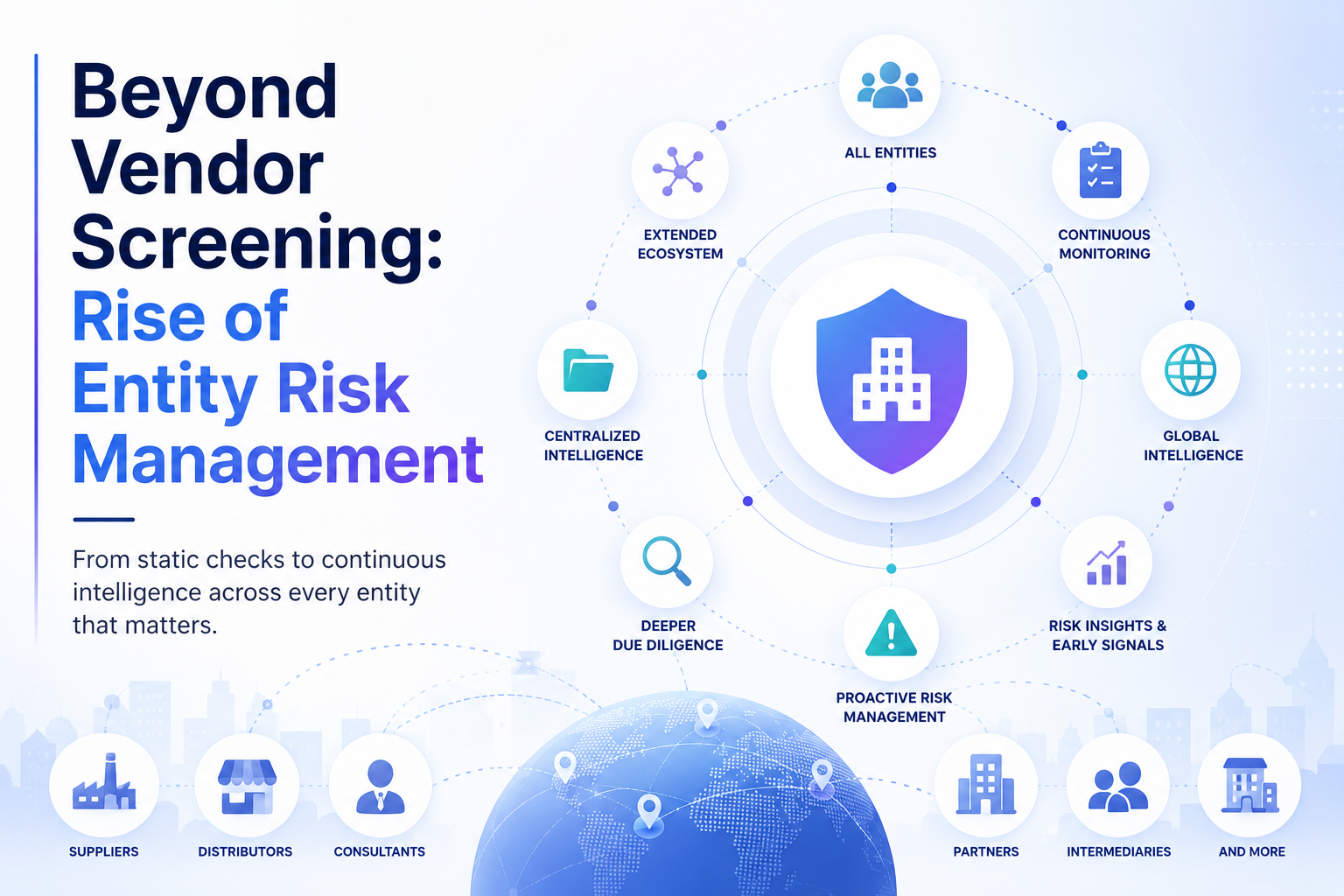





How Risk360 is helping enterprises simplify intelligence gathering and due diligence for long-tail entity ecosystems
Enterprise risk teams are excellent at investigating large, high-profile vendors.
The real operational challenge begins elsewhere.
It begins with the thousands of smaller entities that sit quietly across procurement, onboarding, compliance, distribution, investment, and third-party ecosystems entities that may not appear critical individually, but collectively create massive intelligence blind spots for organizations.
These smaller entities often include:
- regional suppliers,
- shell distributors,
- subcontractors,
- consultants,
- local intermediaries,
- low-volume vendors,
- privately held businesses,
- and emerging counterparties.
Most organizations know these entities carry risk.
The problem is that traditional due diligence processes were never designed to investigate them efficiently at scale.
As a result, enterprises face a growing operational imbalance:
- critical vendors receive deep investigations,
- while smaller entities often receive fragmented or delayed scrutiny.
And in modern compliance environments, that gap is becoming increasingly dangerous.
The Hidden Operational Problem Enterprises Rarely Discuss
In theory, every entity should undergo structured due diligence.
In practice, most organizations struggle because investigations are:
- expensive,
- time-consuming,
- operationally fragmented,
- and difficult to scale.
For smaller entities especially, teams often face a difficult tradeoff:
- either conduct manual investigations that slow operations,
- or accelerate onboarding with limited visibility.
Neither option is ideal.
This creates a common enterprise pattern:
- due diligence becomes inconsistent,
- intelligence gathering becomes reactive,
- and operational teams begin prioritizing speed over clarity.
Over time, this weakens governance maturity across the organization.
The issue is not that enterprises ignore risk.
The issue is that traditional due diligence models create too much operational friction for high-volume entity ecosystems.
Why Smaller Entities Are Becoming a Bigger Risk Concern
Historically, due diligence programs focused heavily on large counterparties and strategic vendors.
But risk has evolved.
Today, operational exposure increasingly emerges through: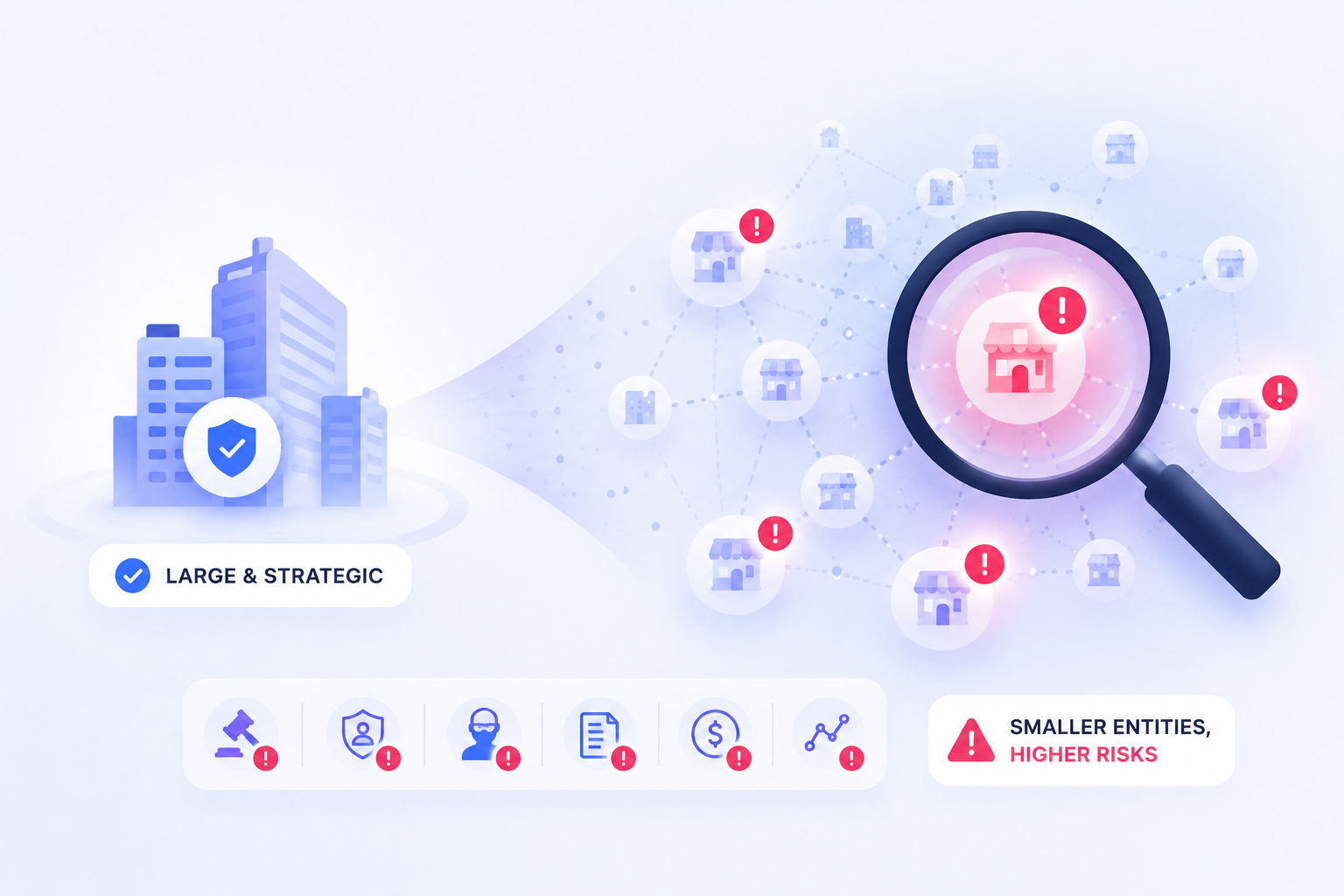
- downstream supplier networks,
- hidden ownership structures,
- regional intermediaries,
- fragmented payment ecosystems,
- and lightly monitored third parties.
In many enterprise environments, smaller entities now represent:
- the least visible,
- least standardized,
- and least continuously monitored layer of the ecosystem.
This is especially important because smaller entities may still expose organizations to:
- sanctions risk,
- reputational exposure,
- fraud indicators,
- compliance failures,
- financial irregularities,
- or hidden relationship networks.
And yet, many enterprises still rely on manual processes to investigate them.
The Shift Toward Search-Led Due Diligence
One of the biggest changes happening in enterprise intelligence today is the movement away from investigation-heavy workflows toward search-led intelligence accessibility.
Risk and compliance teams increasingly want systems where they can:
- search an entity instantly,
- evaluate available intelligence quickly,
- and initiate due diligence workflows without operational complexity.
This is where platforms like Risk360 by SignalX are becoming operationally valuable.
Rather than positioning due diligence as a long investigative cycle, Risk360 simplifies the process into a more accessible intelligence workflow designed for faster entity evaluation.
The experience is intentionally straightforward:
- search for an entity,
- review available intelligence signals,
- and request a due diligence report directly through the portal.
This simplicity matters more than many organizations realize.
Because the faster enterprises can access structured intelligence, the easier it becomes to scale governance across high-volume entity ecosystems.
Why Accessibility Is Becoming the Future of Due Diligence
One of the major reasons traditional due diligence struggles operationally is that intelligence systems are often designed primarily for specialists.
But modern organizations require broader accessibility.
Today, due diligence is no longer isolated to:
- dedicated investigators,
- financial crime teams,
- or enterprise compliance functions alone.
Procurement teams, onboarding operations, legal departments, partnership managers, and business stakeholders increasingly require fast access to reliable intelligence visibility.
This changes how due diligence platforms must function.
The most effective intelligence systems are no longer those that simply store data.
They are the systems that reduce the effort required to transform intelligence into operational decisions.
That is where workflow simplicity becomes a strategic advantage.
The Risk360 Experience: Simplifying Entity Intelligence
Risk360 is designed around a practical enterprise reality:
Teams need faster access to entity intelligence without navigating fragmented research environments.
The workflow removes much of the operational friction commonly associated with traditional investigations.
Users can:
- search entities directly from the platform,
- review intelligence visibility,
- identify relevant risk indicators,
- and place requests for structured due diligence reports from a centralized interface.
This creates a significantly more scalable approach for organizations handling:
- large onboarding volumes,
- distributed vendor ecosystems,
- regional supplier networks,
- or recurring entity verification workflows.
Instead of building investigations manually across disconnected systems, enterprises can centralize the process into a more streamlined intelligence experience.
Why This Matters Operationally
The operational value of simplified due diligence is often underestimated.
But for many organizations, investigation delays directly affect:
- vendor onboarding speed,
- procurement timelines,
- partnership approvals,
- customer verification workflows,
- and regulatory responsiveness.
When intelligence gathering becomes easier to initiate and operationalize, organizations gain:
- faster decision-making,
- improved governance consistency,
- and better visibility across long-tail entity ecosystems.
This becomes especially important in industries where:
- compliance expectations are rising,
- onboarding volumes are increasing,
- and risk conditions evolve continuously.
The Emerging Enterprise Trend: Intelligence Democratization
A major transformation happening across risk operations is the democratization of intelligence access.
Enterprises no longer want intelligence locked inside specialized investigation teams.
They want broader operational accessibility across:
- procurement,
- compliance,
- legal,
- onboarding,
- and operational risk functions.
Platforms like Risk360 reflect this shift by making due diligence initiation significantly more approachable and workflow-oriented.
This represents an important evolution in enterprise governance:
from complex investigation dependency
toward scalable intelligence accessibility.
Due Diligence Is Becoming a Speed Problem
For years, enterprises treated due diligence primarily as a verification exercise.
Today, it is increasingly becoming a responsiveness challenge.
Organizations that cannot:
- investigate quickly,
- monitor continuously,
- and operationalize intelligence efficiently
will struggle to maintain governance maturity as third-party ecosystems expand.
The future of due diligence will likely favor platforms that combine:
- accessibility,
- intelligence visibility,
- operational simplicity,
- and scalable workflows.
Not because enterprises need more data.
But because they need faster clarity.
Final Perspective
The next generation of due diligence platforms will not succeed simply because they collect more information.
They will succeed because they make intelligence easier to access, easier to operationalize, and easier to scale across increasingly complex entity ecosystems.
For enterprises managing growing volumes of smaller vendors, suppliers, and counterparties, this shift is becoming critical.
Risk360 by SignalX represents this broader movement toward more accessible, intelligence-driven due diligence workflows helping organizations move beyond fragmented investigations toward faster and more scalable entity risk visibility.
FAQs
What is Risk360 by SignalX?
Risk360 by SignalX is a platform that enables users to search entities, review intelligence visibility, and request due diligence reports through a simplified workflow.
Why are smaller entities difficult to investigate?
Traditional due diligence processes are often resource-intensive and difficult to scale across high-volume ecosystems involving smaller vendors, suppliers, and counterparties.
How does Risk360 simplify due diligence?
Risk360 allows users to:
- search entities directly,
- evaluate intelligence signals,
- and place due diligence report requests from a centralized platform experience.
Why is scalable due diligence becoming important?
As enterprises expand globally, organizations must investigate and monitor larger numbers of entities without slowing operational workflows or compromising governance standards.