Healthcare Due Diligence Services
Healthcare mergers, acquisitions, and investments come with opportunities for strong returns but also with risks that don’t exist in most other industries. Regulatory complexity, reimbursement uncertainty, clinical quality, and data privacy all play a direct role in whether a deal succeeds or fails. This is where healthcare due diligence services become essential.
Unlike standard financial or commercial reviews, healthcare due diligence takes a deep, sector-specific look at clinical operations, regulatory exposure, reimbursement models, and long-term sustainability. For investors, private equity firms, and strategic buyers, it provides clarity on risk, validates valuation assumptions, and supports informed decision-making before capital is deployed.
This article explores what healthcare due diligence services involve, why they are critical, how the process works, and how to choose the right partner for healthcare-focused transactions.
What Are Healthcare Due Diligence Services?
Healthcare due diligence services are specialized assessments conducted during mergers, acquisitions, financing, or strategic investments in healthcare organizations. The goal is to identify risks, validate performance claims, and evaluate whether a target organization is compliant, financially sound, and operationally sustainable.
While general due diligence often focuses on financial statements, market position, and growth projections, healthcare due diligence goes further. It examines clinical quality, patient safety, regulatory compliance, reimbursement exposure, and operational readiness within a highly regulated environment.
Healthcare-specific due diligence recognizes that a strong balance sheet alone is not enough. A business may appear profitable but still carry hidden liabilities related to billing practices, licensing gaps, or quality-of-care concerns that could significantly impact future value.
Why Healthcare Due Diligence Is Critical for Investors and Buyers
Healthcare transactions carry unique risks that can materially affect deal outcomes if not properly assessed. Regulatory scrutiny, payer dependency, workforce shortages, and evolving reimbursement models can quickly erode expected returns.
Healthcare due diligence services help investors and buyers understand how these risks influence valuation and long-term viability. For example, compliance failures can lead to fines, audits, or even loss of licensure. Weak clinical governance can damage reputation and reduce patient volumes. Overreliance on a single payer can create revenue instability.
By identifying these issues early, buyers can renegotiate deal terms, adjust valuation models, structure risk mitigation strategies, or walk away from high-risk opportunities altogether. In this sense, healthcare due diligence is not just a defensive exercise it is a strategic tool for smarter investments.
Key Components of Healthcare Due Diligence Services
Clinical Due Diligence
Clinical due diligence evaluates the quality and consistency of patient care delivered by the organization. This includes reviewing patient outcomes, care protocols, and quality metrics to ensure clinical practices meet accepted standards.
It also assesses provider credentialing, peer review processes, and clinical governance structures. Weak oversight or inconsistent quality controls can signal future regulatory or reputational risks, especially in provider-based healthcare models.
Clinical findings often influence both valuation and post-transaction integration plans, particularly when growth depends on maintaining or expanding patient trust.
Regulatory and Compliance Due Diligence
Regulatory compliance is one of the most critical areas of healthcare due diligence services. Healthcare organizations operate under extensive federal, state, and local regulations, including HIPAA, CMS requirements, licensing rules, and accreditation standards.
This component examines policies, audit histories, billing practices, and compliance programs to identify exposure to fraud, abuse, or enforcement actions. Even minor compliance gaps can become major liabilities after a transaction closes.
Understanding the regulatory posture of a target helps buyers estimate future compliance costs and avoid inheriting unresolved legal risks.
Financial and Reimbursement Due Diligence
Healthcare revenue is heavily influenced by payer dynamics and reimbursement rules. Financial due diligence in healthcare goes beyond traditional accounting to analyze payer mix, reimbursement rates, denial trends, and billing accuracy.
Healthcare due diligence services assess whether revenue is sustainable under current reimbursement models and whether coding and documentation practices support reported earnings. This is particularly important in value-based care environments, where payment is tied to outcomes rather than volume.
A clear picture of reimbursement risk ensures that projected cash flows are realistic and defensible.
Operational Due Diligence
Operational due diligence focuses on how efficiently and effectively the organization runs day to day. This includes evaluating staffing models, workforce stability, provider productivity, and leadership structure.
Healthcare organizations are especially vulnerable to staffing shortages and turnover, which can directly impact care quality and growth potential. Operational assessments also examine facility capacity, workflows, and scalability to determine whether the business can support future expansion.
Strong operations often distinguish high-performing healthcare assets from those with hidden execution risks.
Technology and Data Due Diligence
Technology plays an increasingly central role in healthcare delivery and compliance. This component of healthcare due diligence services evaluates electronic health record systems, interoperability, and data management practices.
Cybersecurity and data privacy risks are also assessed, particularly given the sensitivity of patient information and the consequences of data breaches. Weak technology infrastructure can increase operating costs and limit an organization’s ability to scale or integrate post-acquisition.
Technology due diligence helps buyers understand both current capabilities and future investment needs.
Healthcare Due Diligence Process: Step-by-Step
The healthcare due diligence process typically begins with a high-level assessment of the target organization and its risk profile. This initial phase identifies key areas of focus based on the transaction type, care setting, and regulatory environment.
The next step involves data collection, including document reviews, management interviews, and stakeholder discussions. Clinical, financial, operational, and compliance data are analyzed in parallel to ensure a comprehensive view.
Findings are then synthesized into a detailed report that highlights risks, opportunities, and recommended actions. This report often informs valuation adjustments, deal structuring, and post-close integration planning. Effective healthcare due diligence services provide not just findings, but clear, actionable insights for decision-makers.
Who Needs Healthcare Due Diligence Services?
Healthcare due diligence services are essential for a wide range of stakeholders involved in healthcare transactions. Private equity firms rely on them to validate investment theses and manage downside risk. Strategic healthcare buyers use due diligence to ensure alignment with long-term operational goals.
Venture capital investors benefit from healthcare due diligence when evaluating early-stage companies operating in regulated environments. Lenders also use due diligence findings to assess credit risk and structure financing terms.
Even healthcare operators considering partnerships or expansions can use due diligence to gain clarity before committing resources.
Healthcare Due Diligence vs Commercial Due Diligence
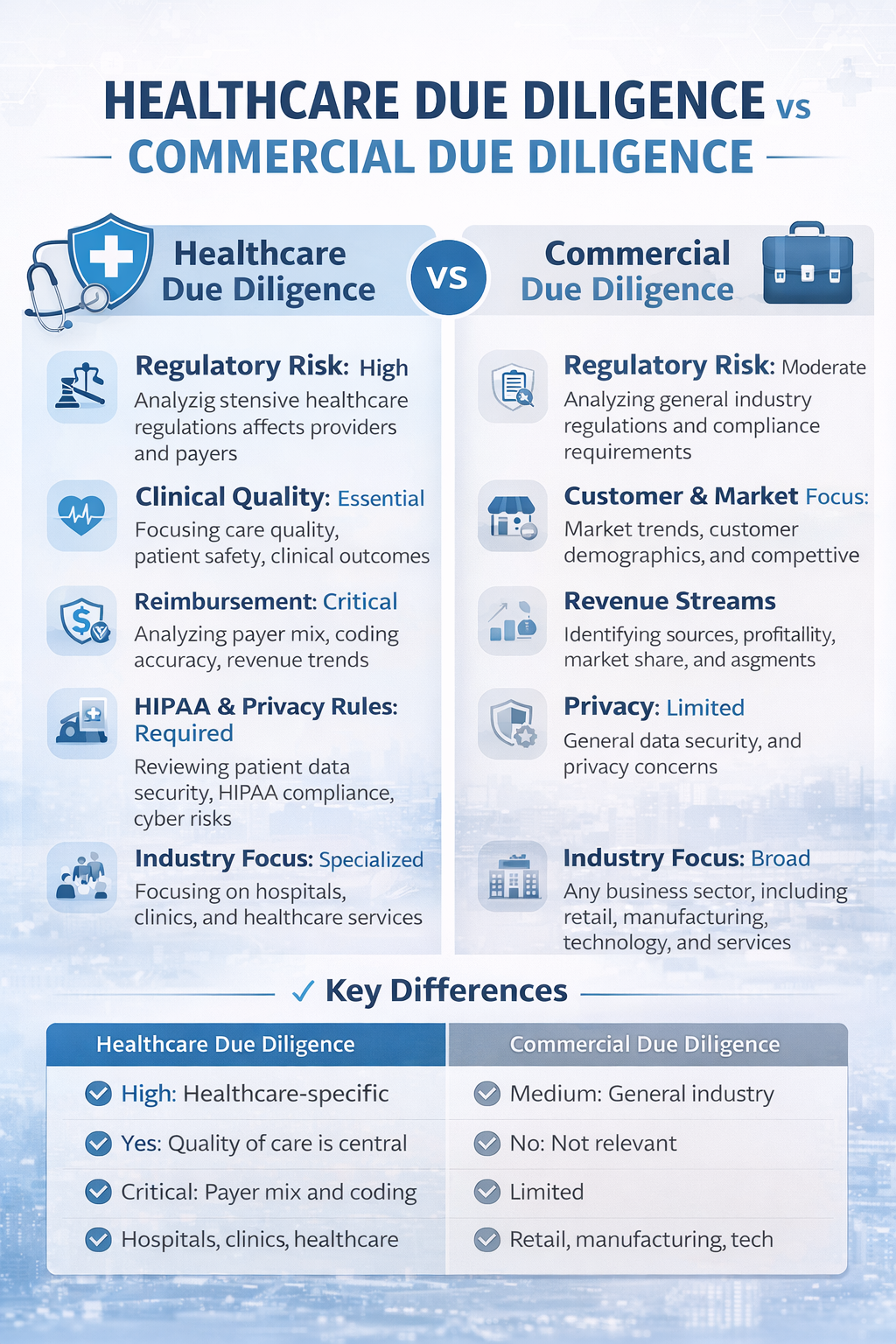
While commercial due diligence focuses on market size, competition, and growth drivers, healthcare due diligence services dive deeper into industry-specific risks. Regulatory compliance, clinical quality, and reimbursement structures are central to healthcare but often peripheral in other industries.
Healthcare due diligence also requires specialized expertise, including clinical knowledge and regulatory experience, that goes beyond traditional consulting capabilities. The depth and complexity of healthcare reviews reflect the sector’s unique risk profile and regulatory oversight.
For healthcare transactions, commercial due diligence alone is rarely sufficient.
Common Risks and Red Flags Identified During Healthcare Due Diligence
Healthcare due diligence services frequently uncover issues that are not immediately visible in financial statements. Regulatory non-compliance, such as expired licenses or inadequate compliance programs, can pose serious post-close risks.
Revenue concentration is another common concern, particularly when a large portion of income depends on a single payer or contract. Clinical quality issues, including poor outcomes or inconsistent protocols, may threaten reputation and growth.
Technology gaps, outdated systems, or weak cybersecurity controls can also emerge as significant challenges. Identifying these red flags early allows buyers to plan mitigation strategies or reconsider the transaction.
How to Choose the Right Healthcare Due Diligence Partner
Selecting the right partner for healthcare due diligence services is critical. Experience in healthcare-specific transactions is essential, as generalist firms may overlook sector-specific risks.
The best partners offer a multidisciplinary approach, combining clinical, regulatory, financial, and operational expertise. They also have direct experience with similar deal types and care settings, allowing them to benchmark findings effectively.
Clear communication, practical recommendations, and the ability to integrate due diligence insights into deal strategy are key indicators of a strong healthcare due diligence provider.
FAQs About Healthcare Due Diligence Services
How long does healthcare due diligence usually take?
Healthcare due diligence timelines depend on the size and complexity of the transaction, the availability of data, and the scope of review. In most cases, the process takes several weeks, progressing from an initial assessment through detailed analysis and concluding with final reporting.
What areas are covered in healthcare due diligence?
Healthcare due diligence provides a comprehensive evaluation of the target organization by reviewing clinical quality, regulatory and compliance posture, financial performance, operational efficiency, and technology infrastructure. This broad scope ensures buyers gain a well-rounded understanding of risks and opportunities.
How does healthcare due diligence impact valuation?
Healthcare due diligence helps validate key assumptions and uncover potential risks that may affect future performance or costs. By identifying these issues early, buyers can more accurately price assets, negotiate deal terms, and avoid unexpected expenses after the transaction closes.
Conclusion
Healthcare transactions demand a level of scrutiny that goes beyond traditional due diligence. Regulatory complexity, clinical responsibility, and reimbursement uncertainty make informed decision-making essential.
Healthcare due diligence services provide the clarity investors and buyers need to assess risk, validate value, and structure successful deals. By uncovering hidden liabilities and confirming long-term sustainability, healthcare due diligence supports confident, low-risk acquisitions in an increasingly complex healthcare landscape.
For any organization considering a healthcare investment or acquisition, comprehensive healthcare due diligence is not optional it is a strategic necessity.


Samruddhi Kulkarni
Samruddhi is a marketing professional who creates content that simplifies complex topics such as third-party risk management, compliance, and vendor governance. By combining market research, insights, and domain understanding, she develops blogs, e-books, and best-practice guides that help organizations strengthen their risk posture and build long-term resilience.
