Investment Due Diligence: A Complete Guide for Smart Investors
Every successful investment begins long before capital is deployed. Markets fluctuate, projections change, and narratives can be misleadingbut facts, when properly verified, provide clarity. Investment due diligence is the disciplined process that allows investors to separate opportunity from risk and conviction from speculation.
From venture capital and private equity to strategic acquisitions, investors who rely on structured due diligence consistently outperform those who don’t. In this guide, we break down what investment due diligence is, why it matters, how to execute it effectively, and how platforms like SignalX are transforming how investors evaluate deals in today’s data-driven environment.
What Is Investment Due Diligence?
Definition and purpose
Investment due diligence is a comprehensive investigation conducted before making an investment decision. Its purpose is to validate information provided by the target company, identify material risks, assess value drivers, and ensure alignment with the investor’s strategic and financial objectives.
Why investment due diligence matters for investors
Due diligence reduces uncertainty. It enables investors to uncover risks early, avoid overpaying, and make informed decisions based on evidence rather than assumptions or pressure-driven timelines.
Difference between due diligence and investment analysis
Investment analysis focuses on potential returns and strategic fit. Due diligence focuses on verification, risk exposure, and downside protection. One evaluates opportunity; the other validates reality.
Why Investment Due Diligence Is Critical Before Investing
Risk mitigation and capital protection
Due diligence identifies financial, operational, legal, and market risks that could impair returns or lead to capital loss.
Identifying hidden liabilities
Undisclosed debt, regulatory violations, customer churn, or weak governance often surface only through structured investigation.
Valuation accuracy and deal confidence
A well-executed diligence process ensures valuation reflects sustainable performance, not inflated projections.
Regulatory and compliance assurance
Confirming compliance reduces the likelihood of post-investment penalties, deal reversals, or reputational damage.
Types of Investment Due Diligence You Must Perform
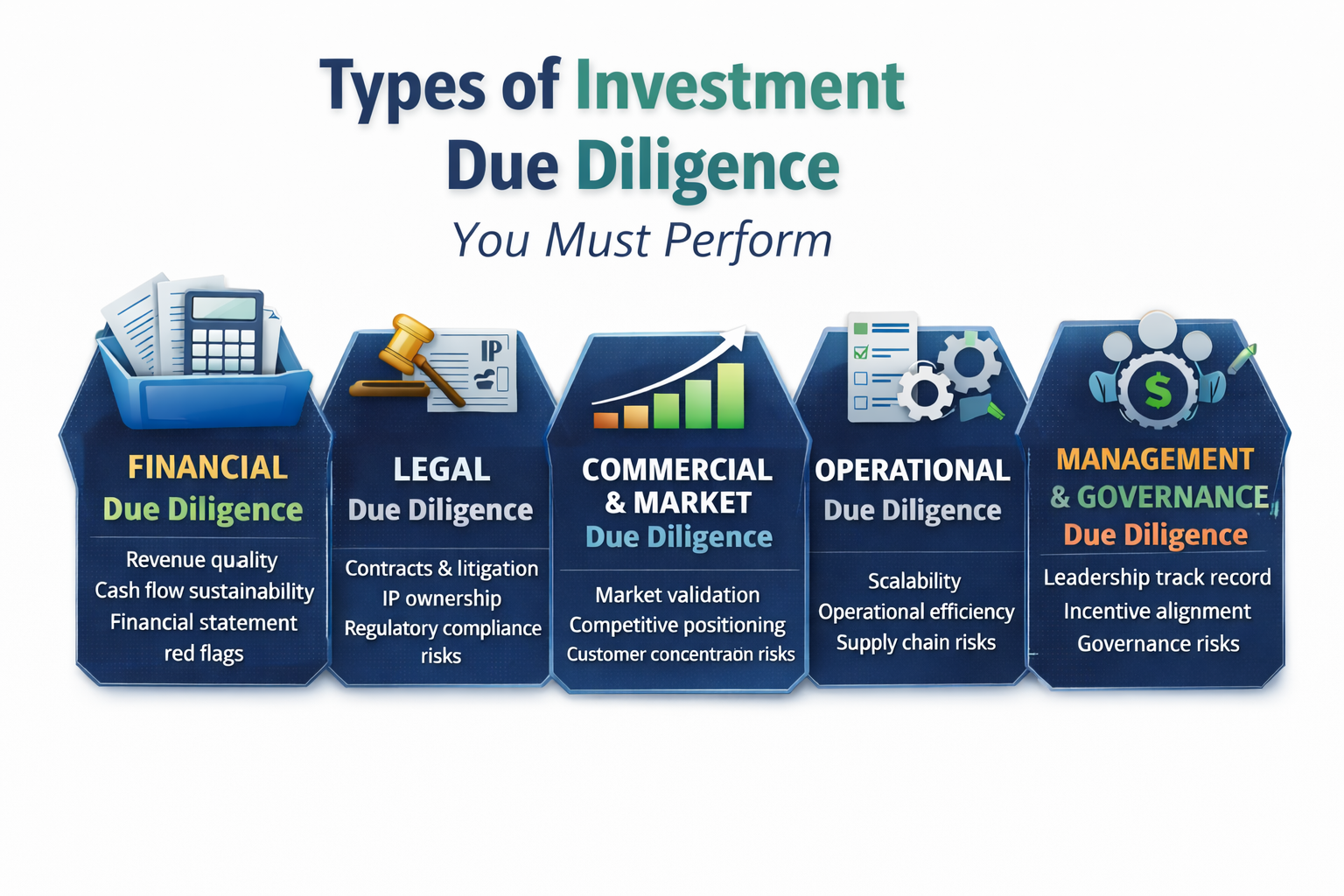
Financial Due Diligence
Revenue quality
Assess whether revenue is recurring, diversified, and supported by long-term customer relationships.
Cash flow sustainability
Evaluate working capital dynamics, burn rates, and liquidity resilience under downside scenarios.
Financial statement red flags
Look for aggressive accounting, unexplained adjustments, and weak internal controls.
Legal Due Diligence
- Contracts, litigation, IP ownership
Review enforceability of key contracts, ownership of intellectual property, and exposure to litigation.
- Regulatory compliance risks
Ensure licenses, filings, and industry regulations are fully satisfied.
Commercial & Market Due Diligence
Market size and growth validation
Understanding the true size of the market is critical to assessing an investment’s upside potential. This goes beyond accepting management’s stated TAM figures. Investors must independently validate the market using third-party industry data, sector reports, customer research, and comparable company benchmarks.
Competitive positioning
A strong market does not guarantee investment success. Commercial due diligence examines how well a company can compete within that market. This includes analyzing the company’s value proposition, product differentiation, and pricing strategy relative to existing and emerging competitors.
Customer concentration risks
Revenue stability is heavily influenced by the diversity of a company’s customer base. Heavy reliance on a small number of customers creates material risk, even if current performance appears strong. The loss, renegotiation, or delayed payment from a single large customer can significantly impact cash flow and valuation.
Operational Due Diligence
Business model scalability
Evaluate whether the company’s technology, processes, and organizational structure can handle increased volumes without proportionally increasing costs or complexity. Scalable models maintain performance and margins as the business grows.
Operational efficiency
Review how effectively the company converts inputs into outputs by analyzing cost structure, workflow efficiency, and key productivity indicators. Persistent inefficiencies or manual processes can limit growth and erode profitability.
Vendor and supply chain risks
Assess dependence on critical suppliers, geographic concentration, and contractual flexibility. Supply chain disruptions or single-source dependencies can create operational instability and margin pressure.
Management & Governance Due Diligence
Leadership track record
Examine management’s history of executing strategies, navigating challenges, and delivering results. Consistent performance and accountability often matter more than ambitious future plans.
Incentive structures
Analyze how compensation, equity, and performance metrics influence behavior. Misaligned incentives can encourage short-term decisions that undermine long-term value.
Governance risks
Review board composition, oversight mechanisms, and decision-making authority. Weak governance structures increase the likelihood of strategic missteps, compliance failures, and ethical issues.
Investment Due Diligence Process (Step-by-Step)
- Pre-screening and investment thesis validation :Assess strategic fit and eliminate misaligned opportunities early.
- Data collection and document review :Gather financials, legal documents, operational data, and market intelligence.
- Deep-dive analysis by domain : Specialists evaluate each risk category independently.
- Risk assessment and scenario modeling : Stress-test assumptions and model downside cases.
- Findings report and investment recommendation :Consolidate insights into a clear go/no-go decision framework.
Checklist
Financial checklist
- Audited financials
- Revenue and margin analysis
- Cash flow and liquidity review
Legal checklist
- Corporate structure and contracts
- IP ownership and litigation review
Market and customer checklist
- Market validation
- Customer concentration and churn
Operational checklist
- Cost structure
- Supply chain resilience
Management checklist
- Leadership capability
- Incentive alignment
Don’t Miss Critical Due Diligence Risks
Download our comprehensive investment due diligence checklist used by professional investors to systematically assess financial, legal, operational, and market risks.
PDF • Printable • Investor-ready
Common Red Flags Found During Investment Due Diligence
- Aggressive revenue recognition
- Weak internal controls
- Overdependence on key customers
- Regulatory non-compliance
- Founder or management misalignment
Multiple red flags often signal structural risk rather than isolated issues.
Investment Due Diligence for Different Investor Types
Venture Capital Due Diligence
Focuses on market opportunity, team strength, product differentiation, and scalability.
Private Equity Due Diligence
Emphasizes cash flow stability, operational improvement potential, and exit readiness.
Strategic & Corporate Investors
Prioritize synergies, integration complexity, and long-term strategic alignment.
Angel Investors
Balance speed with selectivity, often emphasizing founder quality and early traction.
Investment Due Diligence Tools & Technology
Modern investors increasingly rely on technology to enhance diligence quality and speed:
- Virtual data rooms
- Financial modeling and scenario tools
- AI-powered risk detection
- Deal and portfolio management platforms
These tools improve efficiency but work best when paired with expert judgment.
In-House vs Third-Party Investment Due Diligence
Pros and cons of internal teams
Internal teams offer institutional knowledge but may face bandwidth or bias limitations.
When to outsource due diligence
Complex, cross-border, or regulated deals often require specialized external expertise.
Cost vs risk trade-offs
The cost of diligence is minimal compared to the cost of a failed investment.
How Long Does Investment Due Diligence Take?
Timeline by deal size
- Early-stage deals: 2–4 weeks
- Mid-market transactions: 4–8 weeks
- Large or complex deals: 8–12+ weeks
Factors affecting duration
Data readiness, deal complexity, and regulatory requirements.
Accelerating due diligence without increasing risk
Clear scoping, parallel analysis, and technology-enabled insights reduce delays.
Investment Due Diligence Best Practices
- Align diligence scope with investment strategy
- Actively challenge assumptions
- Avoid confirmation bias
- Maintain strong documentation and audit trails
- Integrate diligence findings into post-investment monitoring
Common Investment Due Diligence Mistakes to Avoid
- Overlooking non-financial risks
- Rushing under deal pressure
- Ignoring downside scenarios
- Poor coordination between stakeholders
Investment Due Diligence FAQs
What is included in investment due diligence?
Financial, legal, operational, market, management, and ESG reviews.
Who performs investment due diligence?
Investors, internal teams, and specialized third-party advisors.
How much does investment due diligence cost?
Costs vary but are insignificant compared to potential investment losses.
Can due diligence stop an investment?
Yes and preventing a bad investment is a successful outcome.
Is due diligence legally required?
Not always, but it significantly reduces legal and financial exposure.
How SignalX Supports Investment Due Diligence
SignalX enhances investment due diligence by delivering data-driven intelligence and risk signals that help investors make faster, more confident decisions.
SignalX’s role in modern diligence
SignalX centralizes critical financial, market, operational and risk data, reducing information gaps and surfacing insights that traditional diligence methods often miss.
Early risk signal identification
SignalX helps identify:
- Revenue volatility and margin pressure
- Customer concentration and churn risks
- Operational inefficiencies
- Governance and compliance vulnerabilities
- These insights allow investors to focus diligence efforts where risk is highest.
- Market and competitive intelligence
SignalX supports commercial diligence by validating market assumptions, tracking competitive dynamics, and identifying emerging threats or opportunities.
Faster, smarter decision-making
By prioritizing high-impact risk areas, SignalX accelerates diligence timelines without sacrificing rigor.
From pre-investment to post-investment
SignalX supports:
- Opportunity screening
- Active deal diligence
- Post-investment monitoring
- This continuity ensures diligence insights remain relevant beyond deal closure.
Why investors choose SignalX
Investors rely on SignalX for independent analysis, scalable diligence support, and improved confidence in valuation and risk assessment.
Make Better Investment Decisions—Faster
See how SignalX uncovers hidden risks, validates assumptions, and accelerates investment due diligence with data-driven intelligence—before capital is deployed.
No obligation • Built for VCs, PE firms & strategic investors
Final Thoughts: Making Confident Investment Decisions Through Due Diligence
Investment success is rarely accidental. A disciplined investment due diligence process enables investors to protect capital, uncover hidden risks, and make decisions rooted in evidence. With the support of modern intelligence platforms like SignalX, investors can navigate complexity with clarity and turn uncertainty into informed conviction.


Samruddhi Kulkarni
Samruddhi is a marketing professional who creates content that simplifies complex topics such as third-party risk management, compliance, and vendor governance. By combining market research, insights, and domain understanding, she develops blogs, e-books, and best-practice guides that help organizations strengthen their risk posture and build long-term resilience.
