Why Compliance Tracking Breaks Without Monitoring: Securing Your Supply Chain with Continuous Vendor Due Diligence
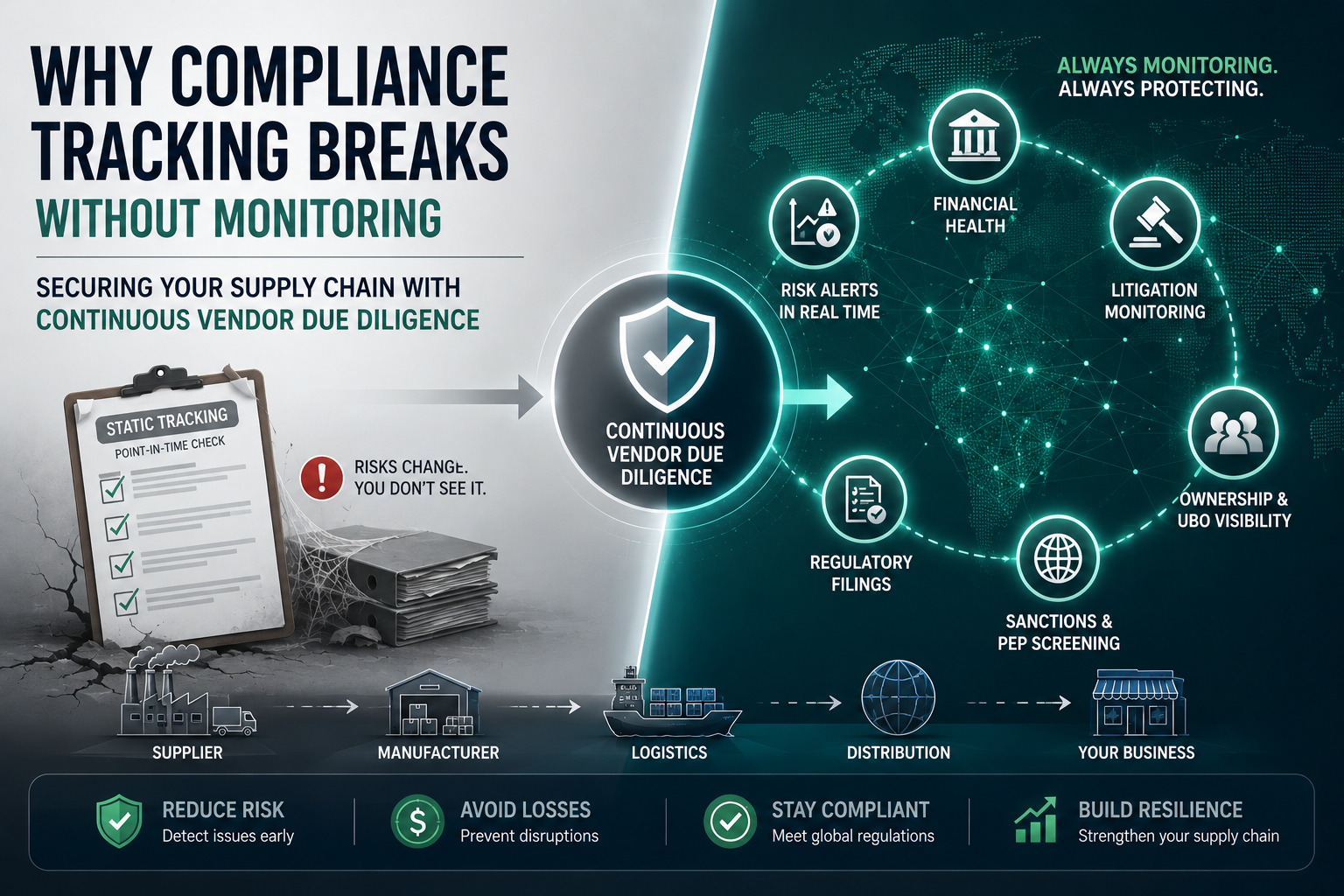





Most corporate compliance dashboards are giving us a false sense of security.
We spend massive portions of our budget on risk infrastructure, watch our internal tracking spreadsheets fill up with reassuring green checkmarks, and assume our supply chain is safe. We checked all the right boxes during onboarding, so we think we are covered.
But we aren’t.
The uncomfortable truth in our industry is that standard compliance tracking is fundamentally broken. It creates a dangerous illusion of safety because it only captures a static, point-in-time snapshot. It tells you exactly what a vendor looked like on the day they signed their contract, but it leaves you completely blind to what they look like today right as you are about to sign off on a major transaction.
If we want to actually protect our operations from supply chain disruptions and financial crime, we have to move past legacy checklists. The only real solution is transitioning to a strategy of continuous vendor due diligence.
The Reality of Compliance Data Decay
Why do traditional compliance tracking frameworks fail us so consistently? Because business operations change in real-time, but static tracking tools do not.
The exact moment a third-party partner passes your initial onboarding checks, their risk profile begins to shift. Look at how fast corporate data actually degrades in the real world:
-
The 3% Monthly Drift: Corporate records, legal filings, and structural data decay at a rate of roughly 2% to 3% every single month.
-
The Exposure Gap: Within a single year, up to 35% of your vendor compliance database will no longer match reality.
Think about the math there. If a critical supplier encounters a severe lawsuit, a winding-up petition, or quietly shifts its ownership to a sanctioned entity just three months into an annual audit cycle, a standard tracker won’t catch it. Your organization stays completely exposed for the next nine months until the next manual review rolls around. Static tracking looks backward; modern risk moves fast.
Tracking vs. Monitoring: Let’s Break Down the Difference
A lot of teams use “tracking” and “monitoring” interchangeably, but treating them as the same thing is exactly how supply chain vulnerabilities happen. Here is how they actually stack up operationally:
-
Data Recency: Legacy tracking is completely Point-in-Time. Information is frozen at onboarding or annual reviews. Continuous Risk monitoring is Real-Time, using live data streams to capture corporate changes as they happen.
-
Operational Stance: Tracking is Reactive, relying heavily on manual audit cycles or vendor self-declarations. Monitoring is Proactive, using smart software to actively crawl for risk triggers daily.
-
Scope of Visibility: Tracking is Surface-Level, checking basic entity registration and baseline documents. Monitoring is Multi-Dimensional, looking at financial health, litigation scans, and AML status simultaneously.
Are You Monitoring Vendors Or Just Tracking Them?
Point-in-time reviews create blind spots. Discover how leading enterprises monitor vendor risk continuously across financial, legal, regulatory, and ownership dimensions.
Three Gaps Threatening Your Supply Chain Right Now
1. The Real Cost of Third-Party Gaps
Relying on point-in-time checks exposes businesses to massive financial liabilities. Recent global supply chain data highlights that 97% of organizations experienced a third-party breach in 2025, which is a sharp 20% increase year-over-year. Moreover, a single breach involving a third party incurs an average cost of $4.91 million. Treating vendor risk as a static, check-the-box exercise isn’t just an administrative risk anymore it is a direct hit to your bottom line.
2. Manual Burnout and Human Error
If your organization is like most, you are likely managing hundreds of active vendors. Expecting an internal compliance team to manually track court registries, Active vendor due diligence, and conduct daily AML screening across thousands of entities is completely unrealistic. When human teams are overwhelmed by data entry, fatigue sets in. Spot checks become sloppy, reviews are rushed, and critical red flags get missed.
3. The Maze of Hidden Ownership
Modern corporate risk doesn’t usually show up on the surface; it hides inside complex corporate layers and shell networks. A standard tracking check will tell you if a vendor’s immediate corporate registration is active. What it won’t tell you is if their Ultimate Beneficial Owners (UBOs) have suddenly shifted, linking them to a blacklisted jurisdiction or a politically exposed person (PEP). Without persistent ownership tracking, you are essentially flying blind.
The Fix: Moving to SignalX Continuous Risk Infrastructure
We cannot solve dynamic, real-world risk with static, manual checklists. Securing a modern enterprise requires a live, automated defense.
This is exactly why organizations are shifting to SignalX. SignalX replaces the headache of manual tracking with an enterprise-grade continuous risk infrastructure. Instead of waiting for the next annual audit cycle, SignalX automates the entire third-party risk management lifecycle, giving your procurement and legal teams real-time visibility into vendor health.
-
Always-On Due Diligence: SignalX’s automated engines run 24/7 scans across legal courts, regulatory filings, financial registries, and adverse media, sending you an instant alert the moment a vendor’s risk profile changes.
-
Complete Financial Crime Compliance: It automatically untangles complex corporate structures, runs seamless AML screening, and verifies global sanctions lists to unmask hidden liabilities instantly.
-
Zero Manual Fatigue: By automating the tedious data-gathering workflows, SignalX frees your team from administrative burnout so they can focus on actual risk mitigation instead of chasing spreadsheets.
What Changed In Your Vendor Ecosystem Today?
Risk doesn’t wait for annual reviews. Monitor litigation, financial distress, sanctions exposure, ownership changes, and compliance events in real time.
Moving Beyond the Checklist
Relying on legacy compliance tracking without continuous risk monitoring is like checking your rearview mirror once at the beginning of a cross-country drive and assuming the road ahead will stay completely clear. It is a massive operational gamble that none of us should be taking.
To protect your brand equity and secure your operational health, continuous vendor due diligence is no longer optional. By partnering with SignalX, you can eliminate compliance blind spots, stop chasing broken data, and transform your risk management into a proactive competitive advantage.
If you are tired of wondering whether your vendor data is actually accurate, reach out to the team at SignalX today. Let’s look at how automated risk intelligence can bulletproof your enterprise operations.