Continuous Risk Monitoring vs. Annual Audits: Choosing the Right Third-Party Risk Strategy





For decades, enterprise risk management followed a predictable, linear routine. Once a year, the compliance team would pull a sample of core suppliers, send out lengthy self-certified spreadsheets, manually cross-reference basic corporate registries, and archive a static PDF dossier for the annual audit committee review.
If the vendor’s corporate registration was active and their self-reported answers looked clean, they were green-lit for another twelve months.
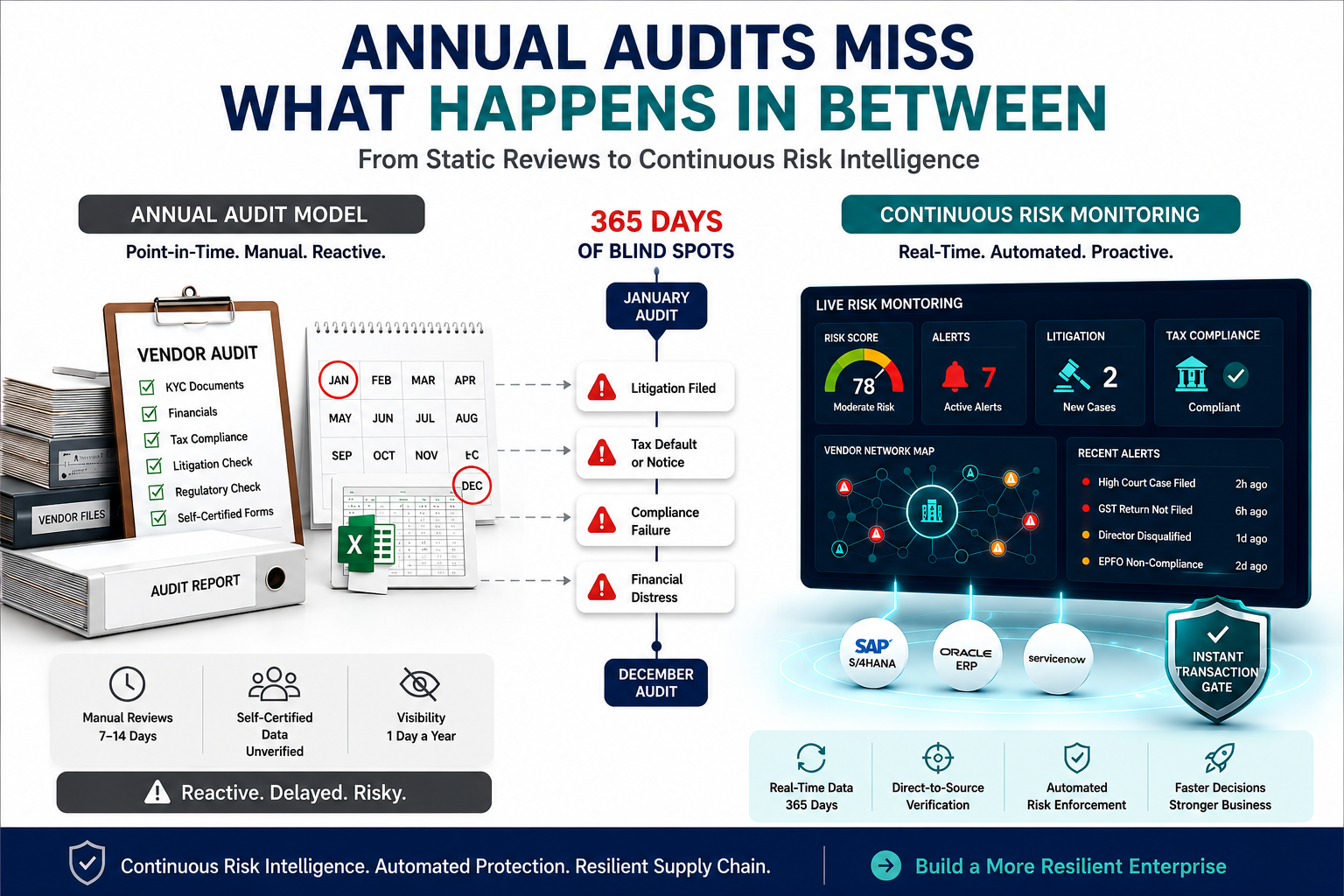
But in today’s hyper-connected, high-velocity business ecosystem, managing risk through point-in-time snapshots is no longer a viable defense. It is an operational liability. A vendor can be fully solvent, operationally stable, and legally compliant in January, yet face acute financial distress, a severe regulatory default, or a crippling court litigation by June.
When your procurement and finance departments rely on a static, retrospective vetting cadence, a dangerous visibility gap opens up between risk occurrence and risk enforcement. This guide breaks down the structural limitations of the traditional annual audit model, the operational necessity of continuous risk monitoring, and how SignalX.ai provides the automated data infrastructure required to secure the modern enterprise supply chain.
The Structural Failure of the Annual Audit Model
The traditional annual audit model is built on a fundamental flaw: it treats risk as a static variable. This static approach introduces three critical blind spots that leave large-scale organizations deeply exposed:
1. The Perils of the Multi-Month Blind Spot
An annual audit provides visibility for precisely one day out of the year. The remaining 364 days are an operational black box. Fraud syndicates and financially unstable suppliers exploit this exact latency. They clean up their compliance posture to pass onboarding or annual renewal gates, and then execute high-risk, volatile business practices shortly after. By the time a periodic refresh detects a deviation, the entity may have defaulted, leaving the parent enterprise to deal with the operational fallout.
2. Over-Reliance on Subjective, Self-Certified Forms
Traditional Third-Party Risk Management (TPRM) relies heavily on text-heavy Excel questionnaires. This approach measures compliance based on what a vendor claims they do, rather than their actual, verifiable behavior. Vendors are naturally incentivized to provide polished, templated answers to avoid losing a contract. A questionnaire cannot verify whether a supplier is mismanaging cash flows, facing imminent insolvency, or dealing with promoter-level legal disputes.
3. Delaying Procurement Velocity
Manual audits are slow. They require human analysts to log into a dozen fragmented government and legal databases to manually pull records, compile dossiers, and draft risk memos. This manual process takes anywhere from 7 to 14 business days per vendor. In a fast-moving corporate environment, this creates intense internal friction, forcing procurement teams to choose between delaying production lines or cutting compliance corners to meet operational deadlines.
The Strategic Shift: Shifting from Post-Mortem to Preventative Data
To build true supply chain resilience, enterprises must move away from retrospective check-the-box exercises and transition to an API-first, continuous risk change detection engine.
This is the exact operational framework we engineered when designing SignalX.ai.
Instead of acting as a portal that sells static background reports, SignalX serves as a continuous, automated risk infrastructure. Through direct-to-source API automation, the platform continuously tracks live compliance, legal, and operational signals across your entire vendor ecosystem, moving your risk posture from reactive post-mortems to proactive prevention.
Comparing the Strategies: Annual Audits vs. Continuous Risk Monitoring
| Risk Metric | Traditional Annual Audit Model | SignalX Continuous Risk Monitoring Infrastructure |
| Data Cadence | Point-in-time, retrospective snapshot (yearly/quarterly). | Real-time, automated data streaming (365 days/year). |
| Verification Speed | 7 to 14 business days of manual document parsing. | Complete 27-parameter risk profile. |
| Data Integrity | Subjective, self-certified vendor questionnaires. | Hard, objective, direct-to-source regulatory data. |
| Risk Enforcement | Reactive; discovered months after capital has left the bank. | Preventative; automated triggers freeze risky transactions. |
| Supply Chain Scope | Restricted to Tier-1 suppliers due to cost constraints. | Scalable across 100% of your tier-one and long-tail vendors. |
Inside the SignalX Engine: How Continuous Risk Monitoring Works
SignalX does not rely on superficial external scans or unverified questionnaires. The platform evaluates a comprehensive 26-parameter risk scorecard derived from direct-to-source API connections to the Ministry of Corporate Affairs (MCA), employees’ provident fund registries (EPFO), global AML watchlists, and the tax network.
Our continuous monitoring engine actively targets three critical failure points where annual audits are blind:
1. Real-Time Litigation Intelligence Across 7,000+ Indian Courts
Legal and financial distress rarely happens overnight; it is preceded by a trail of disputes. SignalX runs continuous, automated crawls across India’s highly fragmented judicial registries. If an onboarded vendor is hit with a major commercial dispute, an anti-evasion tax notice, or an insolvency proceeding in a regional National Company Law Tribunal (NCLT), SignalX detects the change and triggers an instant alert weeks before it culminates in operational failure or a canceled tax registration.
2. Continuous Financial and Capacity Verification
An active corporate profile on paper does not guarantee execution capacity. SignalX continuously monitors concrete operational signals, such as live headcount trends derived from trailing EPFO filings. A sudden, unexplained drop in a vendor’s employee strength is a leading indicator of internal operational distress or labor disputes. By tracking these hard data signals programmatically, enterprises can catch supply chain anomalies before they cause a production shutdown.
3. Relationship Mapping & Ultimate Beneficial Ownership (UBO)
Annual audits frequently miss the hidden corporate ecosystem behind a vendor. SignalX employs a sophisticated graph-database engine to illustrate the relationships between connected entities and corporate structures by associating company PANs, Corporate Identification Numbers (CINs), and Director Identification Numbers (DINs). The engine continuously monitors the broader web of directors and sister companies, automatically alerting you if a primary promoter becomes associated with a disqualified board seat or a struck-off shell entity elsewhere in the market.
Operationalizing Risk: The Headless ERP Integration
The true value of continuous risk intelligence lies in its ability to enforce compliance programmatically at the point of transaction. SignalX does not require your teams to manage another isolated compliance dashboard. Instead, our platform exposes robust REST APIs that feed real-time risk data straight into your core enterprise resource planning (ERP) environment including SAP S/4HANA, Oracle Cloud ERP, and ServiceNow.
[SignalX Live Risk Engine] ➔ [Automated REST API Payload] ➔ [ERP Vendor Master (SAP/Oracle)] ➔ [Instant Transaction Gate]
When the SignalX engine detects a critical risk change such as a missed tax filing sequence or an active litigation alert it dispatches an encrypted data payload directly to your ERP webhooks.
Inside your ERP, this live data can programmatically trigger a block on specific database fields (such as updating posting block indicators in SAP or applying supplier site holds in Oracle). The system instantly blocks the procurement team from raising new purchase orders or prevents the finance team from releasing payment runs to that vendor code until the risk is successfully remediated. This creates a highly effective, automated safety shield that protects your cash flow and shields your working capital from downstream Input Tax Credit (ITC) reversals.
Don’t Just Detect Risk.
Block It.
The strongest risk programs don’t stop at alerts. They automatically prevent risky transactions from moving forward.
Securing Your Supply Chain Balance Sheet
Relying on annual audits to manage third-party risk is the operational equivalent of checking your security cameras once a year. In a complex, highly regulated business environment where a supplier’s hidden financial, legal, or regulatory distress can directly impact your operations, continuous monitoring has become a baseline operational requirement.
Enterprise resilience demands a shift toward automated gatekeeping. By embedding the direct-to-source intelligence of SignalX.ai directly into your transaction streams, you replace slow, manual workflows with an invisible, real-time safety layer. With continuous, automated risk infrastructure, modern enterprise organizations are taking complete control of their supply chain destiny protecting their margins, eliminating compliance liabilities, and defending their capital at scale.