How to Automate Vendor Due Diligence: Streamlining Onboarding Without Missing Risks





Manual vendor onboarding is fundamentally broken. Procurement and compliance leaders routinely ask a frustrating question:
“Why do our vendor onboarding processes take months and keep missing compliance risks?”
In the current unpredictable market, the corporate environment evolves rapidly, whereas conventional due diligence processes are sluggish. When a risk team is buried under legacy spreadsheets, manually chasing down certificates, and toggling between dozens of isolated government portals, operational delays are inevitable. Worse, critical security flaws, hidden financial irregularities, and sudden legal disputes get completely overlooked.
This comprehensive guide details how to transform your vendor intake into a fast, automated, and legally airtight ecosystem.
What is Vendor Due Diligence (VDD)?
Before exploring automation, it is essential to establish a baseline. Vendor Due Diligence is the systematic process of auditing a prospective third-party supplier before finalizing a business contract. The goal is to verify that the vendor meets your organization’s legal, financial, environmental, and cybersecurity standards.
Why is Vendor Due Diligence Important?
A business does not operate in a vacuum. When you sign a vendor, you inherit their vulnerabilities. In real-world enterprise operations, failing to conduct rigid VDD can lead to devastating consequences: data breaches, hidden financial insolvency disrupting your production, and severe regulatory penalties. Effective VDD protects your enterprise from data liabilities, financial instability, and long-term reputational disasters.
Step-by-Step: A Guide to Automating Vendor Due Diligence
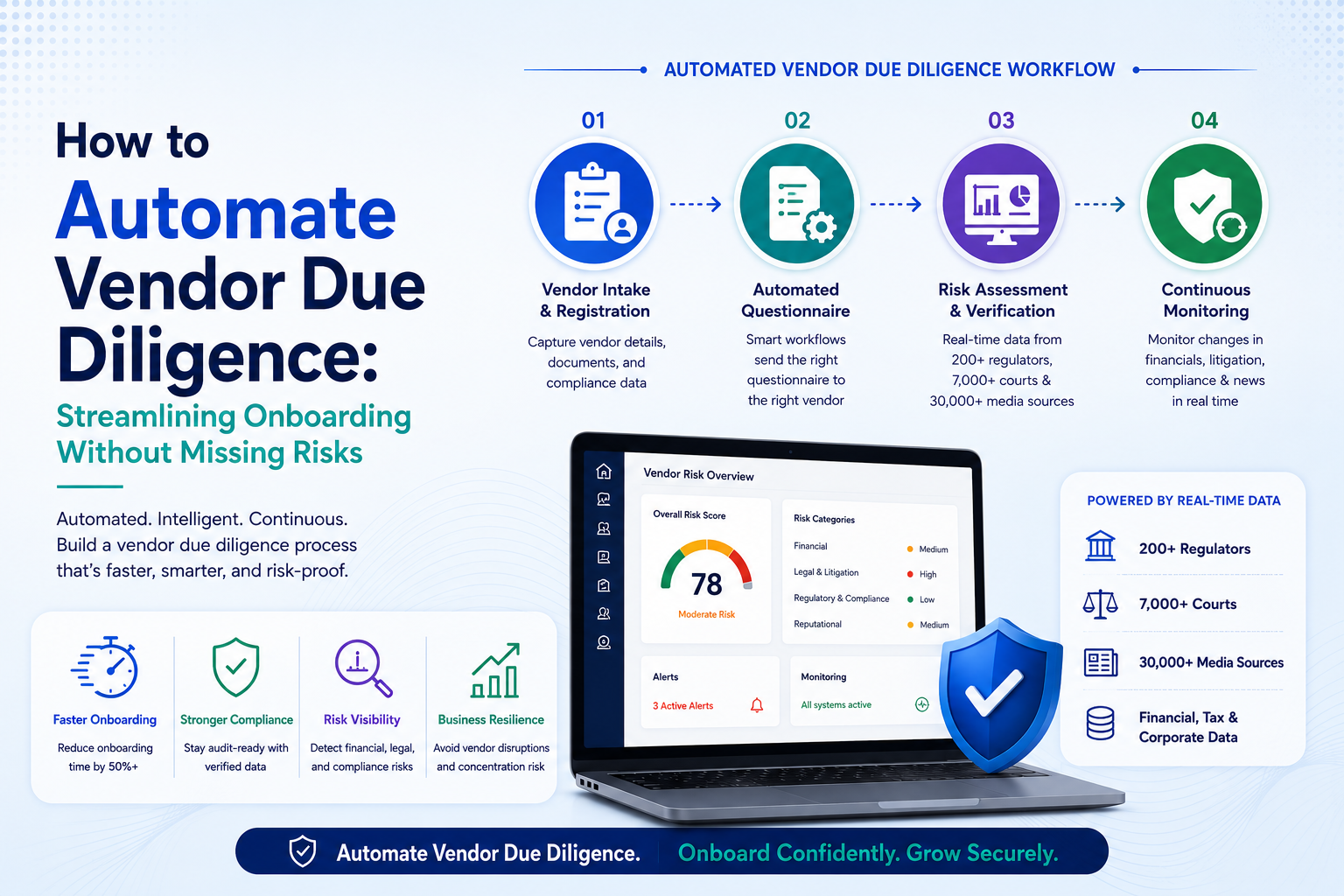
Streamlining your processes through automation reduces the likelihood of human mistakes and speeds up the realization of value in new business collaborations. An automated lifecycle generally follows this sequence:
[Vendor Intake Form] ➔ [Automated Risk Tiering] ➔ [Dynamic Questionnaire Distribution] ➔ [Continuous Compliance Monitoring]
Still Relying On Spreadsheets To Assess Vendors?
Use our practical vendor due diligence checklist to standardize onboarding, reduce review delays, and strengthen compliance coverage.
1. Standardize the Vendor Intake & Registration Form
The journey begins the moment a business unit requests a new tool or supplier. Instead of managing back-and-forth emails, implement a unified intake workflow.
-
What is a Vendor Registration Form? This is the primary digital platform through which a vendor provides their essential business entity information, compliance records, and certifications.
-
What is a Vendor Profile? This profile serves as a centralized dashboard a single source of truth containing all validated documentation, active risk scores, and historical audit trails for that specific vendor.
2. Implement Automated Questionnaire Distribution
Never send standard, 500-question spreadsheets to every vendor regardless of size. A low-risk office supply vendor should not receive the same security assessment as a cloud hosting provider.
-
Smart Logic Workflows: Use conditional logic to deploy automated questionnaires based on how the vendor handles data.
-
The Blueprint: Look for tools that let you build out a comprehensive vendor evaluation form or template. The system should automatically follow up with automated reminders, freeing your risk team from administrative tasks.
3. Evaluate Core Vendor Capabilities
Automation allows you to efficiently verify operational competence alongside compliance risk. Your automated platform can instantly pull public records, credit checks, and cross-reference performance fields to evaluate whether a vendor is technically and operationally equipped for your scope of work.
Real-World Market Context: Enter SignalX
In the current market, enterprises no longer have the luxury of waiting weeks for traditional background checks. This is where market leaders like SignalX redefine the due diligence landscape.
SignalX operates India’s most comprehensive Digital Due Diligence platform, sourcing real-time data from 200+ regulators, 7,000+ courts, and over 30,000 media outlets. By consolidating financial, legal, tax, and reputational information into a unified, automated system, SignalX reduces industry-standard turnaround times by threefold, providing thorough enterprise-level risk reports in less than 48 hours.
The Real Scenario: Moving Beyond “Check-Box” Compliance
Traditional due diligence models fail because they capture a single point in time. A vendor could pass your onboarding check on Monday, only to face an insolvency filing or a major regulatory sanction on Friday.
The SignalX Advantage: Rather than treating due diligence as a one-off hurdle, the SignalX Risk Master turn continuous risk monitoring into a live, continuous safeguard. If a critical supplier delays their tax filings, gets entangled in an economic default, or faces adverse media mentions, the automated risk engine triggers a real-time red-flag alert to your dashboard. This future-proofs your operations, shifting your risk posture from reactive firefighting to proactive mitigation.
Solving Specific Portfolio Risks with Automation
As organizations scale, managing third-party relationships introduces complex risk vectors that manual review processes simply cannot trace.
Managing Vendor Concentration Risk
A common operational blind spot is inadvertently relying too heavily on a single provider.
-
What is Vendor Concentration Risk? This risk occurs when a significant portion of an enterprise’s critical business operations, infrastructure, or processing activities relies on a single vendor or a tightly clustered network of suppliers. For example, if your primary merchant processing activity is facilitated by just one vendor, a single outage could halt your entire revenue stream.
-
The Corporate Reality: Imagine a mid-sized e-commerce giant or banking partner whose payment infrastructure goes completely dark because their sole external vendor suffered a infrastructure breach.
-
Automating the Solution: Modern risk programs like SignalX continuously evaluate your entire supplier network architecture. By utilizing automated data harmonization, the platform sounds an early warning alarm if too many internal business units are onboarding vendors reliant on the exact same upstream dependencies, enabling you to build operational redundancies before a failure occurs.
How Dependent Is Your Business On A Single Vendor?
Many organizations discover supplier concentration risk only after an outage, disruption, or compliance failure. Gain visibility into hidden dependencies before they become operational failures.
Mitigating Supply Chain & Regulatory Compliance Risks
How does automated compliance actively mitigate vendor supply chain risk? By shifting your posture from manual spot-checks to continuous verification.
Automated tools help enforce vendor regulatory compliance by running background checks against global watchlists, anti-money laundering (AML) databases, and environmental, social, and governance (ESG) risk parameters the moment an intake form is submitted. If an active vendor falls out of regulatory compliance or incurs a major civil litigation, the platform flags it instantly preventing a weak link in your supply chain from disrupting your broader corporate operations or dragging down your brand’s reputation.
Selecting the Right Software: What Tools Streamline Vendor Intake?
When shifting away from manual processes, selecting an effective technology stack is critical. Enterprise-grade due diligence software should prioritize specific features to optimize operations:
| Required Feature | Business Function | Impact on Efficiency |
| Dynamic Intake Forms | Standardizes how business units request new third-party vendors. | Eliminates missing data points before the review starts. |
| Continuous Monitoring | Automatically alerts risk teams if a vendor’s security or legal posture drops mid-contract. | Replaces rigid “once-a-year” legacy audits with real-time risk visibility. |
| Native API Integrations | Connects directly to external security scorecards, business registries, and internal ERP systems. | Reduces time-consuming manual lookups across disparate web portals. |
Frequently Asked Questions (FAQ)
What is a third-party vendor?
A third-party vendor is any external entity, contractor, consultant, or service provider that your organization partners with to deliver products, services, or software. Even if they are never granted direct access to sensitive corporate networks or data systems, their financial and operational stability remains critical to your overall business continuity.
Whose approval is required for new vendor onboarding?
Onboarding approvals typically follow a cross-functional model tailored to an enterprise’s internal risk policies. Generally, it requires a verified sign-off from the Procurement/Sourcing manager (for commercial terms), the Security/Compliance team (for risk sign-off), and the Business Unit Stakeholder who owns the budget and the day-to-day relationship.
What is included in a vendor risk questionnaire?
An effective assessment questionnaire must be adaptive, but it should consistently cover core domains including data protection policies, business continuity/disaster recovery plans, regulatory compliance alignment (e.g., GDPR, SOC 2), and a clear breakdown of their own fourth-party (subcontractor) risk management procedures.
What features are needed for SME/supplier due diligence software?
For managing a massive, distributed supplier network, the software must feature high-volume automated verification of company information (such as automatic validation of tax, corporate registry records, and labor compliance). It requires instant red-flag generation, dynamic risk scoring, and zero-latency reporting capability so that smaller vendors can be processed without bottlenecking the entire procurement cycle.
What is the typical vendor evaluation process?
The vendor evaluation process involves multi-dimensional vetting where a vendor is graded across financial health (liquidity and solvency ratios), compliance status (tax filing consistency), legal history (summaries of civil or criminal litigations), and market sentiment (adverse media tracking). Platforms like SignalX automate this entire evaluation by consolidating these disparate public and private data points into an audit-ready risk report.
How do businesses evaluate vendors for global payment capabilities?
When dealing with cross-border trade, enterprises evaluate vendors by cross-referencing global sanctions lists, Anti-Money Laundering (AML) databases, Politically Exposed Persons (PEP) registries, and trade restriction watchlists. Utilizing automated compliance screening ensures that initiating global payment capabilities does not inadvertently violate international trade laws or trigger financial non-compliance penalties.
```html ```