Vendor Fraud Detection: 10 Risk Signals That Could Indicate Vendor Fraud





Let’s bypass the standard corporate platitudes about operational integrity and look directly at the math.
According to the 2026 AFP Payments Fraud and Control Survey, an astonishing 76% of organizations experienced attempted or actual payments fraud in the past year alone. This isn’t a cybersecurity failure where hackers breach your mainframe; it is a breakdown of trust within the procurement pipeline. Fraudsters don’t break down your digital doors anymore. They simply send an invoice that looks completely normal, wait for your manual approval process to falter, and watch your cash walk out the front door.
Over years of managing supply chain risk, I’ve learned that vendor fraud thrives exactly where visibility is lowest. Below are the 10 structural risk signals that indicate your corporate accounts payable (AP) workflow is actively being exploited and how we transition teams from reactive auditing to absolute automated control.
The 10 Risk Signals Hiding in Your AP Workflow
1. The “Ghost Vendor” Profile
An internal actor or external fraudster establishes a fictitious company profile inside your Enterprise Resource Planning (ERP) platform to route payments to a personal or shell account.
-
The Signal: The vendor’s registration details point to a P.O. Box, a residential home, or share an address with an internal employee. Crucially, they have zero digital footprint no verified corporate registry, active website, or institutional presence.
2. Invoices Bypassing Approval Thresholds
When an organization establishes strict governance such as requiring secondary executive approval for any disbursement exceeding $10,000 bad actors adjust their tactics instantly.
-
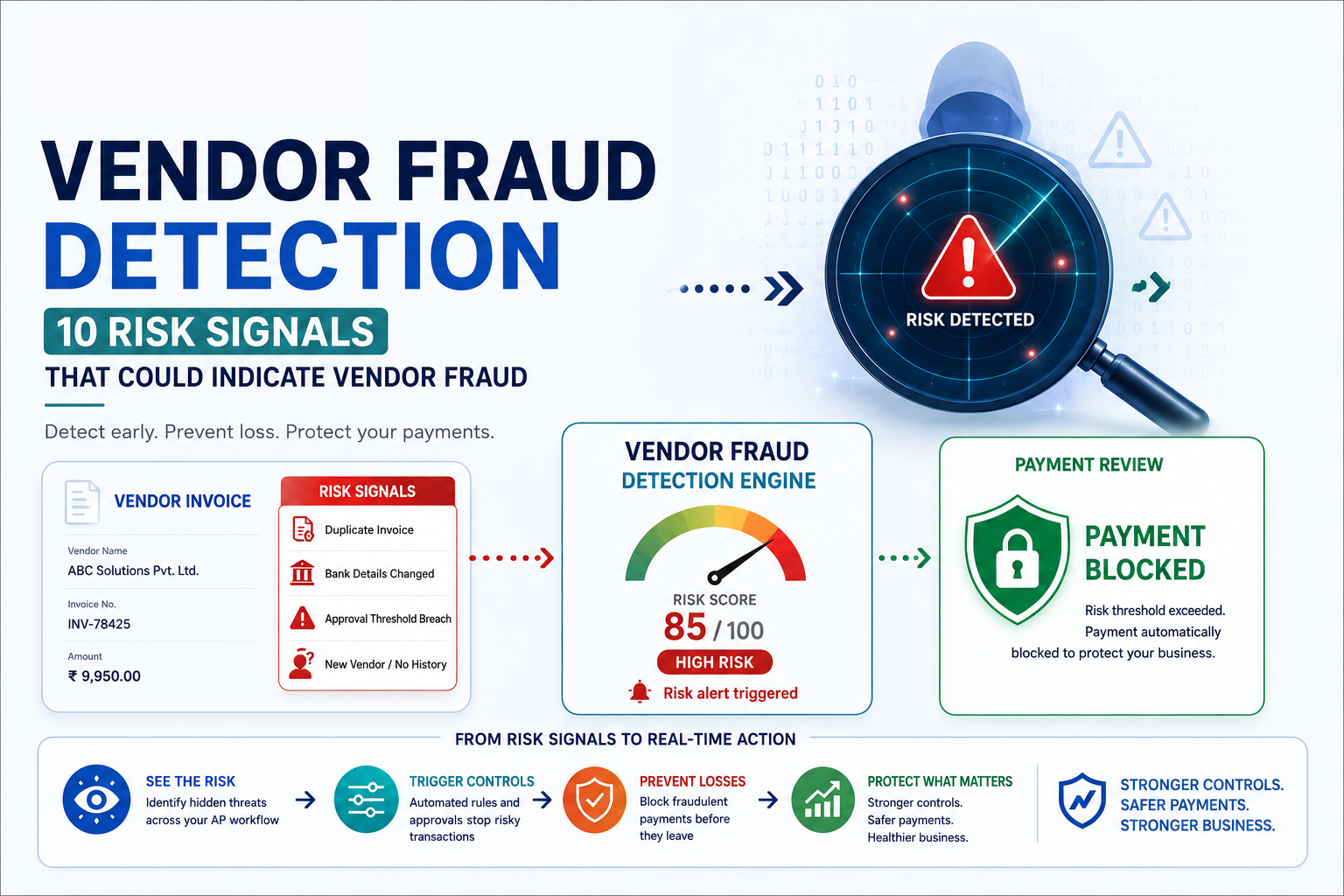
The Signal: A sudden, coordinated high volume of invoices from a single counterparty resting precisely at $9,850 or $9,990. These micro-transactions are deliberately engineered to slip under automated threshold radars.
3. Perfectly Sequential Invoice Numbers
Legitimate B2B vendors manage diverse client portfolios. If a supplier invoices your organization in April with invoice number 104, and their submission for May is invoice number 105, it suggests an architectural irregularity.
-
The Signal: A series of consecutive invoice numbers obtained over multiple months from the same vendor. This indicates that your company is their sole source of billing, a classic hallmark of a custom-built fraud shell.
4. Drastic, Unexplained Price Spikes
While macroeconomic fluctuations are normal, sudden, unannounced 20% to 30% jumps in routine line-item costs often point to an active supplier testing your oversight or an internal employee pocketing a kickback.
-
The Signal: Unit costs quietly creeping upward across consecutive billing cycles without any corresponding contract modifications or verifiable material shortages.
┌────────────────────────────────────────────────────────────────────────┐
│               VISUALIZING INVOICE ANOMALIES & THRESHOLDS               │
├────────────────────────────────────────────────────────────────────────┤
│  Invoice Amt:  ██████████████████████████████   $9,950 (Risk Alert!)   │
│  Approval Cap: ░░░░░░░░░░░░░░░░░░░░░░░░░░░░░░░  $10,000 (Threshold)    │
│                                                                        │
│  Pattern: Invoices consistently cluster 0.5% below review line.        │
└────────────────────────────────────────────────────────────────────────┘
5. Generic or Vague Line-Item Descriptions
It is exceptionally difficult to fake a delivery bill for 200 physical office desks; someone will eventually notice the empty warehouse floors. It is, however, terrifyingly easy to fake a bill for “strategic advisory services.”
-
The Signal: High-value invoices relying entirely on ambiguous phrases like services rendered, administrative overhead, or miscellaneous professional fees without granular hour logs, milestone markers, or physical deliverables.
6. Fragmented “Altered” Duplicates
Standard AP software easily identifies direct duplicate billing (e.g., two submissions labeled invoice #550). To circumvent this, fraudulent actors rely on slight clerical adjustments.
-
The Signal: Multiple invoices hitting the system within the same cycle featuring identical financial amounts, but altered slightly with suffixes like #550-A, #550_v2, or #550B.
7. Urgent Requests to Change Bank Details
This is the ultimate execution point for Business Email Compromise (BEC). A bad actor intercepts your communication with a real, trusted supplier and issues a fraudulent mandate to redirect future funds.
-
The Signal: An “urgent” or “confidential” email from a known partner stating their banking institution is changing immediately before a massive scheduled milestone payment.
8. Deficient Three-Way Matching
Enterprise control relies on a strict internal triangle: the Purchase Order (PO), the Receiving Report (verifying delivery), and the Vendor Invoice.
-
The Signal: Invoices being accelerated through the payment queue missing matching PO numbers, or scenarios where the exact same individual who authorized the initial vendor is also signing off on the receipt of goods.
9. Volumes Disconnected from Physical Reality
This situation arises when a supplier imposes charges for operational consumables or inventory quantities that your physical business infrastructure is incapable of absorbing or utilizing.
-
The Signal: Financial ledgers indicating a small regional branch went through 500 boxes of hardware components in a month, or a facility purchasing more raw materials than the physical square footage of your warehouse can physically hold.
10. Anomalous Employee-Vendor Dynamics
Human behavior remains one of the clearest leading indicators of internal collusion and kickback networks.
-
The Signal: A specific internal manager who aggressively sequesters a vendor relationship, fiercely resists routine cross-departmental performance audits, or repeatedly demands manual “rush processing” for that specific entity.
How Many Of These 10 Fraud Signals Exist In Your AP Workflow Today?
Most organizations don’t discover vendor fraud until after the payment has already cleared.
Why Point-in-Time Checklists Leave You Exposed
Historically, our defense against these vectors was a rigid onboarding checklist and an annual manual review. But here is the hard operational truth: static compliance checks are fundamentally broken.
A vendor might pass your manual background check on January 1st. But what happens if they become entangled in a major corporate litigation battle in March? What if their corporate architecture changes quietly in May, linking their promoters directly to a sanctioned entity or a high-risk shell ring?
By the time an internal audit team flags a sequential invoice pattern or a lapsed corporate registration manually, the cash has long since cleared your accounts.
How SignalX Transforms Enterprise Risk Infrastructure
To scale securely, modern corporate governance requires moving away from reactive checklists and deploying automated, continuous intelligence. This is why leading organizations have centralized their verification architecture onto SignalX.ai.
SignalX doesn’t just automate forms; it acts as an intelligent, forensic guardrail integrated directly into your procurement lifecycle.
1. Risk360: Advanced Forensic Onboarding
When assessing high-value suppliers, you cannot operate on guesswork. SignalX Risk360 transforms vendor validation from an administrative task into a deep forensic analysis. The platform instantly crawls data across more than 26 critical risk parameters including financial health markers, tax compliance histories, promoter backgrounds, and global regulatory watchlists delivering an audit-ready risk scorecard in days instead of weeks.
2. Continuous Portfolio Visibility
Compliance is dynamic. The SignalX Third-Party Risk Management (TPRM) engine continually scans external legal registries, corporate filings, and civil court records. The moment an active supplier experiences a negative regulatory deviation, an unauthorized ultimate beneficial ownership (UBO) pivot, or an adverse legal filing, the platform triggers an automated risk alert.
┌────────────────────────────────────────────────────────────────────────┐
│                        THE COMPLIANCE EVOLUTION                        │
├───────────────────────────────┬────────────────────────────────────────┤
│ Traditional Static Audits     │ Continuous Intelligence (SignalX)      │
├───────────────────────────────┼────────────────────────────────────────┤
│ • Manual, slow data gathering │ • Immediate 26-parameter validation    │
│ • Point-in-time snapshots     │ • Real-time legal & financial alerts   │
│ • High human error rates      │ • Automated ERP-integrated guardrails  │
└───────────────────────────────┴────────────────────────────────────────┘
Real-World Impact: What the Data Shows
Organizations transitioning to an intelligence-driven framework see immediate operational dividends:
-
90% Reduction in Cycle Times: Enterprises that previously spent 14 days manually pulling corporate filings, verifying tax numbers, and scanning watchlists now generate comprehensive, unified risk profiles within a fraction of the time.
-
Proactive Threat Containment: By integrating SignalX APIs directly into core enterprise ERP platforms like SAP or Oracle, organizations can automatically restrict payment eligibility the moment a vendor’s risk scorecard crosses an unmitigated threat threshold blocking fraud before disbursements occur.
Take Definitive Control of Your Supply Chain
Relying on legacy invoice matching and manual periodic checkups means operating with a massive corporate blind spot. Fraud vectors are evolving rapidly; protecting your bottom line requires an equally sophisticated technological defense.
By embedding continuous automated intelligence directly into your procurement infrastructure, you eliminate the visibility gaps where vendor fraud takes root.