How to Scale TPRM(Third-party Risk Management) Without Increasing Compliance Headcount





As enterprise vendor ecosystems expand exponentially, compliance leaders face a critical operational paradox: How do you scale a Third-Party Risk Management (TPRM) program when budgets are capped and headcount is fixed?
Historically, managing more vendors meant hiring more analysts to manually distribute, track, and score questionnaires. However, this linear scaling model is fundamentally broken. It introduces operational bottlenecks, slows down business onboarding, and fails to surface real-time risk.
To achieve non-linear scale where risk coverage expands while operational costs remain flat organizations must shift from administrative data collection to automated risk intelligence.
1. Structural Bottleneck: The Flaw of Manual Questionnaires
The Challenge: Operational Friction and Low Fidelity
Relying heavily on vendor-self-attested questionnaires creates significant vulnerabilities:
-
Administrative Burden: Analysts spend up to 80% of their time chasing missing documents and managing email follow-ups rather than analyzing actual risk data.
-
Low Data Fidelity: Questionnaires provide a subjective, point-in-time snapshot. They capture what a vendor claims to be true, not necessarily the objective reality of their financial or legal standing.
The Solution: Automated Entity-Based Verification
To scale without adding personnel, organizations must replace manual discovery with automated, external data verification.
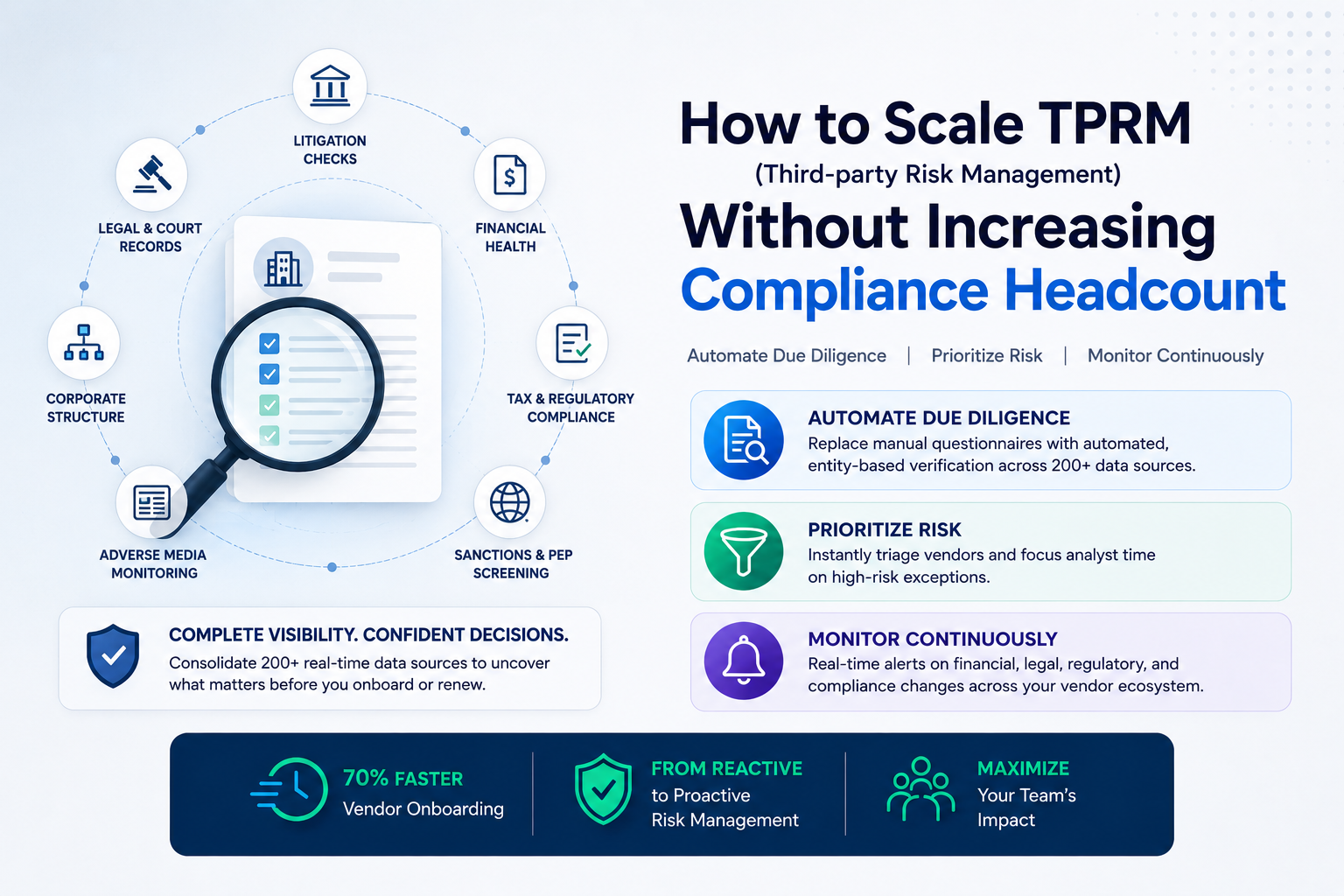
SignalX.ai addresses this by serving as an automated risk infrastructure. Instead of requiring analysts to manually cross-reference corporate registries, court dockets, and financial data rooms, We instantly run multi-dimensional checks across more than 200 integrated data points.
With minimal core entity inputs, the platform automatically aggregates and analyzes litigation history, financial health metrics, tax compliance status, and global sanctions lists. This shifts the analyst’s role from a data collector to a strategic data validator.
Still Chasing Documents to Understand Vendor Risk?
The strongest TPRM programs don’t spend weeks collecting information. They start with verified intelligence and focus analyst time where risk actually exists.
2. Resource Allocation: Transitioning to Automated Risk Tiering
The Challenge: Treating All Vendors Equally
A common operational failure is applying uniform, deep-dive due diligence to every vendor in the pipeline. Treating a low-risk marketing agency with the same scrutiny as a core cloud infrastructure provider creates massive backlogs, burning out existing staff on low-impact reviews.
The Solution: Triaging via Instant Intelligence
Scaling efficiently requires an objective, automated triaging mechanism to isolate high-risk entities immediately.
Organizations utilize SignalX to execute programmatic segmentation during onboarding. For standard evaluations, teams leverage SignalX Risk360 reports to generate a reliable, objective snapshot of a vendor’s financial stability and corporate credibility within minutes.
[Vendor Onboarding Request]
          │
          ▼
[SignalX Risk360 Automated Scan]
          │
          ├──► (No Flags) ──► Fast-Track Approval
          │
          └──► (Red Flags: Litigation/Tax Defaults) ──► Route to Analyst for Deep-Dive
By automating this initial screening, low-risk vendors clear the pipeline instantly, allowing the existing compliance team to dedicate 100% of their specialized attention to genuine anomalies.
| Traditional Triaging Model | Scaled Model (Powered by SignalX) |
| Manual, uniform due diligence applied across all tiers. | Instant, automated tiering based on live data signals. |
| Weeks spent waiting on background checks and responses. | Risk360 reports generated asynchronously in minutes. |
| Scale is strictly bound to analyst headcount. | Scale is decoupled from headcount via automated workflows. |
3. Risk Mitigation: Eliminating the “Point-in-Time” Blindspot
The Challenge: Decay of Periodic Assessments
A vendor vetted and approved in January can experience severe financial distress, regulatory scrutiny, or material litigation by June. Traditional TPRM models rely on annual or biennial reassessments, leaving organizations exposed to silent, unmonitored risk vectors for months at a time.
The Solution: Continuous Risk Monitoring
Manually tracking hundreds of active vendors for continuous regulatory, financial, or legal shifts is structurally impossible for a lean compliance team.
The solution lies in continuous, early-warning automation. By deploying SignalX’s Risk Terminal, companies establish real-time monitoring across their critical vendor portfolios.
Instead of waiting for the next audit cycle, SignalX constantly monitors live data feeds for adverse media, tax defaults, corporate structural shifts, and legal filings. If a material risk event occurs, the platform filters out the noise and delivers an immediate, actionable alert to the risk team.
Risk Doesn’t Wait For Your Next Review Cycle.
A vendor’s risk profile can change overnight. Stay ahead of litigation, financial distress, regulatory actions, and compliance failures with continuous monitoring.
Executive Summary: Achieving Operational Leverage
Scaling a modern TPRM program is an infrastructure and workflow optimization challenge, not a headcount deficit. By shifting away from administrative document collection and adopting an intelligence-first framework powered by SignalX.ai, risk teams can expect:
-
A 70% reduction in vendor onboarding cycles.
-
Transition from reactive, periodic checks to continuous, 24/7 visibility.
-
Maximizing existing human capital, moving analysts away from data aggregation and into high-value risk mitigation and decision-making.