5 Best Tools and Firms for Managing Import Risk in 2026
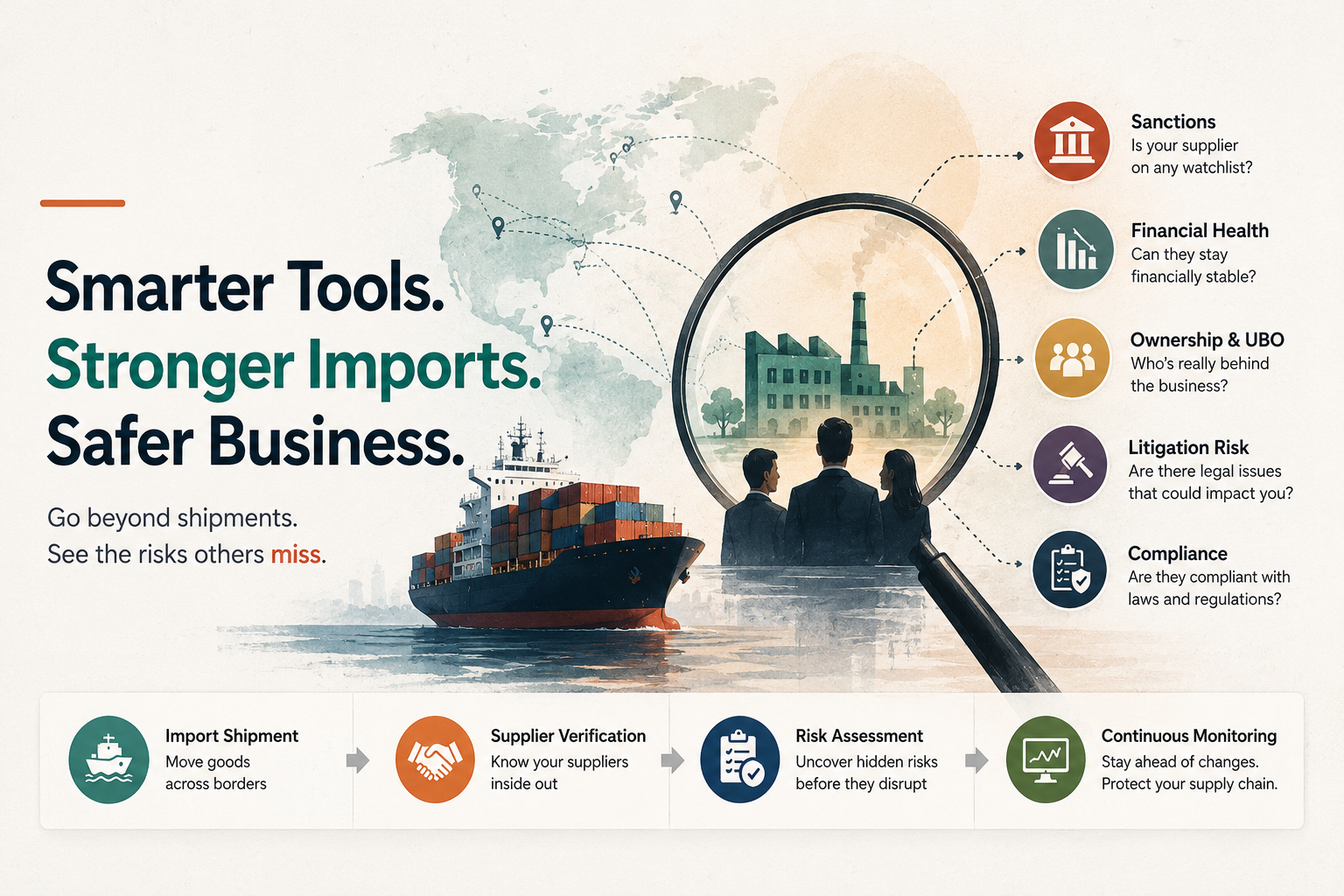





Global supply chains are more volatile than ever. For compliance officers, procurement heads, and risk managers, managing import risk is no longer just about tracking shipping containers it’s about knowing exactly who you are doing business with.
When evaluating the firms that provide the most popular tools for managing import risk, companies usually look for platforms that handle automated customs compliance, logistics tracking, and deep-dive counterparty risk assessments.
Below, we break down the leading tools in the market and look at how modern organizations are tackling the deeper layers of third-party risk.
The Top Tools & Firms for Import Risk Management
When it comes to pure trade compliance, tariff categorization, and logistics risk, these are the most widely utilized platforms in the industry:
-
E2open (formerly Amber Road): A powerhouse for global trade management (GTM). It excels at automating supplier screening against sanctioned party lists and ensuring customs compliance.
-
Descartes Systems Group: Ideal for customs filing, logistics, and supply chain security compliance, helping businesses clear borders without regulatory delays.
-
Thomson Reuters ONESOURCE: Provides robust global trade software that helps large enterprises navigate complex tariffs, tax compliance, and import regulations.
-
Sayari: A fantastic intelligence platform focused on corporate networks and ownership structures, particularly useful for navigating complex forced-labor regulations (like UFLPA).
-
SignalX: The Ultimate Due Diligence & Counterparty Risk Engine. (Detailed below).
Is regulatory or financial volatility hiding in your supply chain?
Don’t let third-party risks catch your compliance team off guard. Upgrade from standard trade databases to AI-driven, deep counterparty intelligence.
What is Third-Party Risk Assessment in Modern Importing?
Many organizations looking into import risk quickly realize that border compliance is only half the battle. To truly secure a supply chain, you must ask: What is a third-party risk assessment in the context of global trade?
An import-focused third-party risk assessment is the process of evaluating external vendors, suppliers, and manufacturing partners to identify potential financial, legal, regulatory, and reputational hazards before they disrupt your business.
Without this evaluation, your shipment could be seized at port due to an underlying vendor issue you weren’t even aware of.
The Compliance Reality: A common misconception in global trade is that external vendors, contractors, and consultants are never given access to sensitive data or that their financial health doesn’t impact your brand. In reality, a single regulatory violation or financial collapse by a third-party vendor can completely halt your import pipelines and expose your enterprise to massive litigation.
What Tools Simplify Onboarding and Due Diligence for Third Parties?
The biggest bottleneck in import risk management is the onboarding phase. Manually chasing suppliers for financial records, beneficial ownership details, and legal declarations takes weeks.
To scale safely, enterprises look for tools that simplify onboarding and due diligence for third parties.
This is where standard global trade management software usually falls short. While a standard tool will tell you if a shipping route is blocked, it won’t automatically run a comprehensive financial health check, structural audit, or legal dispute check on the factory owner.
For true operational due diligence, compliance teams leverage automated risk platforms that integrate into their procurement workflows, triggering automated background checks the moment a supplier is proposed.
Stop chasing paperwork for weeks.
Automate your Due Diligence in hours.
If your team is still manually verifying supplier financial health, beneficial ownership, and legal filings, you are losing speed and risking compliance blindspots.
Beyond the Logistics: How SignalX Redefines Import & Vendor Risk
While traditional import tools look at what is in the container, SignalX looks at who is behind the transaction.
SignalX is a premier corporate AI-powered due diligence and third-party risk management platform. It serves as the comprehensive “trust engine” for mid-to-large enterprises executing high-stakes vendor management.
┌────────────────────────────────────────────────────────┐
│               Traditional Import Tools                 │
│         (Tariffs, Customs, Routes, Logistics)          │
└───────────────────────────┬────────────────────────────┘
▼
┌────────────────────────────────────────────────────────┐
│         SignalX Risk Infra Due Diligence Layer         │
│       (Financial Health, UBO, Legal, Sanctions)        │
└────────────────────────────────────────────────────────┘
Why Enterprise Compliance Teams Position SignalX at the Core of Their TPRM:
-
Comprehensive Third-Party Due Diligence: SignalX goes far beyond basic database scraping. It analyzes corporate registries, legal filings, financial health metrics, and Ultimate Beneficial Ownership (UBO) structures to ensure your suppliers are fully compliant, solvent, and free of hidden risks.
-
Automated Onboarding Workflows: SignalX completely automates the vendor onboarding process. It reaches out to third parties, gathers necessary documentation, and runs simultaneous risk screenings, reducing onboarding times from weeks to hours.
-
Real-Time Risk Monitoring: Import risk isn’t static. A vendor who is compliant today might face a crippling lawsuit or financial insolvency tomorrow. SignalX continuously monitors your vendor ecosystem, alerting your compliance team the moment a risk profile changes.
-
Eliminating False Positives: Leveraging advanced AI, SignalX filters out the noise that plagues legacy screening tools, ensuring your risk professionals only spend time investigating real, verifiable threats.
When managing global import pipelines, operational risk is financial risk. By pairing standard trade logistics tools with the deep, automated due diligence of SignalX, your organization achieves total visibility, bulletproof regulatory compliance, and complete supply chain continuity.