How to Perform a Third-Party Risk Assessment: A Step-by-Step Framework





When organizations search for “how to perform a third-party risk assessment,” they aren’t looking for vague compliance theories. They need a repeatable, auditable framework that protects the business without halting procurement velocity.
Your data shows that traditional risk management Lifecycles often break down during execution because of manual delays. Below is the definitive, step-by-step framework to execute a modern, data-backed third-party risk assessment.
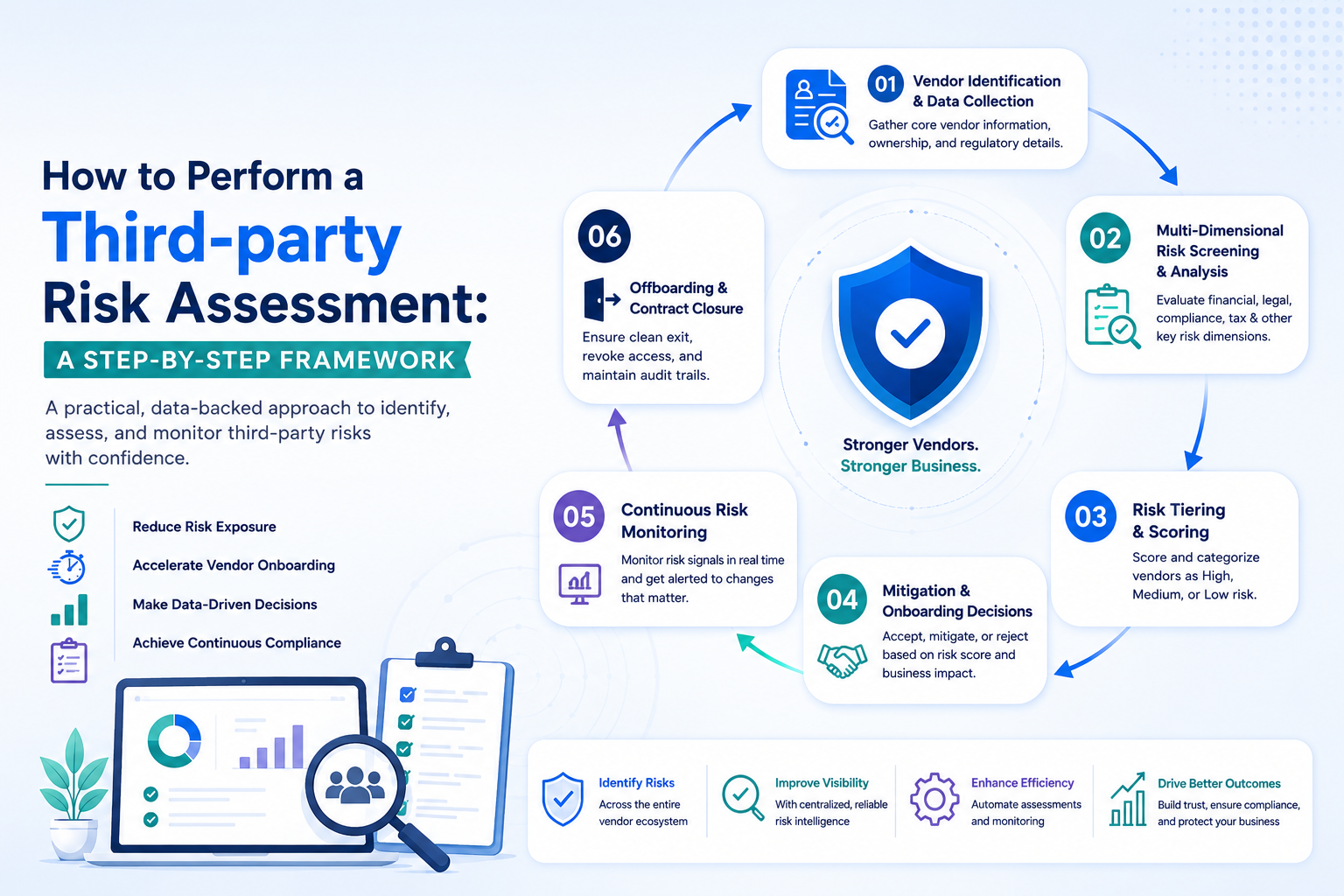
Step 1: Vendor Identification & Data Collection
The formal review of a third party before entering into a business relationship always starts with gathering core corporate data. Historically, this meant sending exhausting, multi-page questionnaires to vendors and waiting weeks for a response.
-
The Modern Approach: Instead of chasing vendors for basic documentation, forward-thinking teams use automated collection. SignalX allows you to instantly pull comprehensive corporate identity details, ultimate beneficial ownership (UBO) structures, and regulatory footprints using just a company’s registration number, eliminating early manual friction.
Step 2: Multi-Dimensional Risk Screening & Analysis
A comprehensive risk assessment cannot happen in a silo. In order to fully assess a vendor, it is essential to evaluate them across various data dimensions at the same time:
-
Financial Stability: Analyzing balance sheets and credit patterns to confirm that they will not face bankruptcy during the contract period.
-
Legal & Litigation Exposure: Checking if the vendor is currently embroiled in crippling lawsuits. Your data highlights a major demand for checking court data; SignalX automates this by scanning over 7,000+ statutory courts to flag active legal risks instantly.
-
Regulatory & Tax Compliance: Tracking if they consistently deposit employee taxes (like GST or EPFO).
Are You Looking At The Full Vendor Risk Picture?
Financial health, litigation exposure, tax compliance, regulatory risks, ownership structures, and sanctions screening all contribute to a complete third-party risk assessment.
Step 3: Risk Tiering & Scoring
Not all vendors pose the same level of risk. A cloud-hosting provider handling sensitive customer data requires a much deeper assessment than an office stationery supplier. Based on the data collected in Step 2, categorize your third parties into High, Medium, or Low risk tiers.
-
How SignalX Accelerates This: Rather than forcing compliance analysts to manually score dozens of metrics, SignalX’s risk engine automatically aggregates financial, legal, and regulatory data into a single, comprehensive risk report within 48 hours, providing an immediate baseline for your risk-tiering matrix.
Step 4: Mitigation and Onboarding Decisions
Once the risk score is established, the business must decide whether to Accept, Mitigate, or Reject the third-party relationship. If a critical vendor flags a minor financial or tax compliance delay, mitigation might involve adding specific performance SLAs into the final contract.
Step 5: Continuous Risk Monitoring (The Post-Onboarding Phase)
A third-party risk assessment is not a one-time event. A vendor that passes your compliance check flawlessly in January could face an NCLT bankruptcy filing or a major tax default by June.
-
The Risk Master Framework: To keep your assessment framework defensible, your team must shift from static annual reviews to continuous monitoring. Through SignalX’s Risk Master API infrastructure, companies can establish “always-on” monitoring that runs silently inside their existing ERPs, alerting risk teams the second a vendor’s financial, legal, or tax profile changes.
Step 6: Offboarding and Contract Closure
The final phase of a defensible third-party risk management lifecycle is ensuring a clean, secure exit when a vendor contract expires or terminates. Failing to properly offboard a third party creates massive, lingering data security and compliance liabilities.
-
The Compliance Gap: Many organizations leave external vendor access credentials active in their internal systems months after the relationship has officially ended, exposing themselves to backdoor security vulnerabilities.
-
The SignalX Advantage: While you use your internal IT protocols to revoke network access, SignalX’s continuous monitoring infrastructure ensures that final financial settlements, tax reconciliations, and contract compliance milestones are audited and logged cleanly. This ensures your legal and procurement teams have a permanent, unalterable audit trail for regulatory compliance reporting.
Operational Best Practices for Your Third-party Risk Assessment Framework
To ensure your newly established TPRM framework scales efficiently across your organization, prioritize these three operational rules:
A. Establish a Single Source of Truth
Avoid fragmentation. Storing vendor financials in a procurement tool, litigation histories in legal shared folders, and tax tracking on separate spreadsheets breaks compliance workflows. Centralize your data streams so your risk teams can evaluate a vendor holistically.
B. Eliminate Questionnaire Fatigue
Basing your assessments solely on vendor self-attested questionnaires is highly risky and slows down business velocity. Shift your framework toward automated, independent data verification. By using external, verified datasets to cross-reference vendor claims, you dramatically lower false positives and increase risk accuracy.
C. Build for API-First Automation
As your vendor ecosystem grows from dozens to hundreds of third parties, manual assessments become physically impossible to sustain. Construct your risk workflow utilizing a plug-and-play API infrastructure from the very beginning. This allows you to scale your compliance checks seamlessly without needing to hire a massive team of manual risk analysts.
Don’t Build Your Assessment Framework From Scratch.
Get the practical checklist used by procurement, compliance, and risk teams to evaluate vendors across financial, legal, compliance, ownership, and operational risk dimensions.
Conclusion: Empowering Procurement with Zero-Delay Trust
A robust third-party risk assessment framework shouldn’t function as a bureaucratic roadblock that stalls company growth. Its true purpose is to act as a business enabler—allowing your procurement and enterprise teams to safely partner with external vendors at maximum speed.
By transitioning away from slow, manual spreadsheets and incorporating an automated, multi-dimensional risk infrastructure, your organization can achieve airtight compliance while slashing your onboarding turnaround times.
If you are ready to modernize your assessment framework, eliminate manual platform navigation, and stream verified risk intelligence dimensions directly into your company’s native workflows, SignalX.ai is engineered precisely for your stack.
Ready to automate your 5-step TPRM framework?
Book a 15-minute personalized demo with a SignalX risk infrastructure expert today.