Beyond the Forms: Why Your Vendor Onboarding Software Needs Automated Risk Intelligence





When organizations shop for vendor onboarding software, they are usually looking for a digital doorway. They want an elegant, automated pipeline where a vendor can type in their corporate details, upload their tax registrations, and sign an NDA.
For a long time, this was considered the gold standard of onboarding. It moved teams away from messy email chains and into structured, central databases.
But there is a dangerous misconception anchoring this approach: the belief that gathering data is the same thing as mitigating risk.
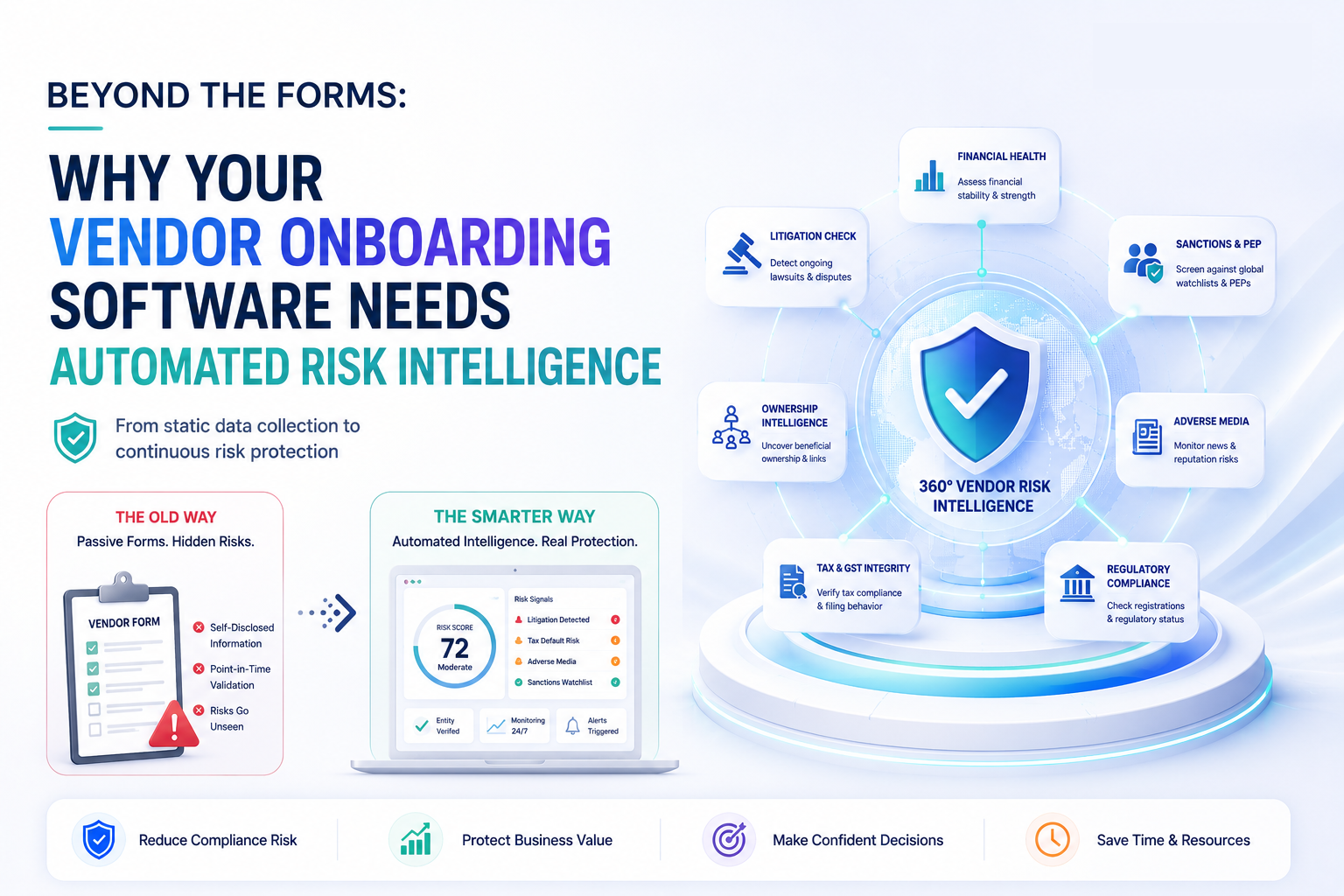
In an increasingly complex and heavily audited corporate environment, passive data collection is no longer a shield against compliance risk. If your vendor onboarding software simply acts as a digital filing cabinet for self-disclosed PDFs, your organization is exposed to severe compliance vulnerabilities. True risk reduction requires shifting from static form collection to automated Risk Infrastructure.
The Illusion of Safety: Why Passive Forms Fail Compliance
Traditional vendor onboarding platforms treat compliance as a “hygiene check.”
They ask: Did the vendor provide a valid tax ID? Is their corporate registration active?
While these checks are necessary, they only verify that the vendor legally exists at the exact minute they filled out the form. They fail to catch hidden, dynamic risks that a vendor will never self-report:
- The Litigious Overlook: A vendor might upload a valid corporate registry document, but they won’t tell you they are currently facing an active multi-crore fraud lawsuit in a regional district court.
- The Tax Integrity Loophole: A supplier can present a clean GSTIN registration certificate, yet have a systematic history of defaulting on monthly tax filings. If they default after you onboard them, your finance team loses its Input Tax Credit (ITC), directly impacting your bottom line.
- The Regulatory Blind Spot: New privacy frameworks, such as India’s Digital Personal Data Protection Act (DPDPA), place strict accountability on how your third-party processors handle information. A simple checkbox agreement on a form does not verify if their corporate promoters or connected networks are on a global sanctions watchlist.
To address this gap, organizations are revamping their onboarding processes by integrating them with a sophisticated risk infrastructure layer.
What Risk Would Your Current Onboarding Process Miss Today?
Enter the Risk Infrastructure: Upgrading Onboarding with SignalX
Mitigating compliance risk shouldn’t happen after a vendor is onboarded, nor should it slow down the business. It must be built directly into the fabric of your procurement architecture.
SignalX provides the comprehensive Risk Infrastructure that transforms the vendor lifecycle from a manual administrative task into an automated, forensic defense mechanism. Depending on how your organization scales, this risk layer can be deployed across three distinct operational frameworks:
[ SIGNALX RISK INFRASTRUCTURE ]
|
+—————————–+—————————–+
[ 1. Risk360 Reports ] [ 2. TPRM Platform ] [ 3. RT Data APIs ]
On-Demand Due Diligence Continuous Portfolio Monitoring Raw Risk Datablocks for
& Audit-Ready Dossiers & Evolving Threat Alerts Custom Enterprise Ingestion
1. Risk360: Moving from Checklists to Enhanced Due Diligence
When onboarding a critical vendor, a software provider, or a high-value supplier, you cannot afford to guess.
SignalX Risk360 serves as the ultimate analytical layer for deep-dive validation. Rather than relying on manual, weeks-long background investigations, Risk360 compiles an on-demand, comprehensive due diligence report in days rather than weeks.
By analyzing 26+ critical risk parameters, it scans financial viability, promoter backgrounds, adverse media, and regulatory watchlists, delivering an audit-ready risk scorecard. It ensures that before a contract is generated, a forensic eye has already cleared the relationship.
2. SignalX TPRM: Shifting from Onboarding to Continuous Ecosystem Monitoring
Compliance risk is not a one-time hurdle; it is a moving target. A vendor who enters your ecosystem completely clean on January 1st could face insolvency, severe litigation, or international sanctions by June.
The SignalX Third-Party Risk Management (TPRM) platform extends the utility of your onboarding engine by providing continuous, always-on portfolio visibility. It aggregates fragmented risk signals from thousands of external databases in real time. The moment an active vendor experiences a negative regulatory deviation, an ownership structure shift, or an adverse media event, the platform alerts your governance team automatically allowing you to contain threats before they disrupt your supply chain.
3. SignalX RT (Risk Terminal) APIs: Building Block Datablocks for Custom Workflows
For high-volume enterprises, marketplaces, and financial tech institutions, using a standalone dashboard isn’t always efficient. They need risk intelligence embedded natively within their existing internal apps, proprietary software, or core ERP systems.
This is where SignalX functions strictly as an infrastructure provider through Risk Terminal APIs.
Instead of forcing you to change your workflow, SignalX provides raw, programmatic access to verified corporate data. Developers can pull specific, highly targeted JSON datablocks to automate instantaneous decision-making at the point of onboarding:
- AML & KYB Verification API: Quickly evaluates entities by cross-referencing them with international PEP lists, sanctions, and law enforcement databases.
- Litigation & Court Records API: Automatically searches through over 7,000 Indian courts and tribunals to identify ongoing legal disputes.
- Financial & Tax Hygiene API: Systematically retrieves organized balance sheets, financial ratios, and the integrity of historical GST filings directly into your internal credit or risk assessment systems.
Which Risk Infrastructure Model Fits Your Organization?
Whether you need enhanced due diligence, continuous vendor monitoring, or risk intelligence embedded directly into your internal systems, discover the framework best suited to your risk maturity and operational scale.
Setting a New Corporate Standard
| Onboarding via Form Automation | Onboarding via SignalX Risk Infrastructure |
| Captures self-disclosed documents. | Cross-references data against 100M+ independent public points. |
| Treats compliance as a static snapshot. | Ensures continuous, real-time monitoring post-onboarding. |
| Requires manual compliance review. | Automates forensic audits via AI-native risk scoring. |
| Creates decentralized data silos. | Unifies financial, legal, and reputational risk into one layer. |
The Executive Imperative: Own the Infrastructure
Relying purely on a basic user interface to onboard vendors is a systemic vulnerability. To truly insulate your enterprise from legal disputes, data breaches, and financial fraud, you must look beyond the forms.
By embedding an end-to-end risk infrastructure, companies gain the speed of modern workflow automation combined with the precision of deep forensic vetting. Whether you consume this intelligence through standalone Risk360 reports, manage it via a comprehensive TPRM workflow, or stream raw parameters directly through RT APIs, establishing a robust risk infrastructure is the only definitive way to turn compliance from an operational bottleneck into a competitive advantage.
Ready to transition your vendor ecosystem from passive tracking to active defense? Explore how SignalX builds the infrastructure for continuous entity intelligence.