Future of Third-Party Risk Management(TPRM): How AI Is Redefining Vendor Risk Management




For years, Third-Party Risk Management(TPRM) has been treated as a compliance exercise.
I’ve seen organizations spend weeks sending questionnaires, chasing vendors for responses, reviewing documents manually, and updating spreadsheets that become outdated almost as soon as they are completed. The process checks a box, but it rarely provides a real-time understanding of risk.
The problem is simple: risk doesn’t operate on an annual review cycle.
A vendor can experience a regulatory action, data breach, financial decline, executive misconduct issue, or adverse media event tomorrow. Yet many organizations won’t discover it until the next scheduled assessment.
This is exactly why I believe we are entering a new era of Third-party Risk Management(TPRM) one where Artificial Intelligence and Risk Intelligence fundamentally change how organizations understand and manage third-party risk.
The Traditional TPRM Model Is Reaching Its Limits
Most TPRM programs were built around a workflow that looks something like this:
- Onboard a vendor
- Send a questionnaire
- Review documentation
- Assign a risk score
- Reassess annually
While this approach has served organizations for years, it was designed for a business environment where vendor ecosystems were smaller and risks evolved more slowly.
Today, organizations rely on hundreds, sometimes thousands, of third parties across technology, operations, supply chains, finance, customer support, and critical business functions.
The challenge is no longer collecting information.
The challenge is identifying which information actually matters and detecting risk before it becomes a business problem.
This is where AI begins to change the conversation.
Can Your TPRM Program Detect a Critical Vendor Risk Before Your Next Annual Review?
If the answer is uncertain, it may be time to rethink how risk intelligence is operationalized across your vendor ecosystem.
AI is Moving TPRM Towards Intelligence from Assessment
One of the biggest misconceptions about AI in TPRM is that it simply automates questionnaires.
While automation certainly helps, the real value of AI is its ability to transform raw data into actionable intelligence.
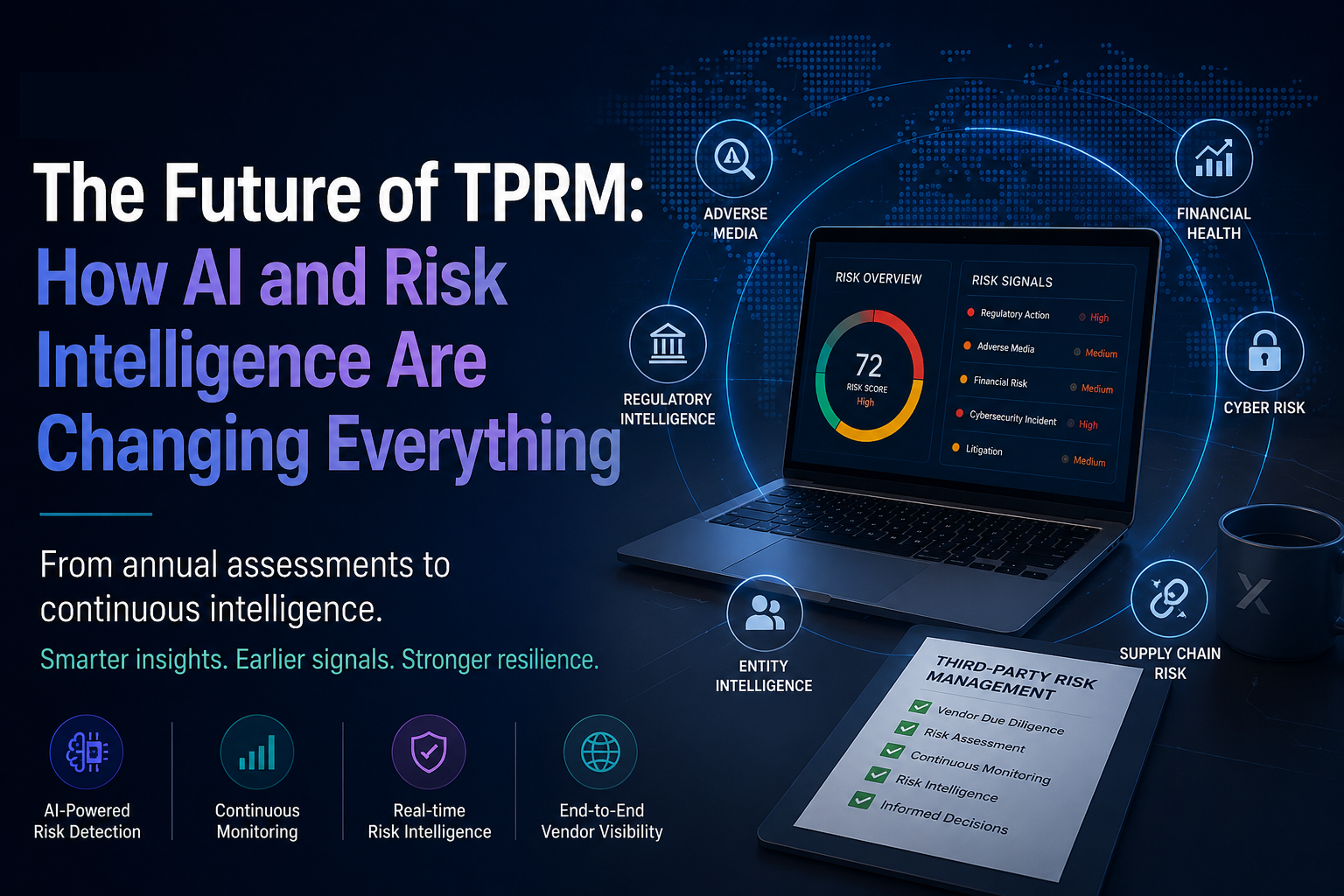
Instead of relying solely on vendor-provided information, modern AI systems can continuously analyze external and internal risk signals, including:
- Regulatory actions
- Litigation records
- Adverse media coverage
- Ownership changes
- Financial indicators
- Sanctions and watchlists
- Cybersecurity incidents
- ESG-related controversies
- Supply chain disruptions
The result is a shift from static assessments to dynamic risk visibility.
Organizations no longer need to ask, “What did we know about this vendor six months ago?”
They can start checking, “What details / risk do we know about this vendor right now?”
The Rise of Continuous Risk Monitoring
In my view, continuous risk monitoring will become the defining characteristic of next-generation TPRM programs.
The future of vendor risk management is not about collecting more questionnaires. It is about continuously monitoring risk signals and understanding when something changes.
A vendor that appeared low-risk during onboarding may become high-risk six months later due to:
- Financial distress
- Regulatory investigations
- Executive misconduct
- Negative media exposure
- Supply chain disruptions
- Cybersecurity incidents
Without continuous monitoring, these developments often go unnoticed until they create operational, compliance, or reputational consequences.
AI enables organizations to move from periodic reviews to continuous awareness.
And that shift is far more important than simply automating existing processes.
Why Risk Intelligence Is Becoming a Strategic Advantage
One of the most important developments in the TPRM market is the growing role of Risk Intelligence.
Historically, organizations have relied heavily on information directly provided by vendors. While vendor disclosures remain important, they represent only one piece of the risk picture.
Risk Intelligence expands that view by incorporating external signals that help organizations understand what may not be disclosed during an assessment.
This is where platforms like SignalX are helping reshape the conversation.
Rather than treating TPRM as a questionnaire management exercise, SignalX approaches the problem through a risk intelligence lens combining due diligence, adverse media monitoring, regulatory intelligence, entity intelligence, and continuous monitoring to provide a more comprehensive view of third-party risk.
What I find particularly compelling about this approach is that it addresses a question many risk leaders are increasingly asking:
“How can we recognize risks that vendors might not reveal themselves?”
That question sits at the heart of modern TPRM.
What Risks Are Hiding Beyond Your Vendor Questionnaires?
See how leading organizations uncover hidden legal, reputational, financial, and compliance risks that traditional assessments often miss.
AI Will Transform Vendor Due Diligence
Vendor due diligence has traditionally been resource-intensive.
Teams spend countless hours reviewing documentation, validating information, conducting background checks, and assessing risk exposure.
AI is changing this process dramatically.
Instead of manually reviewing large volumes of information, organizations can use AI to:
- Analyze vendor documentation
- Detect inconsistencies
- Identify emerging risk indicators
- Surface relevant regulatory developments
- Monitor adverse media in real time
- Generate contextual risk summaries
This allows risk professionals to focus on decision-making rather than information gathering.
The objective is not to replace human judgment.
The objective is to augment it.
The Next Evolution: Predictive Risk Management
Today, most TPRM programs focus on identifying current risk.
Tomorrow’s programs will focus on predicting future risk.
As AI models become more sophisticated, organizations will increasingly be able to identify patterns associated with:
- Vendor failure
- Regulatory action
- Financial instability
- Reputational events
- Operational disruptions
The shift from detection to prediction may become one of the most significant transformations in the history of third-party risk management.
Organizations that can anticipate risk will have a meaningful advantage over those that simply react to it.
What Risk Leaders Should Be Doing Today
The future of TPRM is not about implementing AI for the sake of innovation.
It is about building a more effective risk management capability.
I believe risk leaders should focus on four priorities:
- Move beyond annual assessments.
- Establish continuous monitoring capabilities.
- Incorporate external risk intelligence into decision-making.
- Examine the ways in which artificial intelligence can streamline low-value administrative duties while improving risk awareness.
The organizations that embrace these principles will be better positioned to manage increasingly complex third-party ecosystems.
Which Side of the Risk Curve Is Your Organization On?
Final Thoughts
The future of TPRM will not be defined by better questionnaires.
It will be defined by better intelligence.
As vendor ecosystems continue to expand, organizations need more than compliance workflows and periodic assessments. They need real-time visibility, continuous monitoring, and actionable insights that help them understand risk as it evolves.
Artificial Intelligence is making that possible.
The most successful organizations over the next decade will be those that combine AI, continuous monitoring, and risk intelligence to create a proactive approach to third-party risk management.
The question is no longer whether AI will impact TPRM.
The question is which organizations will leverage it first to build a smarter, more resilient, and intelligence-driven risk management program.