Why Basic Screening Fails and How Enhanced Due Diligence for Vendors Protects the Supply Chain





I’ve spent years navigating the corporate compliance and procurement ecosystem, and if there’s one reality that keeps chief risk officers awake at night, it’s the illusion of safety.
Every enterprise leader has a variation of this story: Your procurement team brings in a critical, high-volume strategic vendor. They run the standard corporate compliance checklist PAN is verified, the GSTIN is active, and the Ministry of Corporate Affairs (MCA) portal shows the company status as a pristine, green “Active.”
You sign the contract, roll out a substantial advance payment, and tie your quarter’s production timelines to their deliverables. Then, three months later, the floor drops out.
You find out the company’s promoter is fighting a massive asset-siphoning case in a regional state court. Or worse, an early-stage insolvency petition was quietly admitted against them in the NCLT. A sudden injunction hits, their operational bank accounts are frozen, and your production line grinds to an absolute halt.
When things blow up, the question from the board is always the same: “Did we run due diligence on these guys?”
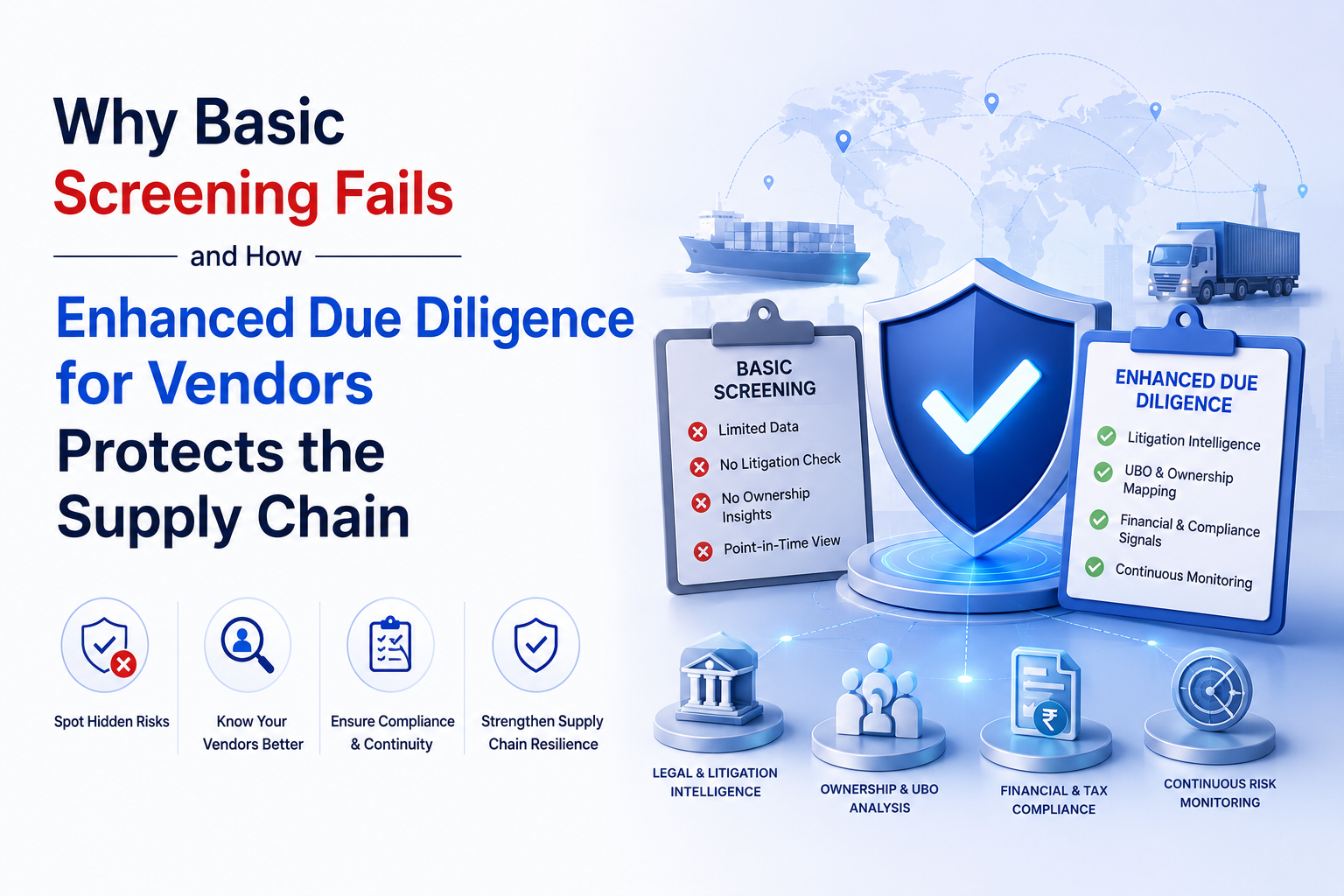
You did. But you ran basic identity verification, not comprehensive risk mitigation. The hard truth we must accept is that standard screening is broken, and executing a strategy of enhanced due diligence for vendors is the only way to protect complex corporate supply chains.
The Structural Failure of the “Check-the-Box” KYC Model
When we rely strictly on automated, “check-the-box” KYC portals instead of deep enhanced due diligence for vendors, we aren’t actually looking at risk we are looking at registrations. Fragmented data architectures create major operational blind spots that point-in-time checks miss entirely.
To contextualize how severe these blind spots are, consider this comparative lookup matrix based on data profiles commonly found in mid-to-high risk enterprise vendor databases:
The Compliance Intelligence Gap
| Risk Parameter | Standard KYC Verification | Enhanced Due Diligence (EDD) Infrastructure |
| MCA / Registry Status | Confirms “Active” status and date of incorporation. | Scans 10+ historical filing delays to identify operational stagnation. |
| Litigation Risk | Zero visibility (Does not check judicial records). | Scrubs 7,000+ courts to isolate active NCLT, CBI, or civil suits. |
| Tax Discipline | Verifies active GSTIN registration. | Analyzes GSTR-3B compliance history to predict Input Tax Credit (ITC) default risk. |
| Ownership Integrity | Lists current registered directors only. | Maps out Ultimate Beneficial Ownership (UBO) to uncover hidden shell networks. |
1. The Regional Litigation Echo Chamber
India’s legal system doesn’t live on a single, clean dashboard. It spans over 7,000 central, state, and district courts, alongside specialized tribunals like the National Company Law Tribunal (NCLT), National Green Tribunal (NGT), and Real Estate Regulatory Authority (RERA).
A vendor can be locked in an existential legal battle or commercial dispute in a regional district court without it ever reflecting on their main corporate profile or generic web searches. If your screening system isn’t actively digging into unstructured court records, you are flying completely blind.
2. Complex Promoter & Cross-Directorship Webs
Bad actors rarely operate under a single, easily traceable entity. They use multi-layered corporate structures, holding companies, and cross-directorships to mask liabilities.
Standard checks validate the immediate company name but completely miss whether the promoters or ultimate beneficial owners (UBO) are deeply tied to historically defaulted entities, shell networks, or active regulatory sanctions.
3. The Silent Signals of Financial Distress
A company doesn’t go bankrupt overnight. The warning signs appear months in advance: delayed provident fund (EPFO) deposits, irregular tax filings, or minor labor disputes. These compliance deviations are the earliest indicators of an impending operational collapse, yet they are rarely captured in standard credit reports or annual MCA balance sheet reviews.
The Solution: Transitioning to an Automated 27+ Parameter Risk Infrastructure
To scale a modern enterprise, we have to move away from point-in-time “checks” and shift to an automated system of record. At SignalX, we solved this friction by architecting a unified data and intelligence layer that aggregates disparate data points into an audit-ready, 26-parameter risk framework. This allows teams to execute enhanced due diligence for vendors seamlessly across four critical pillars:
[Procurement ERP System] ──(Asynchronous Bulk API)──> [SignalX Engine]
                                         │
                     ┌───────────────────┬──────────────────┴──────────────────┐
                     ▼                   ▼                                     ▼
             [Sovereign Portals]      [Judicial Registries]      [Risk Scoring Engine]
              MCA21, GSTN, EPFO             7,000+ Indian Courts       26-Parameter Matrix Matrix
1. Multi-Tribunal Litigation Scraping
Our platform utilizes specialized Natural Language Processing (NLP) models to continuously scrub court logs across thousands of Indian tribunals. The AI automatically filters out routine commercial noise and isolates high-stakes lawsuits, criminal filings, and active insolvency petitions that threaten business continuity.
2. Direct Tax & Regulatory Discipline
For enterprises operating in India, a vendor’s tax discipline directly impacts your cash flow. If a supplier fails to file their GSTIN returns correctly, Input Tax Credit (ITC) is immediately effected. SignalX maintains direct, secure API gateways to sovereign registries, flagging compliance lapses the moment they occur.
3. Promoter Networks & Ultimate Beneficial Ownership (UBO)
Advanced risk engines use automated entity link analysis to map out the entire corporate graph. This instantly uncovers if a ultimate beneficial owners or vendor’s directors are somehow connected to blacklisted companies, politically exposed persons (PEPs), or active regulatory sanctions.
4. Continuous Financial Quality Analytics
Instead of analyzing balance sheets from the previous financial year, our platform tracks dynamic health indicators. It evaluates liquidity ratios, activity efficiency, and credit defaults before they lead to sudden supplier failure.
| Download Risk360 Sample Report → |
The Enterprise Playbook: When to Trigger a Enhanced Deep Dive
Let’s be realistic: you don’t need to run an exhaustive forensic investigation on every vendor supplying printer paper or office coffee. That is where our low-latency, automated Insta-verify APIs keep your daily procurement database clean.
However, when a vendor crosses specific operational thresholds, your risk playbook must scale from basic KYC to rigorous enhanced due diligence for vendors.
We structure this routing policy across three distinct tier levels based on transactional criticality:
[Vendor Onboarding Request]
│
┌─────────────────────────────┼─────────────────────────────┐
▼                             ▼                             ▼
     [Tier 3: Low Risk/Spend]     [Tier 2: Mid Risk/SaaS]      [Tier 1: High Risk/Strategic]
     Operational Procurement       Handles Proprietary Data      Top 15% Annual Spend Vendor
│                             │                             │
▼                             ▼                             ▼
      Insta-Verify API                SignalX API Scrub                  Risk360 Deep Diagnostic
      (Instant Verification)         (Continuous Tracking)             (Full Enhanced Due Diligence)
In our workflow, we recommend triggering an enhanced diagnostic review the SignalX Risk360 Report whenever a counterparty falls into these high-stakes categories:
-
High-Value Procurement: Any supplier representing the top 15% of your annual procurement spend or single-source dependency.
-
Critical Infrastructure Access: Any vendor integrating directly with your internal IT systems, processing customer data, or managing proprietary intellectual property.
-
Strategic Joint Ventures & Mergers: Before executing partnerships where their reputational or regulatory risks directly impact your brand equity.
By combining real-time infrastructure access with specialized AI processing, the Risk360 Report compresses what used to take weeks of manual legal and financial analysis into a comprehensive diagnostic window. You receive an exportable, audit-ready PDF featuring clear evidence trails to support your governance, risk, and internal compliance reviews.
Stop letting basic identity verification pass for true risk mitigation. By embedding enhanced due diligence for vendors directly into your corporate DNA, you protect your bottom line, satisfy internal auditors, and gain absolute confidence in who you are doing business with.
Protect your next major contract. Request a sample Risk360 Enhanced Due Diligence Report from our team today and bring complete clarity to your vendor ecosystem.