Supplier Risk Assessment vs Supplier Due Diligence: What’s the Difference?





If you are currently running procurement, compliance, or supply chain operations, you have likely encountered a significant amount of overlap in how teams discuss Supplier Due Diligence and Supplier Risk Assessment. In many corporate strategies, these terms are mistakenly bundled together as a single check-the-box administrative task.
However, treating them as identical processes introduces a massive blind spot into your supply chain. It is precisely how organizations onboard vendors who look pristine on paper, only to suffer severe operational bottlenecks, regulatory penalties, or sudden financial defaults six months down the line.
At SignalX, we work alongside risk, legal, and procurement teams every day. Let us break down exactly how these two processes differ, the structural problems present in traditional market solutions, and how you can unify both to build a bulletproof vendor ecosystem.
The Core Difference: Supplier Due Diligence vs. Supplier Risk Assessment
The most practical way to differentiate these two pillars of third-party risk management (TPRM) is by looking at their timing and their core objective.
-
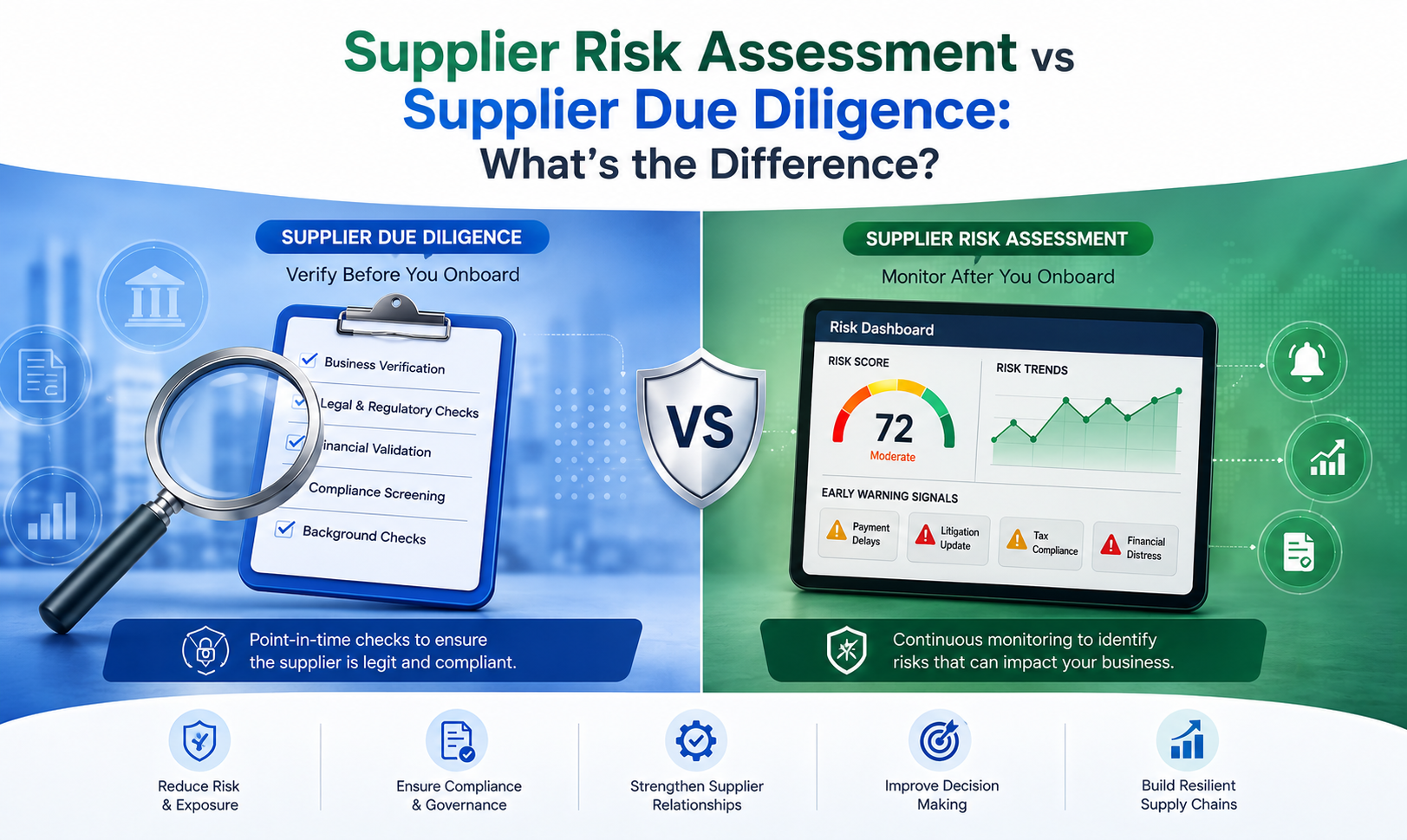
Supplier Due Diligence (The Gatekeeper): This is a point-in-time, binary validation that happens before you sign a contract. It acts as an entrance exam. The primary goal is verification: Is this entity legally registered? Are their financials legitimate? Are they compliant with market regulators? Are their promoters clear of major legal red flags? It is essentially a pass/fail gate.
-
Supplier Risk Assessment (The Watchtower): This is a continuous, context-specific evaluation that runs after onboarding throughout the entire lifecycle of the relationship. It analyzes the active probability and impact of a supplier failing. It shifts the question from “Is that a real company?” to “What happens to our specific manufacturing line, data safety, or daily revenue if this vendor fails to deliver?”
To visualize how these two functions operate across your vendor portfolio, consider their distinct data requirements:
| Dimension |
Supplier Due Diligence (Pre-Onboarding) |
Supplier Risk Assessment (Post-Onboarding) |
| Operational Goal | Verify legitimacy, identity, and legal compliance. | Analyze active threats to your specific business operations. |
| The Trigger | Onboarding a new vendor or major contract renewals. | Continuous monitoring; shifts in market or vendor performance. |
| Core Question | “Are they legally safe to establish a relationship with?” | “What is the operational impact on us if they experience distress?” |
| Primary Data Points | Statutory registries, MCA filings, sanction lists, court records. | Operational KPIs, ongoing litigation updates, dynamic tax compliance. |
Vendor Files Due Diligence Continuous Monitoring Predictive Intelligence
Where Does Your Supplier Risk Program Sit Today?
The Problem with Traditional Market Solutions
When companies attempt to execute these two processes today, they generally run into two distinct, broken workflows available in the market:
1. The “Self-Disclosure” Trap
Many traditional procurement teams rely on form automation. A vendor fills out a form, uploads their tax registration certificates, and signs an NDA.
-
The Flaw: This treats compliance as a passive, static snapshot. You are auditing a vendor based entirely on what they choose to disclose to you, leaving your business exposed to hidden, unverified financial liabilities or legal disputes.
2. The Global Platform Disconnect
To solve manual workflows, some enterprises deploy massive, global Western risk management software.
-
The Flaw: While these platforms plug into global broad-stroke credit registries, they completely miss hyper-localized risk data. They lack the native data pipes required to extract live, fragmented intelligence from regional corporate structures, district courts, or localized tax authorities rendering them ineffective for monitoring regional or domestic vendor networks.
How SignalX Rebuilds This Workflow for Your Benefit
We engineered SignalX.ai specifically to solve these gaps, transforming vendor risk management from a slow administrative burden into an automated, forensic shield for your business. Here is how our system works to actively protect your operations:
Step 1: Automated Enhanced Due Diligence
Instead of forcing your internal teams to manually hunt down records or wait weeks for traditional background checkers, SignalX connects directly to 200+ regulators, 7,000+ courts, and 30,000+ media sources.
-
How you benefit: When you drop a prospective vendor’s details into the platform, our AI extracts real-time public and regulatory points. It synthesizes this raw data into our proprietary 26-Parameter Risk Scorecard instantly grading their financial health, promoter background, legal liabilities, and compliance discipline. You onboard faster, with verified trust, without draining your team’s administrative hours.
Step 2: Shifting Seamlessly to Continuous Risk Assessment
A vendor who passes due diligence flawlessly on January 1st can experience severe financial or legal distress by June. SignalX extends your onboarding defense into an always-on watchtower.
-
How you benefit: Our platform continuously monitors your active vendor portfolio for early warning indicators of distress. For example, if a critical chemical or logistics provider suddenly delays their statutory GST filings for three consecutive months or faces a new contract dispute in a regional court, SignalX automatically triggers an alert for your governance team.
The Operational Advantage: A sudden delay in tax or labor filings is rarely just an oversight it is the leading indicator of a severe cash-crunch. By capturing this risk signal early, SignalX gives you the lead time required to pivot to a secondary supplier before a primary vendor abruptly halts their operations and disrupts your supply chain.
Where Does Your Supplier Risk Program Sit Today?
Most organizations stop at onboarding. The strongest supplier programs combine due diligence, continuous monitoring, and early warning intelligence.
The Bottom Line
If your organization is only conducting a check at the point of onboarding, you aren’t managing risk; you are simply archiving paperwork. True supply chain and operational resilience require using automated due diligence to clear the gates safely, and transitioning immediately into continuous risk profiling.
At SignalX, we provide the unified risk infrastructure that empowers over 350+ leading enterprises to move faster, act earlier, and protect their business continuity with absolute data certainty.
If you are still managing your third-party risks across disjointed spreadsheets and manual follow-ups,
let us show you how to automate your entire pipeline.