What Makes the Best Vendor Risk Platform for Large Enterprises in India 2026?





Introduction
As vendor ecosystems become larger, more interconnected, and increasingly critical to business operations, choosing the right vendor risk platform has become a strategic decision for enterprise leaders.
However, most organizations approach the evaluation process by comparing product names, dashboards, and feature checklists.
That approach often misses the bigger question:
What capabilities actually help reduce vendor risk at enterprise scale?
The reality is that a platform’s value is not determined by the number of features it offers, but by its ability to help organizations identify risks earlier, make better onboarding decisions, maintain continuous visibility, and operationalize risk intelligence across the vendor lifecycle.
For large enterprises in India, where supplier networks often span thousands of vendors across multiple jurisdictions, industries, and risk categories, these capabilities become even more important.
Before selecting a platform, it is worth understanding the features that separate enterprise-grade vendor risk management solutions from basic screening tools.
Build a Smarter Vendor Risk Framework
See how leading enterprises evaluate vendor risk platforms beyond onboarding, compliance questionnaires, and static assessments.
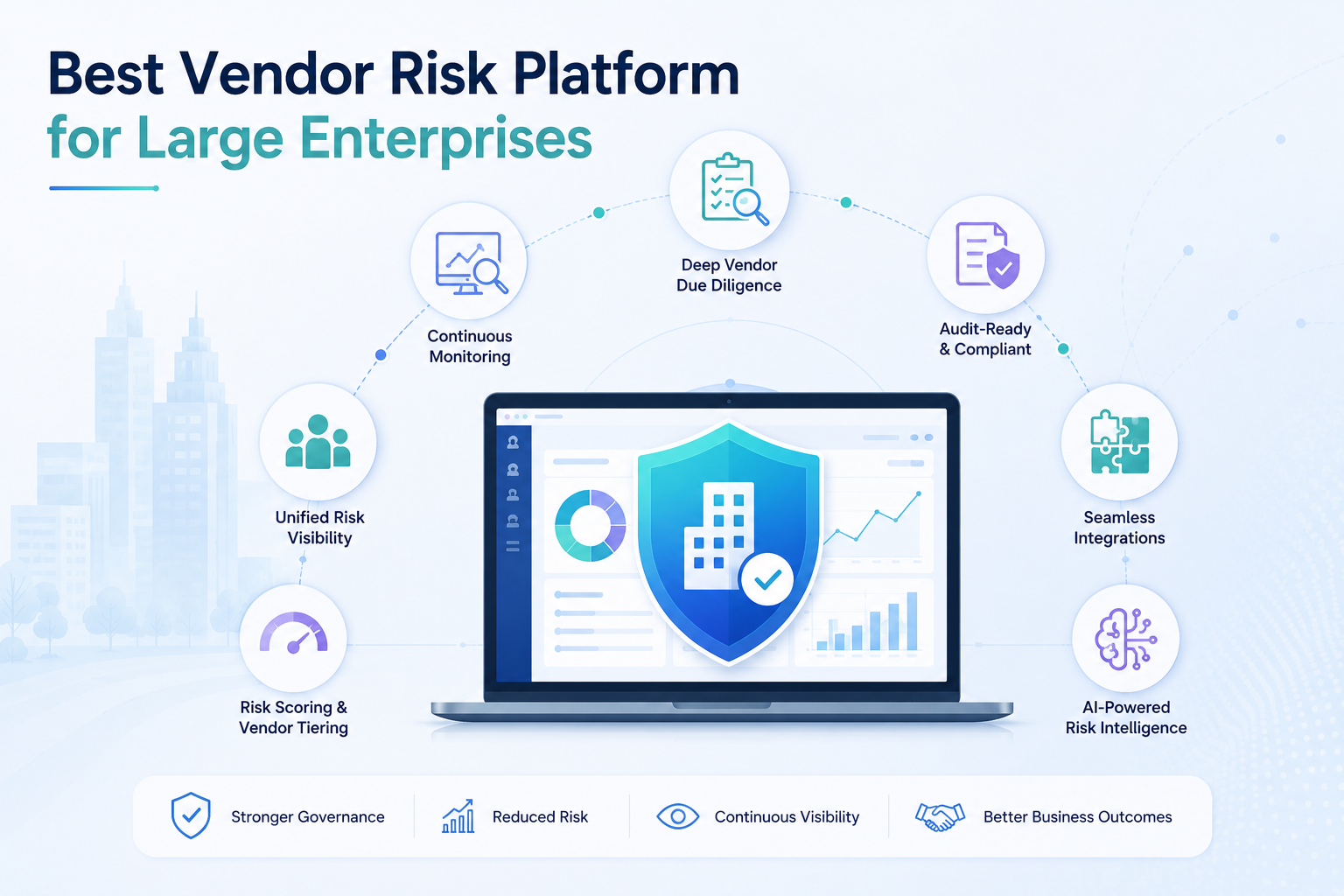
Deep Vendor Due Diligence Capabilities
Many vendor risk platforms can verify whether a company exists.
Far fewer can help organizations understand whether that company introduces material business risk.
This distinction matters because vendor failures rarely occur due to missing registration details. More often, they emerge from hidden legal exposure, financial deterioration, ownership risks, or compliance concerns that traditional onboarding reviews fail to uncover.
A strong vendor risk platform should help risk teams move beyond document collection and into meaningful risk assessment.
What to look for:
- Litigation exposure analysis
- Ownership and UBO visibility
- Financial health indicators
- Regulatory and compliance checks
- Adverse media monitoring
- Promoter and relationship intelligence
The objective is not simply verifying vendors but understanding the risks associated with doing business with them.
Continuous Monitoring Instead of Periodic Reviews
Traditional vendor risk programs are largely built around periodic reviews.
A vendor is assessed during onboarding, reviewed annually, and monitored through occasional audits.
The challenge is that risk does not evolve on an annual schedule.
Financial distress, compliance violations, ownership changes, litigation events, and reputational issues can emerge at any time.
Without continuous monitoring, organizations often discover problems only after they have already affected operations.
The best vendor risk platforms help organizations maintain visibility long after onboarding is complete.
What to look for:
- Real-time risk alerts
- Continuous vendor monitoring
- Ownership change tracking
- Legal and compliance updates
- Reputational risk monitoring
- Configurable monitoring workflows
The goal is to move from reactive risk management to proactive risk intelligence.
Unified Risk Visibility Across Teams
One of the biggest challenges in large enterprises is fragmented risk ownership.
Procurement teams manage onboarding.
Compliance teams assess regulatory exposure.
Legal teams track litigation.
Finance teams evaluate financial stability.
Each function often operates independently, creating inconsistent assessments and duplicated effort.
The best vendor risk platforms provide a unified view of risk across all stakeholders.
This allows everyone to work from the same source of truth.
What to look for:
- Centralized risk dashboards
- Shared risk profiles
- Cross-functional workflows
- Standardized risk scoring
- Unified reporting capabilities
Organizations gain faster decision-making and stronger governance when risk intelligence is centralized rather than fragmented.
Automated Risk Scoring and Vendor Tiering
Not every vendor should be treated the same way.
A low-risk office supplier does not require the same level of scrutiny as a critical technology provider or strategic manufacturing partner.
Without a structured approach to risk classification, organizations often waste resources reviewing low-risk vendors while overlooking higher-risk relationships.
Enterprise-scale vendor risk programs require consistent and automated risk prioritization.
What to look for:
- Automated risk scoring
- Vendor criticality assessments
- Tiering frameworks
- Risk-based workflows
- Dynamic risk classification
This allows organizations to focus resources where risk is highest.
Audit-Ready Evidence Trails
Risk management decisions must be defensible.
As regulatory expectations increase, organizations are expected to demonstrate not only that assessments were completed, but also how decisions were made.
Maintaining audit-ready documentation manually becomes increasingly difficult as vendor ecosystems grow.
A strong platform should automatically preserve evidence throughout the assessment process.
What to look for:
- Assessment histories
- Decision logs
- Evidence repositories
- Workflow documentation
- Audit-ready reporting
These capabilities reduce compliance overhead while improving transparency.
Integration with Existing Enterprise Systems
One of the most common reasons vendor risk initiatives struggle is because the chosen platform becomes another isolated system.
Risk intelligence delivers the most value when it is integrated directly into existing workflows.
The easier it is to connect risk data with procurement, onboarding, and governance systems, the greater the operational impact.
What to look for:
- API connectivity
- ERP integrations
- Procurement platform integrations
- Workflow automation
- Single sign-on support
Integration helps ensure that risk intelligence becomes part of operational decision-making rather than a separate process.
Scalability Across Large Vendor Ecosystems
Many platforms perform well when managing hundreds of vendors.
The challenge emerges when organizations need to monitor thousands or even tens of thousands of third parties.
As vendor volumes increase, manual workflows quickly become unsustainable.
Scalability should therefore be a primary evaluation criterion.
What to look for:
- High-volume processing capabilities
- Automated workflow routing
- Enterprise reporting
- Bulk onboarding support
- Scalable monitoring infrastructure
The best platforms grow alongside the organization’s vendor ecosystem.
AI-Powered Risk Intelligence
Modern enterprises are increasingly adopting AI to manage growing volumes of risk information.
Risk teams today face a fundamental challenge: there are more signals than humans can realistically analyze.
The value of AI is not simply automation. It is the ability to identify patterns, prioritize risks, and surface insights that would otherwise remain hidden.
This allows organizations to focus attention where it matters most.
What to look for:
- Intelligent risk prioritization
- Automated signal analysis
- Contextual risk scoring
- Investigation support
- Alert filtering and prioritization
AI should help teams make faster and more informed decisions, not simply generate more alerts.
India-Specific Risk Intelligence Coverage
Many global vendor risk platforms provide broad international coverage but lack visibility into local business ecosystems.
For enterprises operating in India, localized intelligence is often critical for conducting meaningful due diligence.
A platform that understands the regulatory and business environment can significantly improve risk visibility.
What to look for:
- Indian corporate intelligence
- Compliance monitoring
- Litigation visibility
- Regulatory risk signals
- Financial risk indicators
- Local entity intelligence
The deeper the local coverage, the more effective the due diligence process becomes.
Why These Capabilities Matter More Than Ever
Vendor ecosystems are becoming larger.
Regulatory expectations are increasing.
Supply chains are becoming more interconnected.
Simultaneously, organizations are anticipated to expedite their onboarding decisions while upholding robust governance and compliance standards.
This creates a difficult balancing act.
The best vendor risk platforms help organizations solve this challenge by combining due diligence, monitoring, automation, and intelligence into a single operational framework.
At SignalX, we see enterprises increasingly moving away from static onboarding checks and toward continuous risk intelligence models that provide ongoing visibility across the vendor lifecycle.
The focus is shifting from simply verifying vendors to continuously understanding and managing risk.
The Best Vendor Risk Platforms Do More Than Screening
Learn how enterprises evaluate due diligence, monitoring, governance, and risk intelligence before selecting a platform.
Conclusion
The best vendor risk platform for large enterprises in India is not necessarily the platform with the most features.
It is the platform that helps organizations:
- identify risks before they become incidents
- automate due diligence workflows
- maintain continuous monitoring
- support governance and compliance objectives
- scale risk programs across thousands of vendors
As vendor ecosystems continue to expand, enterprises that invest in continuous risk intelligence will be better positioned to reduce operational disruptions, improve compliance outcomes, and make faster, more confident decisions.
The future of managing vendor risk does not rely on periodic evaluations.
It is continuous visibility.