Scaling Vendor Due Diligence: Why Traditional Verification Fails at Enterprise Level





For many enterprises, scaling vendor due diligence still begins with a familiar process.
A vendor submits onboarding documents. The procurement team verifies GST details, checks incorporation records, reviews compliance declarations, and completes a few internal approvals. Once everything appears valid, the vendor is added to the system and business moves forward.
On paper, the process feels structured.
But in reality, this approach was designed for a much simpler business environment one where vendor ecosystems were smaller, supply chains were less interconnected, and risk was easier to identify.
That environment no longer exists.
Today, enterprises operate across vast networks of suppliers, subcontractors, regional intermediaries, technology providers, logistics partners, and third-party service vendors. Procurement decisions move faster, vendor relationships evolve constantly, and risk rarely stays static for long.
As organizations scale, many begin to realize something important:
the traditional approach to vendor verification often creates an illusion of control rather than actual risk visibility.
A vendor may appear compliant during onboarding and still become a significant operational risk just months later.
That disconnect is exactly why enterprises are rethinking how vendor due diligence should work at scale.
The Problem With Traditional Vendor Verification
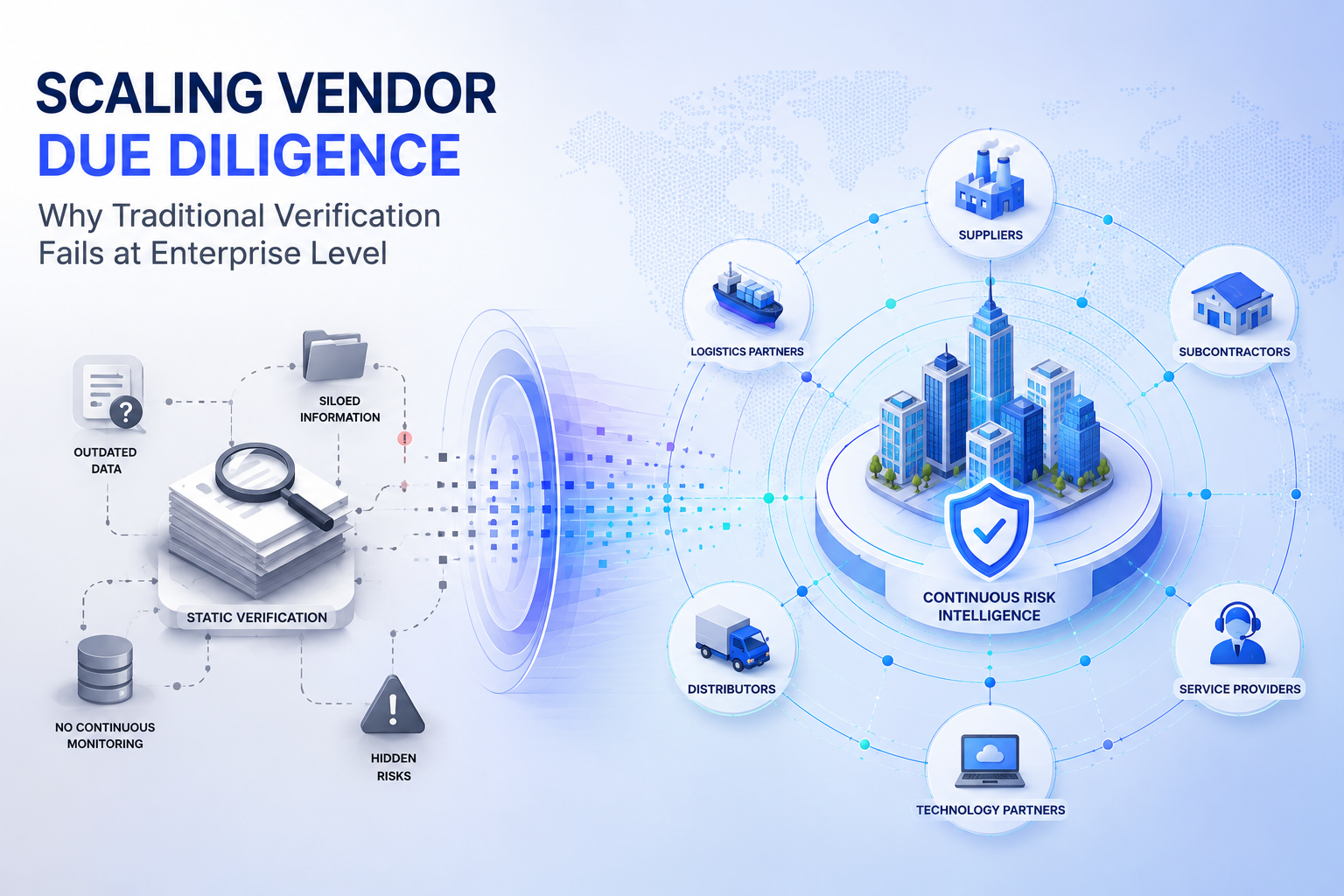
Most traditional due diligence workflows are built around static verification.
The focus is usually on collecting and validating documents at a single point in time:
- GST registration,
- incorporation certificates,
- PAN details,
- MSME declarations,
- banking information,
- and compliance paperwork.
These checks are important, but they only answer one question:
“Was the vendor compliant at the moment of onboarding?”
They do not answer:
- whether the business remains financially stable,
- whether compliance status changes over time,
- whether operational risks are emerging,
- or whether hidden exposure exists deeper in the vendor ecosystem.
This becomes a serious challenge at enterprise scale because risk evolves continuously while traditional due diligence processes do not.
A vendor’s GST status can change.
A supplier may stop filing statutory returns.
A company may become financially distressed.
Ownership structures may shift.
Litigation may emerge.
A business may even become inactive or struck off.
In many organizations, these changes remain invisible because the verification process ends once onboarding is complete.
The issue is not that enterprises lack data.
The issue is that risk signals are often fragmented, disconnected, and continuously changing.
Why Enterprise Vendor Ecosystems Make the Problem Worse
The complexity of vendor ecosystems today is fundamentally different from what many legacy due diligence models were designed to handle.
An enterprise may work with thousands of vendors across multiple regions, business units, and procurement systems. Different teams often maintain their own vendor records, onboarding workflows, and risk assessment processes.
As a result, vendor intelligence becomes fragmented across: 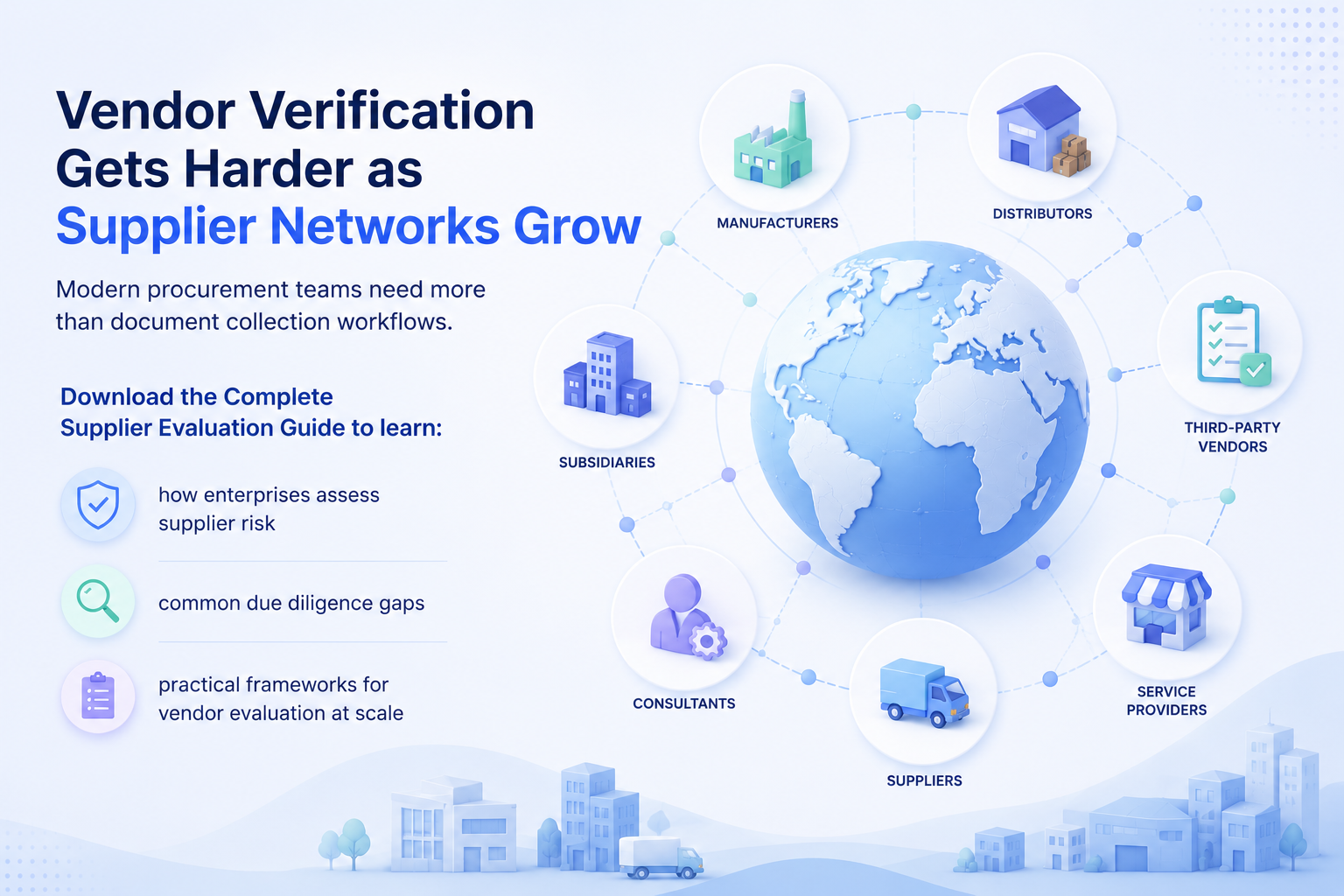
- spreadsheets,
- ERP systems,
- emails,
- procurement platforms,
- and regional compliance databases.
No single team has complete visibility into the broader risk landscape.
This fragmentation creates operational blind spots.
A procurement team may onboard a vendor based on basic compliance checks while another department remains unaware of financial stress signals, adverse media exposure, or regulatory concerns connected to the same entity.
The larger the vendor ecosystem becomes, the harder it is to maintain consistency in verification standards.
Manual reviews become slower.
Risk assessments become reactive.
Teams spend more time chasing documentation instead of evaluating meaningful risk.
And in many cases, critical vendors receive the same level of scrutiny as low-risk suppliers simply because the process lacks scalable prioritization.
The Hidden Cost of One-Time Due Diligence
One of the biggest misconceptions in enterprise risk management is the belief that vendor due diligence is primarily an onboarding function.
In reality, vendor risk is dynamic.
Businesses change constantly, especially in uncertain economic and regulatory environments. A vendor that appeared operationally stable six months ago may now be:
- facing liquidity challenges,
- experiencing compliance lapses,
- exposed to reputational issues,
- or struggling with supply chain disruptions.
Traditional verification frameworks are rarely designed to detect these changes early.
This creates a dangerous gap between:
verified vendors
and
continuously trustworthy vendors.
For enterprises, that gap can lead to:
- procurement disruptions,
- compliance exposure,
- financial loss,
- reputational damage,
- and operational instability.
The problem becomes even more serious when organizations depend heavily on interconnected supplier ecosystems where one weak entity can impact multiple downstream operations.
What does Scaling Vendor Due Diligence Actually Requires
Enterprises today are moving away from static verification models toward continuous risk visibility.
The objective is no longer just to verify documents during onboarding. The goal is to understand how vendor risk evolves over time and identify emerging exposure before it creates operational impact.
This shift is changing how organizations think about vendor due diligence entirely.
Modern due diligence increasingly focuses on:
- continuous monitoring,
- centralized risk intelligence,
- operational visibility,
- and dynamic risk assessment.
Instead of treating vendors as “verified” indefinitely, enterprises are beginning to evaluate vendor risk as an ongoing process.
This includes monitoring:
- compliance changes,
- GST activity,
- litigation exposure,
- financial indicators,
- operational disruptions,
- ownership changes,
- and reputational risk signals continuously.
The organizations that scale vendor due diligence effectively are usually the ones that stop viewing risk as a periodic compliance exercise and start treating it as an operational intelligence function.
Why Continuous Risk Intelligence Matters
One-time checks provide snapshots.
Continuous risk intelligence provides context.
That distinction matters because enterprise risk rarely emerges through a single event. Most operational issues develop gradually through small warning signals that appear over time.
A supplier may begin missing filings.
A vendor’s financial indicators may weaken.
A company’s compliance behavior may become inconsistent.
Adverse media exposure may increase.
Individually, these signals may appear minor.
But together, they often indicate growing operational risk.
Without continuous visibility, enterprises typically discover these issues only after:
- a disruption occurs,
- a payment issue surfaces,
- compliance concerns escalate,
- or procurement operations are already affected.
Modern due diligence frameworks aim to reduce this reactive cycle by helping organizations identify risk earlier and respond faster.
The Shift Toward Scalable Vendor Intelligence
As vendor ecosystems become larger and more interconnected, enterprises increasingly need systems that can scale due diligence beyond manual workflows.
This is where risk intelligence and AI-driven monitoring are becoming more important.
Organizations are beginning to adopt approaches that help them:
- consolidate fragmented vendor data,
- monitor changes continuously,
- identify hidden relationships,
- prioritize high-risk vendors,
- and automate repetitive verification tasks.
The larger objective is to improve decision-making across procurement, compliance, finance, and risk teams by creating a more unified view of third-party exposure.
At scale, vendor due diligence is no longer just about collecting documents.
It becomes about understanding:
- how vendors behave,
- how risk evolves,
- and where operational vulnerabilities may emerge across the broader ecosystem.
Final Thoughts
Traditional vendor verification methods were built for a slower and less interconnected business environment.
But enterprise ecosystems today are increasingly dynamic, fragmented, and operationally complex. Static onboarding checks alone are no longer enough to provide meaningful visibility into third-party risk.
Enterprises now require due diligence models that are:
- scalable,
- intelligence-driven,
- continuously monitored,
- and operationally connected.
Scaling Vendor Due Diligence(VDD) is evolving from a compliance task into a broader risk intelligence capability.
And as companies continue increasing their third-party ecosystems, the ability to assess, monitor and respond to vendor risk continuously will become increasingly central to operational resilience.