Why Is the Need for Third-Party Risk Intelligence Software Increasing in Large Financial Companies?





Introduction
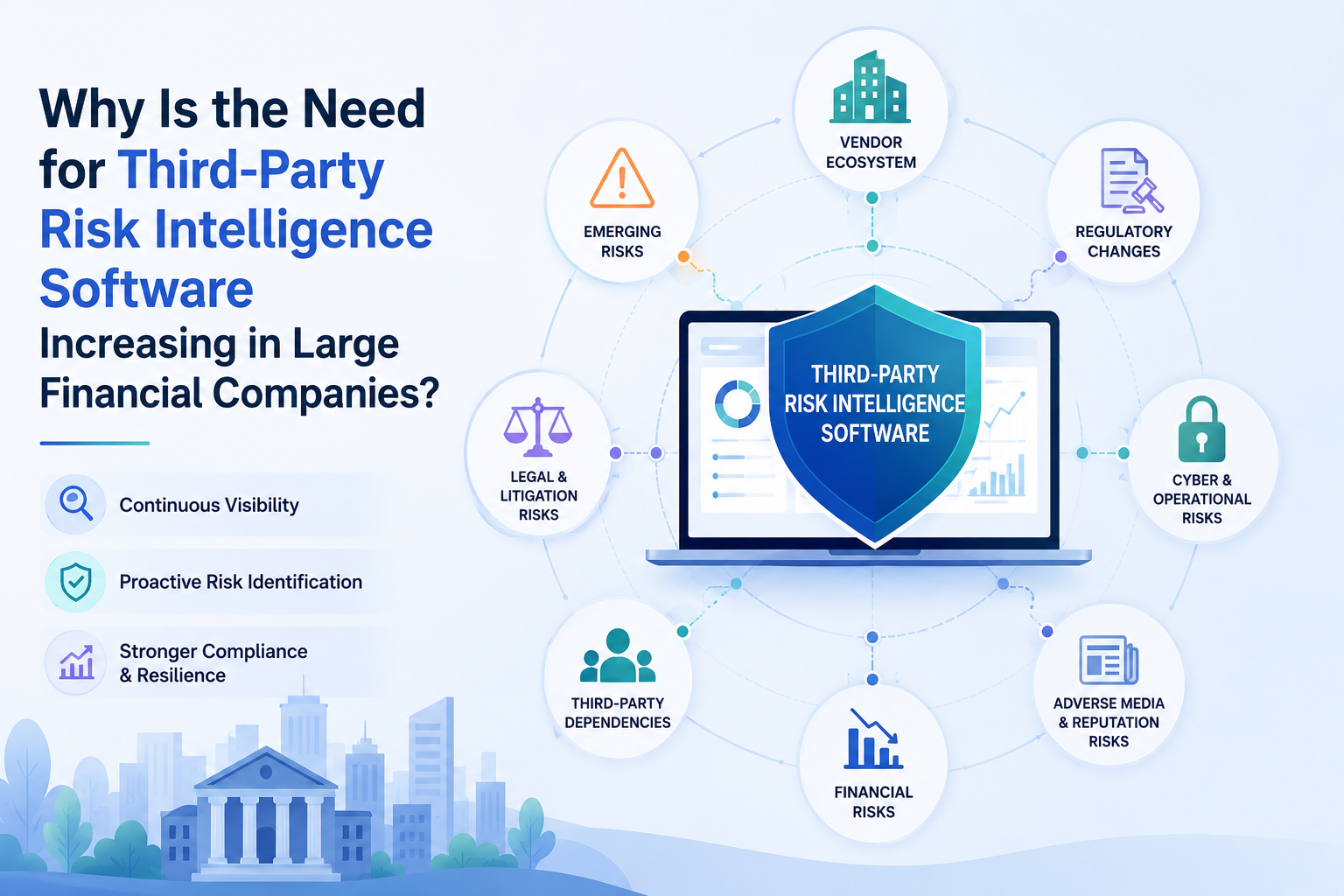
For large financial institutions, risk no longer exists solely within the organization.
Today, banks, insurance providers, NBFCs, payment processors, fintech platforms, and investment firms operate through extensive third-party ecosystems that include technology vendors, cloud providers, outsourcing partners, payment networks, KYC providers, data aggregators, and consulting firms.
As these ecosystems grow, so does the complexity of managing risk.
A single vendor failure can create regulatory exposure, operational disruption, financial losses, reputational damage, and customer trust issues. The challenge is that many financial institutions still rely on periodic assessments and fragmented due diligence processes that struggle to keep pace with evolving risks.
This is why third-party risk intelligence software is rapidly becoming a critical component of modern risk management programs.
The goal is no longer simply assessing vendors during onboarding.
The goal is maintaining continuous visibility across an expanding third-party ecosystem.
At SignalX, we work with enterprises managing complex third-party ecosystems across financial services, manufacturing, and regulated industries. One trend has become increasingly clear: vendor risk is no longer a periodic assessment challenge it is a continuous intelligence challenge. Organizations are struggling not because they lack data, but because they lack the visibility needed to identify material risks before they impact operations, compliance, or business continuity.
The Growing Third-Party Risk Problem in Financial Services
Over the last decade, financial institutions have accelerated digital transformation initiatives.
This has increased dependence on:
- cloud infrastructure providers
- fintech partners
- outsourced operations teams
- payment processors
- cybersecurity vendors
- data and analytics providers
- customer onboarding platforms
Each relationship creates operational dependencies.
The more interconnected these ecosystems become, the more difficult it becomes to identify emerging risks before they impact business operations.
The problem is not a lack of information.
The problem is a lack of visibility.
Large financial institutions often manage hundreds or even thousands of vendor relationships. Yet risk intelligence remains fragmented across procurement systems, compliance tools, legal workflows, and manual monitoring processes.
Without a unified view, identifying emerging threats becomes increasingly difficult.
Why Traditional Vendor Due Diligence Is No Longer Enough
Most financial institutions already perform vendor assessments.
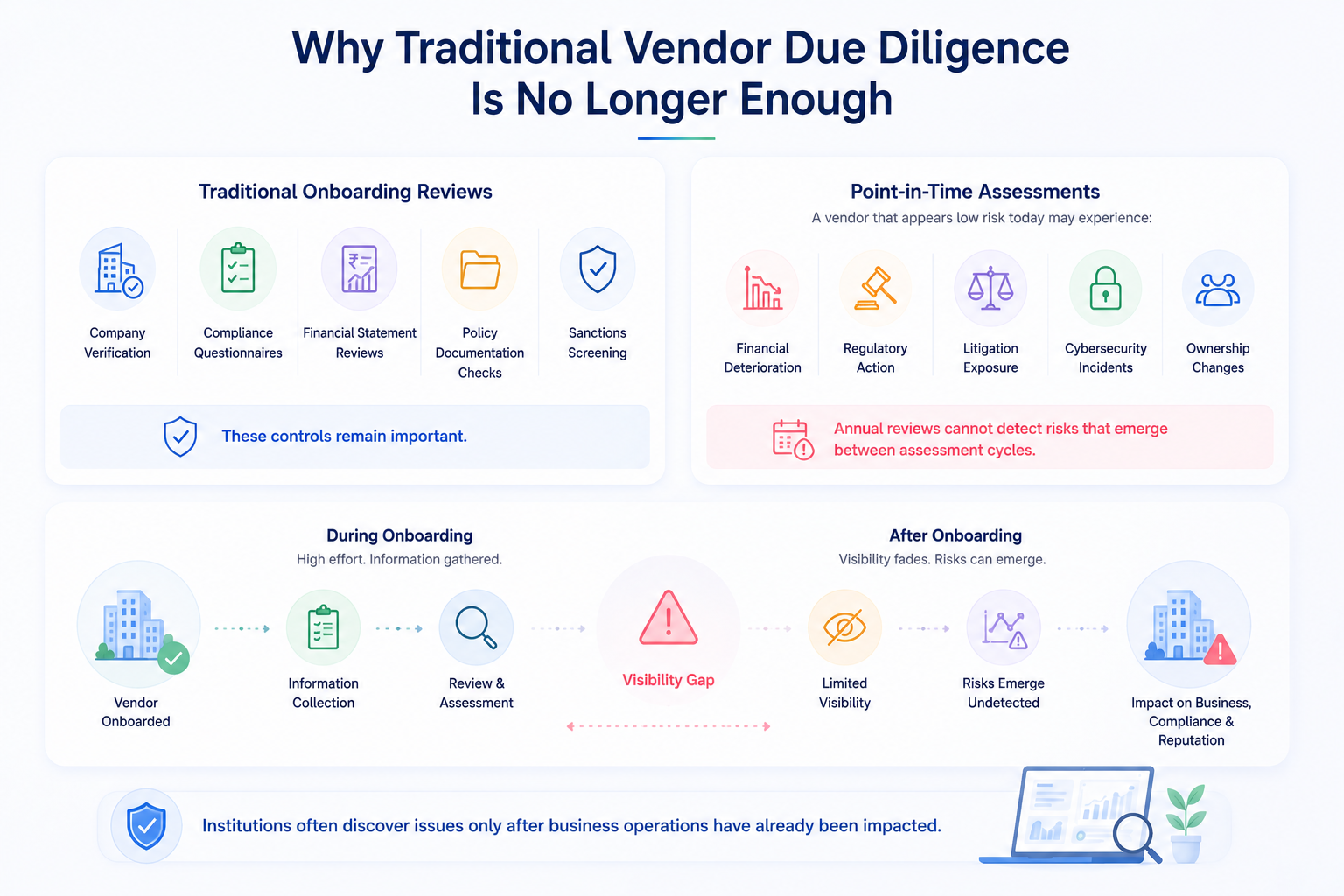
Typical onboarding reviews include:
- company verification
- compliance questionnaires
- financial statement reviews
- policy documentation checks
- sanctions screening
These controls remain important.
However, they are inherently point-in-time assessments.
A vendor that appears low risk today may experience:
- financial deterioration
- regulatory action
- litigation exposure
- cybersecurity incidents
- ownership changes
within weeks or months.
Annual reviews cannot detect risks that emerge between assessment cycles.
Through our work supporting vendor due diligence and ongoing monitoring programs, we frequently see organizations spending significant effort collecting information during onboarding, only to lose visibility once the vendor relationship becomes operational. This creates a gap between risk assessment and risk awareness, where material events can emerge long after initial approval.
As a result, institutions often discover issues only after business operations have already been impacted.
Regulatory Expectations Are Increasing
Regulators globally are placing greater emphasis on third-party oversight.
Financial institutions are increasingly expected to demonstrate:
- continuous vendor monitoring
- risk-based due diligence
- audit-ready governance
- operational resilience
- supply chain visibility
This shift has transformed third-party risk management from a compliance exercise into a strategic governance function.
The question regulators increasingly ask is:
How are you monitoring vendors after onboarding?
Not simply:
How did you assess them initially?
| See How Leading Financial Institutions Monitor Third-Party Risk → |
The Cost of Limited Visibility
One of the biggest challenges facing financial institutions is fragmented risk intelligence.
Different teams often manage different aspects of vendor risk:
| Function | Primary Focus |
|---|---|
| Procurement | Onboarding and contracts |
| Compliance | Regulatory obligations |
| Information Security | Cyber risk |
| Legal | Litigation and contractual exposure |
| Finance | Financial stability |
| Vendor Management | Performance monitoring |
Every team perceives merely a segment of the risk landscape.
Without a unified view, organizations experience:
Delayed decision-making
Teams spend significant time gathering information rather than acting on it.
Inconsistent risk assessments
Different departments may classify the same vendor differently.
Hidden exposure
Emerging risks remain unnoticed until they become material incidents.
Why Continuous Monitoring Is Becoming Essential
Risk is dynamic.
Monitoring vendors once or twice a year is increasingly inadequate for large financial institutions.
Modern risk related problems need to have visibility into ongoing developments such as:
- regulatory actions
- adverse media coverage
- litigation updates
- financial stress indicators
- ownership changes
- sanctions exposure
- operational disruptions
Continuous monitoring allows institutions to identify potential issues earlier and respond faster.
Rather than reacting to incidents, teams can proactively work and manage evolving risk effectively.
| Enable Continuous Third-Party Monitoring → |
What Leading Financial Institutions Are Doing Differently
Rather than relying solely on periodic assessments, leading financial institutions are investing in intelligence-driven approaches that combine onboarding due diligence with Continuous Entity Monitoring.
The objective is not simply to identify risk at a single point in time, but to maintain an evolving view of vendor exposure throughout the lifecycle of the relationship.
At SignalX, we have seen organizations increasingly prioritize risk intelligence capabilities that help unify fragmented risk data, automate monitoring workflows, and provide earlier visibility into emerging issues before they become operational disruptions.
How Third-Party Risk Intelligence Software Solves the Problem
The purpose of third-party risk intelligence software is not simply to automate questionnaires.
This is the philosophy behind SignalX’s approach to third-party risk intelligence. Rather than treating due diligence as a one-time compliance exercise, the focus is on helping organizations operationalize risk intelligence across onboarding, monitoring, governance, and vendor lifecycle management.
It has to showcase continuous visibility across all the vendor ecosystem.
Modern platforms help organizations:
Centralize risk intelligence
Risk data from multiple sources is consolidated into a unified workflow.
Automate due diligence
Manual research and repetitive validation tasks are significantly reduced.
Standardize risk scoring
Consistent methodologies improve decision-making across teams.
Enable continuous monitoring
Organizations receive ongoing updates rather than relying solely on periodic reviews.
Improve audit readiness
Evidence trails and risk documentation remain available for regulators and internal audits.
| Strengthen Vendor Risk Visibility → |
What Financial Institutions Should Look for in a Risk Intelligence Platform
Not every platforms have the same level of visibility.
When evaluating solutions, organizations should consider:
Comprehensive Risk Coverage
The platform should provide visibility across:
- financial risks
- legal risks
- regulatory risks
- compliance risks
- reputational risks
Continuous Monitoring Capabilities
Real-time monitoring is increasingly becoming a core requirement rather than an optional feature.
Workflow Integration
Risk intelligence should integrate with:
- procurement systems
- onboarding workflows
- governance processes
- internal risk management platforms
Audit-Ready Reporting
Institutions need the ability to demonstrate oversight during audits and regulatory reviews.
Scalability
The platform should support large vendor ecosystems without increasing manual effort.
The Future of Third-Party Risk Management
Financial institutions are moving beyond traditional vendor due diligence toward continuous risk intelligence.
The evolution is clear:
| Traditional Approach | Modern Approach |
| Annual reviews | Continuous monitoring |
| Manual assessments | Automated intelligence |
| Siloed risk data | Unified risk visibility |
| Reactive response | Proactive risk management |
| Point-in-time checks | Ongoing oversight |
As vendor ecosystems continue expanding, maintaining visibility across third parties will become increasingly difficult using manual processes alone.
Organizations that invest in risk intelligence capabilities today will be better positioned to strengthen resilience, improve compliance, and make faster risk-informed decisions.
Why Continuous Risk Intelligence Is Becoming a Strategic Priority
As third-party ecosystems continue to expand, financial institutions are increasingly recognizing that traditional risk management frameworks were not designed for the scale, complexity, and speed of modern vendor networks.
At SignalX, we believe the future of third-party risk management lies in continuous risk intelligence where organizations move beyond static assessments and gain ongoing visibility into financial, regulatory, legal, and reputational developments that may impact critical vendor relationships.
The institutions that succeed over the next decade will not necessarily be those with access to the most data, but those with the ability to transform fragmented risk signals into timely, actionable intelligence.
Conclusion
The need for third-party risk intelligence software is increasing because the nature of risk itself has changed.
Large financial institutions no longer operate within isolated organizational boundaries. Their risk exposure extends across vast networks of vendors, partners, technology providers, and service providers.
Managing that complexity requires more than onboarding assessments and annual reviews.
It requires continuous visibility.
Third-party risk intelligence software helps financial institutions move from fragmented due diligence toward proactive, data-driven risk management allowing them to identify emerging threats earlier, strengthen governance, and build more resilient third-party ecosystems.
Build a More Resilient Third-Party Risk Program
Managing third-party risk at scale requires more than periodic vendor reviews. See how SignalX helps financial institutions strengthen due diligence, improve monitoring, and gain continuous visibility across vendor ecosystems.