The Best Third-Party Risk Management (TPRM) Platforms for 2026: A Complete Buyer’s Guide
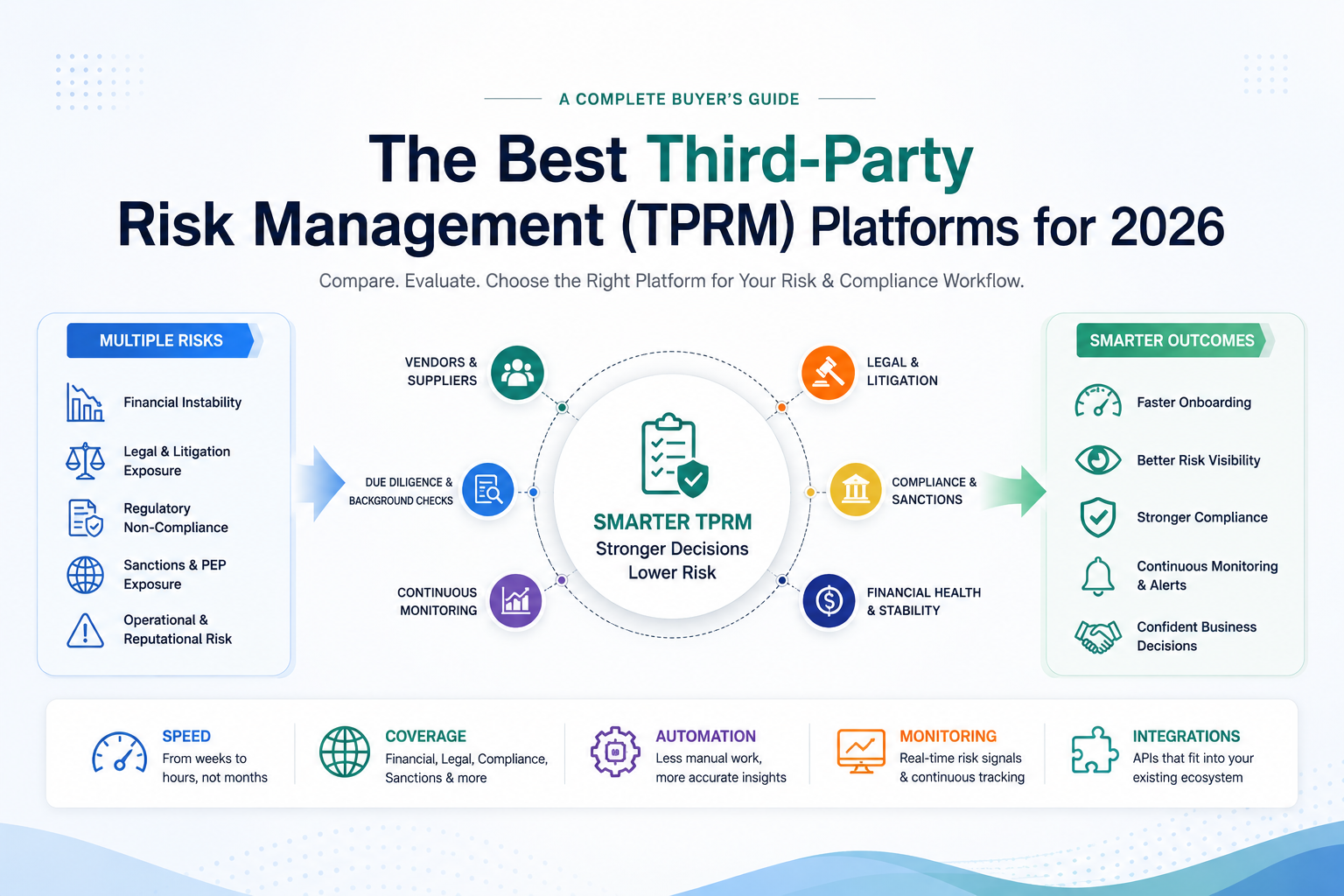





Evaluating external vendors, contractors, and suppliers is no longer just a checkbox compliance exercise it’s a core operational requirement. With regulatory pressures mounting and supply chains becoming more distributed, companies are actively searching for the right tools to simplify onboarding, automate due diligence, and monitor evolving risk in real time.
If you are currently researching the market’s top third-party risk management platforms, the options can feel overwhelming. To help you make an informed decision, we have broken down the leading types of TPRM platforms available today, what they excel at, and where modern enterprises are finding hidden operational bottlenecks.
1. Conventional Enterprise Governance, Risk, and Compliance (GRC) and Legacy Third-Party Risk Management (TPRM) Suites
Examples: Archer, OneTrust, ServiceNow Risk Management
These extensive and all-encompassing GRC suites are tailored for Fortune 500 organizations that require the ability to assess risk across numerous internal divisions and international entities. They excel at internal audit logging, complex policy mapping, and macro-level risk management.
-
The Catch to Consider: Because these platforms were built as broad internal compliance software first, their external vendor risk tools heavily rely on manual workflows. To run a comprehensive check on a vendor’s financials, legal records, or tax compliance, your team often has to manually send out massive questionnaires, follow up with vendors via email, and wait weeks for manual verification. For organizations that need to onboard vendors rapidly, this manual workflow creates a frustrating operational bottleneck.
2. Traditional Cyber & IT Vendor Risk Assessment Tools
Examples: BitSight, SecurityScorecard
These platforms are excellent if your primary concern is the technical cyber-hygiene of an external IT vendor. They scan a company’s IP space, evaluate firewall strength, and score external digital footprints to assign a security rating.
-
The Catch to Consider: While cyber-health is critical, these platforms operate within a silo. A third-party vendor might pass a technical cybersecurity scan with flying colors, but still pose a massive financial, legal, or regulatory risk. They do not natively verify corporate identity (KYB), track deep court litigations, analyze tax filing defaults, or perform promoter integrity checks leaving major blind spots in your overall due diligence.
3. SignalX.ai: The Modern AI-Powered Risk Intelligence Platform
Designed for: Agile enterprises, high-trust industries, and procurement teams that require comprehensive risk visibility without the manual wait times.
SignalX transforms the management of third-party risks by substituting disjointed, manual verification methods with a cohesive, AI-powered risk framework. Instead of waiting weeks for custom compliance reports or questionnaire responses, SignalX automates entity due diligence across hundreds of parameters simultaneously.
-
Unified Risk Coverage: SignalX maps a vendor’s risk profile across financial health, legal and court histories (7,000+ courts), global sanctions, regulatory compliance (GST/EPFO/ESIC history), and promoter integrity all on one platform.
-
Rapid Turnaround (Speed-to-Trust): Traditional due diligence can take weeks of manual digging. SignalX delivers rich, structured, audit-ready risk summaries and comprehensive data reports within 48 hours.
-
From Reactive to Continuous Monitoring: Rather than treating vendor risk as a one-time onboarding check, SignalX’s Risk Terminal and Risk Master systems continuously track changes in a vendor’s financial stability, tax filings, or legal status, alerting your team the moment a risk signal shifts.
- Plug-and-Play Risk Infra APIs (Zero Platform Fatigue): One of the biggest hurdles in adopting a new TPRM tool is forcing your team to learn, navigate, and manage yet another software dashboard. SignalX eliminates this friction entirely. Through our robust Risk Infrastructure APIs, you can bypass our UI completely and stream our data directly into your existing ERP (like SAP or Oracle), CRM, or proprietary internal workflows.
Your Team Already Has Workflows.
SignalX Simply Makes Them Smarter.
Stream verified risk intelligence directly into SAP, Oracle, ServiceNow, or your existing procurement stack.
Deep Customization: Modular APIs for Every Due Diligence Dimension
Every industry faces a unique risk compliance landscape. A financial institution onboarding a high-value vendor requires completely different datasets than a manufacturing unit checking a supply-chain partner.
Because SignalX operates as an open risk infrastructure, you don’t have to ingest a generic, one-size-fits-all report. You can call individual, highly specific APIs based precisely on your organization’s needs and risk appetite. Each fundamental core dimension addressed in our thorough due diligence reports is accessible as an independent API, which includes:
-
Corporate Identity & KYB APIs: Immediate validation of corporate registry information, ultimate beneficial ownership (UBO), and parent-subsidiary corporate frameworks.
-
Financial and Credit Health APIs: An in-depth examination of balance sheets, cash flows, profit and loss metrics, as well as indicators of financial stress.
-
Legal & Litigation Radar APIs: Real-time scanning across 7,000+ courts to flag active lawsuits, criminal records, NCLT cases, or past legal disputes.
-
Regulatory & Tax Compliance APIs: Automated tracking of tax filing regularities, including real-time GST, EPFO, and ESIC deposit histories to ensure your vendors aren’t defaulting.
-
Global Sanctions & PEP Watchlists: Prompt screening against databases of PEP (Politically Exposed Persons), worldwide enforcement lists, and international AML/CFT sanction watchlists.
-
Promoter & Management Integrity APIs: Expanding due diligence beyond the entity level to assess the legal, financial, and reputational histories of directors, founders, and key promoters.
By leveraging these modular APIs, your development and compliance teams can request the exact dataset, with the specific dimensions required, at the exact moment they need it all natively inside the software your company already uses every single day.
Why Open 5 Risk Platforms When One API Can Do The Job?
Stream litigation, compliance, financial health, sanctions, and due diligence intelligence directly into SAP, Oracle, ServiceNow, or your existing workflows.
Key Features to Prioritize When Choosing the right Third-Party Risk Management (TPRM) Platform:
If you are comparing tools to figure out which approach fits your workflow best, ensure the platform addresses these three modern compliance realities:
A. Turnaround Time (TAT) and Onboarding Speed
A TPRM platform shouldn’t slow down business velocity. Look for tools that leverage automated APIs and AI algorithms to pull real-time data directly from regulatory databases, rather than tools that require human analysts to compile static reports manually over several weeks.
B. Multi-Dimensional Risk Signals
Cyber security or a simple credit check isn’t enough. A modern platform must connect disparate dots flagging if a critical supplier has experienced sudden management shakeups, pending labor disputes, hidden tax delays, or adverse media exposure.
C. Continuous Risk Visibility vs. Static Assessments
A vendor that is perfectly safe today could face financial distress or legal trouble six months from now. Select a platform that transcends static PDFs and provides continuous risk monitoring with real-time early warning signals.
Conclusion: Which Platform is Right for You?
The right platform depends entirely on how your organization defines efficiency. If your primary goal is mapping internal corporate policies across thousands of internal departments, a heavy legacy GRC suite may fit the bill.
However, if your business requires a fast, automated, and comprehensive risk infrastructure that protects your supply chain, slashes onboarding delays, and monitors your vendor ecosystem with zero-latency trust SignalX is built for your workflow.
Ready to eliminate the manual bottleneck in your TPRM process?
Book a 15-minute personalized demo with a SignalX risk expert today.
TPRM Frequently Asked Questions:
1. What is (TPRM) / Third-party Risk Management?
Third-party Risk Management (TPRM) is the strategic process of analyzing, monitoring, and mitigating operational, financial, legal, and reputational risks posed by external entities like vendors, suppliers, and contractors.
2. What is a Third-Party Risk Assessment?
A third-party risk assessment is the actual execution of evaluating a specific external entity’s risk profile against your compliance standards before onboarding them, checking data across multiple dimensions like financial health and litigation histories.
3. What is Third-Party Due Diligence?
Third-party due diligence is the continuous investigative process used to verify the corporate identity, regulatory compliance, financial stability, and overall integrity of a business partner to ensure they do not present hidden liabilities.
4. What is the formal review of a third party before entering into a business relationship called?
This process is formally known as Pre-Onboarding Due Diligence or a Third-Party Risk Assessment. It serves as the ultimate gatekeeper check before any contract or business relationship is legalized.
5. What is the primary purpose of third party due diligence as an anti-corruption strategy?
The primary purpose is to identify hidden ultimate beneficial owners (UBOs), politically exposed persons (PEPs), global sanctions, or active bribery track records. This protects your organization from severe regulatory penalties and reputational fallout.
6. What are the best third party risk management software and platforms ?
The best platforms vary by operational need. While legacy GRC tools handle massive internal policy maps and technical cybersecurity scanners score firewalls, modern risk intelligence infrastructure like SignalX.ai is widely regarded as the best for automated, rapid, all-in-one entity due diligence.
7. Which providers deliver the top tools for screening parties based on ownership?
Top traditional compliance databases provide raw corporate records, but modern risk infrastructure platforms like SignalX automate this process by instantly mapping Ultimate Beneficial Ownership (UBO), corporate structures, and parent-subsidiary relationships through live, automated APIs.
8. Which firms provide the most popular tools for managing import risk?
Import and supply chain risk tools are traditionally dominated by heavy logistics tracking suites. However, forward-thinking procurement teams utilize automated risk intelligence software to screen global suppliers against international sanctions, financial health defaults, and legal litigations simultaneously.
```html ```