The Resilient Vendor Due Diligence Framework for Critical SaaS Infrastructure Providers





Defining “Critical” SaaS Infrastructure
- Data Sensitivity: Accesses, hosts, or processes customer Personally Identifiable Information (PII), proprietary intellectual property, or confidential corporate financial records.
- Operational Dependency: A platform whose sudden downtime or service failure completely halts core business delivery pipelines for more than 60 minutes.
- Integration Depth: Software requiring high-level read/write permissions via enterprise APIs, or deep configuration within internal single sign-on (SSO) systems.
Your Vendor Inventory Is Not Your Risk Inventory.
A SaaS provider can appear operationally healthy while carrying hidden legal, financial, regulatory, or fourth-party risks that directly impact your business continuity.
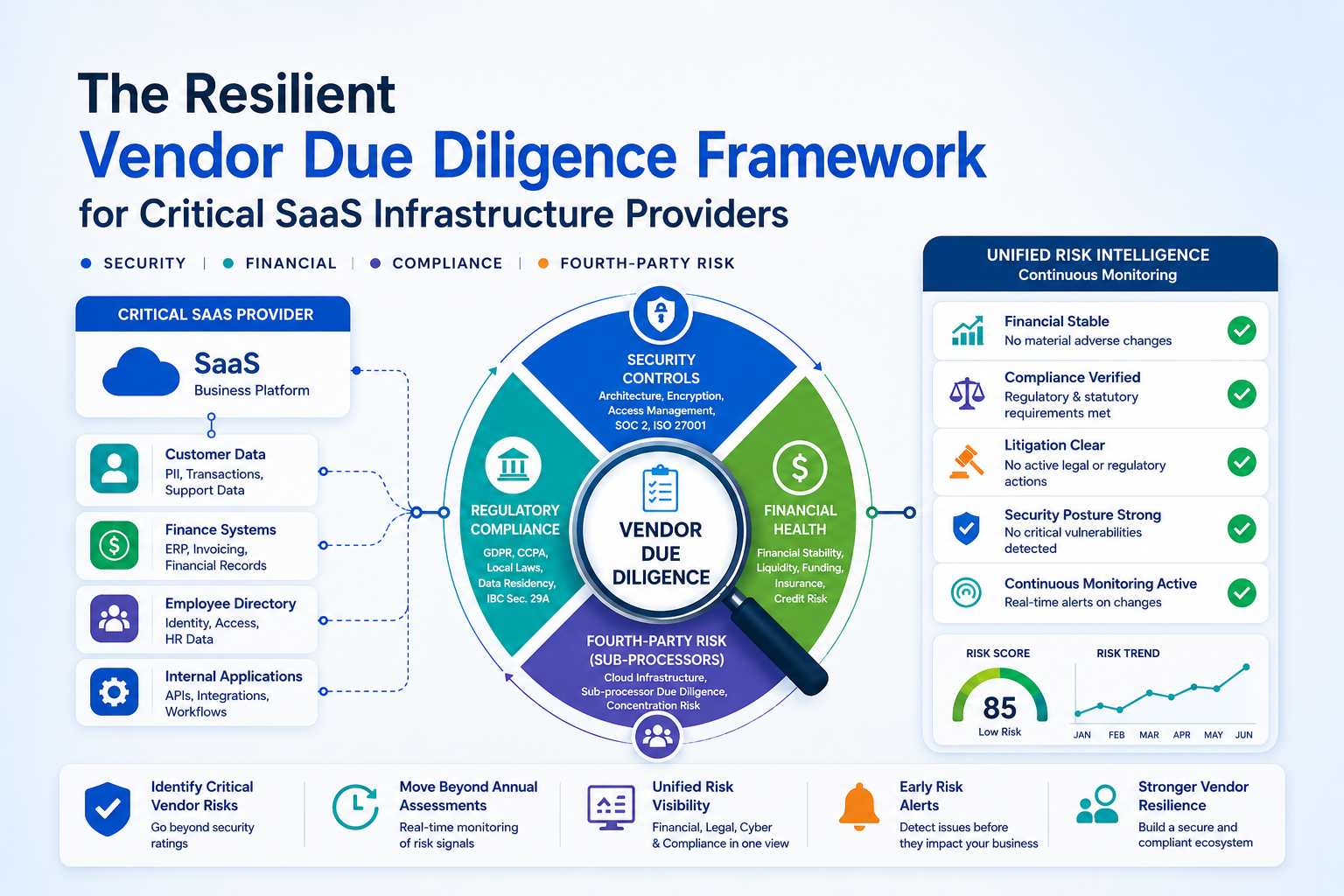
The Four Core Pillars of Tech Infrastructure Vendor Due Diligence Framework:
1. Advanced Security Architecture & Cryptographic Controls
- SOC 2 Type II and ISO/IEC 27001 Validation: Go beyond checking for the existence of a certificate. Review the exact scope of the SOC 2 Type II report. Confirm that the testing window spans at least six consecutive months and specifically covers all infrastructure sub-processors.
- Encryption Standards: Ensure the platform implements industry-standard AES-256 encryption at rest and TLS 1.3 encryption in transit. For hyper-critical deployments, verify if the vendor supports Bring Your Own Key (BYOK) methodologies.
- Identity Controls: The software is required to inherently facilitate secure enterprise integrations, which encompass SAML 2.0/OIDC Single Sign-On (SSO), obligatory Multi-Factor Authentication (MFA), and detailed Role-Based Access Controls (RBAC).
2. Multi-Jurisdictional Regulatory & Compliance Alignment
- Data Privacy Frameworks: Ensure complete compliance with GDPR, CCPA/CPRA, and relevant local data protection laws. The provider must execute a binding Data Processing Addendum (DPA) featuring approved Standard Contractual Clauses (SCCs).
- Targeted Corporate Checks: In highly regulated operating environments, verify the vendor against specific statutory benchmarks. In India, for example, this includes running thorough eligibility verifications under Insolvency and Bankruptcy Code (IBC) Section 29A to ensure zero corporate default exposure.
- Cross-Border Enforcement: Map where data resides physically and ensure their hosting zones align perfectly with your internal data residency mandates.
3. Financial Viability & Corporate Operational Runway
- Audited Financial Analysis: Review financial records to verify liquidity ratios, debt-to-equity metrics, and overall funding stability.
- Legal and Regulatory Sanctions: Screen global watchlists, enforcement registries, and active litigation records to ensure the vendor is not facing structural legal hazards.
- Insurance Verification: Ensure the vendor carries adequate Cyber Liability and Errors & Omissions (E&O) insurance, backed by an active Certificate of Insurance (COI).
4. Fourth-Party Risk (Sub-processor Visibility)
- Cloud Infrastructure Mapping: Identify the underlying cloud provider (e.g., AWS, Google Cloud, Azure) powering the SaaS app.
- Concentration Risk Assessment: Ensure multiple critical vendors do not rely on the exact same nested sub-processor, which could create a single point of catastrophic systemic failure.
Shifting from Point-in-Time Vendor Due Diligence(VDD) to Continuous Risk Infrastructure
[Static Questionnaires] ──────> [Continuous Scanning] ──────> [Unified Risk Intelligence]
Point-in-time snapshots         Real-time automated alerts     Financial + Corporate + Cyber
(Leaves blind spots)            (Catches immediate updates)    (Holistic SignalX Monitoring)
What Changed Since Your Last Vendor Review?
If the answer requires manually checking multiple systems, you’re already operating with a visibility gap.
Automating Enterprise VDD with SignalX
                 ┌───────────────────────────┐
                 │SignalX Risk Infrastructure│
                 └────────────┬─────────────┘
                ┌───────────────────────┼───────────────────────┐
                ▼                       ▼                       ▼
      [  Risk Master  ]          [   Risk360   ]          [   RiskGPT   ]
   Continuous financial &     Comprehensive corporate   AI-driven compliance
    compliance monitoring       due diligence audits     & document analysis
- Multi-Dimensional Due Diligence (Risk360): SignalX aggregates corporate financial health data, legal records, tax filings, and compliance profiles into an integrated risk score. This provides an exhaustive overview of vendor health far beyond basic network scanning.
- AI-Assisted Evaluation (RiskGPT): Eliminate the manual bottleneck of analyzing massive vendor compliance packages. SignalX’s specialized conversational AI automatically interprets complex corporate structures, financial records, and legal histories, instantly flagging hidden risks.
- Continuous Monitoring (Risk Master): Shift away from static annual reviews. SignalX continuously tracks your vendor ecosystem, alerting you the moment a critical SaaS provider encounters financial distress, regulatory scrutiny, or a structural compliance change.
Protect your organization from third-party operational disruptions. Schedule a SignalX platform demonstration today to transform your vendor due diligence framework into a modern, automated risk management system.
Frequently Asked Questions
What is a vendor due diligence framework for SaaS infrastructure?
A SaaS vendor due diligence (VDD) framework is a structured process used by enterprises to evaluate the security, operational, financial, and compliance risks of third-party software providers. It ensures that critical infrastructure vendors meet strict corporate standards before onboarding and during ongoing monitoring.
What is the difference between VDD and TPRM software?
Vendor Due Diligence (VDD) refers to the specific, point-in-time evaluation actions taken during vendor onboarding or contract renewal. Third-Party Risk Management (TPRM) is the overarching software category and ongoing lifecycle process used to automate, track, and monitor these vendor risks continuously.
Why is multi-dimensional risk assessment critical for SaaS vendors?
Evaluating only cybersecurity ratings creates significant operational blind spots. A multi-dimensional risk assessment analyzes a SaaS provider across financial runway stability, legal litigation history, regulatory compliance (such as IBC Sec. 29A), and fourth-party supply chain dependencies to prevent sudden vendor failure.
How does automated vendor due diligence software replace manual checks?
Automated vendor due diligence platforms like SignalX use AI and continuous monitoring engine infrastructures to replace manual spreadsheets. They automate compliance checks, utilize specialized conversational AI (RiskGPT) to interpret complex legal or financial records, and provide real-time risk alerts.