10 Enterprise TPRM Software Rollout Challenges in 2026
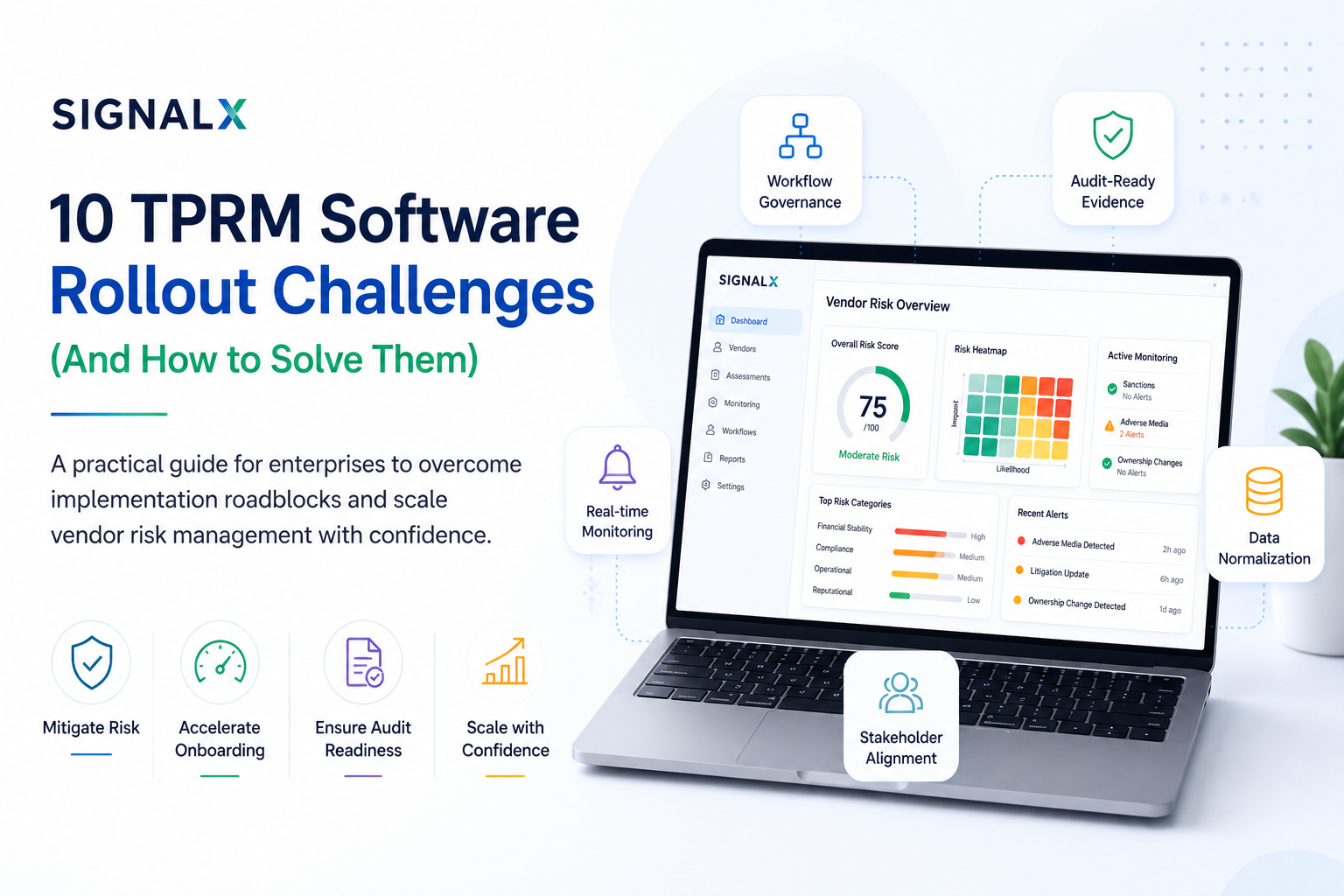





Rolling out third-party vendor risk management software at scale is rarely straightforward. Data silos, resistance to change, and governance gaps can derail even the most promising implementation. SignalX helps enterprise risk teams automate 200+ checks and accelerate due diligence but before you can realize those benefits, you need to navigate the rollout itself.
This article breaks down the ten most common challenges large enterprises encounter when deploying TPRM software, along with clear mitigation steps you can apply immediately. Whether you’re managing thousands of vendors or just getting started with risk automation, these insights will help you avoid costly mistakes.
Quick guide: 10 TPRM software rollout challenges and solutions
- Data ingestion and normalization: Establishing clean data pipelines from disparate sources
- Workflow governance: Defining ownership and approval processes across teams
- Stakeholder alignment: Getting buy-in from compliance, procurement, and IT
- Evidence trail requirements: Building audit-ready documentation from day one
- Vendor tiering complexity: Applying consistent risk scoring at scale
- Real-time monitoring setup: Configuring alerts for sanctions, adverse media, and ownership changes
- Managing legacy vendor data during migration: Conduct legacy vendor data audits before rollout
- User adoption resistance: Overcoming internal friction during the transition
- API and system connectivity: Linking TPRM software with existing procurement and ERP systems
- Scalability for high-volume onboarding: Handling bulk vendor assessments without bottlenecks
| Get a Demo today for Enterprise TPRM Model → |
How we identified these TPRM implementation challenges
We analyzed feedback from enterprise compliance officers, vendor management directors, and risk executives across financial services, manufacturing, and technology sectors. Our goal was to pinpoint the obstacles that delay or derail TPRM software deployments.
- Data quality impact: How well does the implementation process handle inconsistent vendor records and missing information?
- Governance clarity: Are roles, responsibilities, and escalation paths defined before go-live?
- Evidence and audit readiness: Can you generate exportable reports with full evidence trails on demand?
- Scalability under pressure: Does the platform perform when onboarding hundreds of vendors simultaneously?
- Monitoring depth: Are sanctions screening, adverse media alerts, and ownership tracking included?
- User experience: Will your team actually adopt the new system without constant support tickets?
The 10 biggest TPRM software rollout challenges for enterprises
-
Data ingestion and normalization
Most enterprises store vendor information in multiple systems procurement databases, ERP platforms, CRM tools, and even local files. When you deploy TPRM software, all that data needs to flow into a single platform. Inconsistent formats, missing fields, and duplicate records create immediate headaches.
SignalX helps streamline this process by automatically organizing, standardizing, and enriching incoming vendor records within a centralized risk workflow. This reduces manual cleanup efforts, improves data consistency, and enables teams to generate more reliable vendor risk assessments faster. Instead of spending time validating fragmented information across systems, teams can focus on making informed onboarding and risk decisions with greater confidence.
Mitigation steps:
- Conduct a data audit before implementation to identify gaps and inconsistencies
- Establish data quality standards and assign ownership for ongoing maintenance
- Choose a TPRM platform that automates data normalization and deduplication
-
Workflow governance and approval processes
Who reviews vendor risk assessments? Who approves onboarding decisions? Who escalates high-risk findings? Without clear answers, your TPRM rollout stalls in confusion.
Large enterprises often have overlapping responsibilities between compliance, procurement, legal, and business units. Defining workflow governance upfront prevents delays and finger-pointing later. SignalX supports configurable workflows that route assessments to the right stakeholders automatically, keeping your approval process moving.
Mitigation steps
- Map out approval chains and escalation paths before go-live
- Document roles and responsibilities in a shared governance charter
- Use automation to route tasks based on vendor risk tier and assessment type
-
Stakeholder alignment across departments
TPRM software touches multiple teams: compliance wants regulatory coverage, procurement wants speed, IT wants security, and finance wants cost control. Getting everyone aligned on priorities can feel like herding cats.
The key is starting with shared objectives. What outcomes matter most? Faster onboarding? Reduced audit findings? Better visibility into vendor financials? SignalX delivers audit-ready reports and 25+ parameter risk scorecards that give each stakeholder what they need without requiring separate systems or duplicate efforts.
Mitigation steps:
- Hold a kickoff workshop with representatives from each affected department
- Identify three to five shared success metrics everyone can rally around
- Schedule regular check-ins during rollout to address emerging concerns
-
Building audit-ready evidence trails
Regulators and auditors want to see exactly how you assessed each vendor. Screenshots, timestamps, source documents, and decision rationale all need to be captured and stored. Many organizations underestimate this requirement during rollout.
SignalX generates exportable PDF reports with full evidence trails, so every finding is traceable back to its source. This audit readiness is built in from the start, not bolted on later. You can respond to regulatory inquiries in hours instead of scrambling to reconstruct documentation.
Mitigation steps:
- Define evidence retention policies before deploying the platform
- Ensure your TPRM software captures timestamps, data sources, and user actions automatically
- Test your audit response process with a mock inquiry during the pilot phase
-
Vendor tiering and risk scoring consistency
Not every vendor poses the same level of risk. A cleaning service and a cloud infrastructure provider require different assessment depths. But applying consistent tiering criteria across thousands of vendors is harder than it sounds.
Inconsistent risk scoring leads to wasted resources on low-risk vendors and inadequate scrutiny on high-risk ones. SignalX applies methodologies and consistent risk scoring and maps findings to compliance frameworks, giving a standardized approach that scales. The platform’s 26-parameter scorecard covers financial stability, promoter background, reputational signals, compliance rigor, and legal exposure.
Mitigation steps
- Develop a vendor tiering framework based on data access, criticality, and regulatory requirements
- Document scoring criteria and apply them uniformly across all assessments
- Review and refine your tiering model quarterly as your vendor landscape evolves
-
Real-time monitoring configuration
Risk does not stay static. A vendor that passed assessment last quarter might face sanctions, litigation, or ownership changes today. Configuring real-time monitoring is essential but often gets deprioritized during initial rollout.
SignalX delivers real-time business signals including sanctions screening, adverse media monitoring, and ownership change alerts. Once configured, the platform watches your vendor portfolio around the clock, surfacing red flags before they become crises.
Mitigation steps:
- Include monitoring setup in your rollout timeline, not as a “phase two” afterthought
- Define alert thresholds for sanctions hits, adverse news, and ownership changes
- Assign clear ownership for reviewing and acting on monitoring alerts
-
Managing Legacy Vendor Data During Migration
Most enterprises rolling out TPRM software already have years of vendor information spread across ERP systems, spreadsheets, procurement tools, and internal databases. Migrating this legacy data into a new platform often creates unexpected delays.
SignalX reduces migration friction by automatically normalizing incoming vendor data and enriching incomplete profiles, litigation, financial, and media intelligence sources. This helps enterprises accelerate onboarding without rebuilding vendor records manually from scratch.
Mitigation steps:
- Remove duplicate or inactive vendor records early
- Standardize key identifiers across procurement systems
- Choose platforms that support automated data normalization and enrichment
-
User adoption and change management
The most sophisticated TPRM software is worthless if your team refuses to use it. Resistance to change is natural, especially when people have invested years in existing processes even inefficient ones.
Successful rollouts invest in training and communication. Show users how the new platform makes their jobs easier. SignalX offers self-serve, on-demand due diligence that runs 200+ checks in under 48 hours, replacing weeks of effort with a few clicks. Once your team experiences that speed, adoption follows.
Mitigation steps
- Identify and train power users who can champion the platform within their teams
- Talking the “why” behind the change, not just the “what”
- Celebrate early wins to build momentum and positive sentiment
-
API connectivity and system linking
Your TPRM software does not exist in isolation. It needs to exchange data with procurement systems, ERP platforms, contract management tools, and compliance databases. Poor API connectivity creates data gaps and double entry.
SignalX supports both API access and a web dashboard, so you can embed risk checks into existing workflows or run them standalone. This flexibility lets you start with the approach that fits your current architecture and expand over time.
Mitigation steps:
- Map your existing systems and identify required data flows before selecting a platform
- Prioritize connections that eliminate duplicate data entry or manual transfers
- Test API performance under realistic load conditions during the pilot
-
Scalability for high-volume vendor onboarding
Enterprises with thousands of vendors cannot afford bottlenecks during peak onboarding periods. Whether you are bringing on suppliers for a new project or conducting annual re-assessments, your TPRM software needs to handle volume without slowing down.
SignalX is built for scale, supporting both low-volume and high-throughput workloads with low latency. You can run bulk checks on large vendor lists without waiting days for results. This scalability ensures your risk program keeps pace with business growth.
Mitigation steps:
- Stress-test the platform with realistic vendor volumes before full deployment
- Establish SLAs for assessment turnaround times and monitor performance
- Prepare for high-demand times such as contract renewals and mergers and acquisitions.
What should you look for in TPRM software for enterprise rollouts?
Enterprise rollouts demand more than basic vendor assessment features. You need a platform that handles data complexity, scales with your vendor portfolio, and produces evidence that satisfies auditors and regulators.
Look for automation depth how many checks run without human intervention? Assess data coverage does the platform access regulatory filings, court records, and media sources in your key jurisdictions? Evaluate audit readiness can you generate compliant reports on demand?
SignalX checks all three boxes, sourcing data from 200+ regulators, 7,000+ courts, and 30,000+ media outlets while delivering audit-ready reports in hours.
| Reduce TPRM Rollout Friction → |
How can enterprises reduce TPRM software implementation risk?
Start with a pilot. Select a subset of vendors ideally high-risk ones and run them through the new platform before full deployment. This approach surfaces configuration issues, training gaps, and workflow problems early, when they are cheaper to fix.
Invest in change management. Resistance from existing staff is one of the top reasons TPRM rollouts fail. Clear communication, hands-on training, and visible executive sponsorship all help.
Finally, choose a platform that delivers value fast. The longer your rollout drags on, the harder it becomes to maintain momentum. SignalX runs 200+ checks in under 48 hours, so your team sees results quickly and stays engaged.
Why SignalX is the top TPRM software for enterprise rollouts
Rolling out TPRM software does not have to be painful. SignalX eliminates the friction points that slow down enterprise deployments from data normalization to audit-ready reporting.
The platform automates 200+ risk checks across financial, legal, regulatory, litigation, tax, and reputational domains. You get a 26-parameter risk scorecard covering financial stability, promoter background, reputational signals, compliance rigor, and legal exposure. And you can export reports in PDF format with full evidence trails whenever auditors come calling.
SignalX is built for enterprises that need to move fast without sacrificing rigor. If you are ready to accelerate your TPRM rollout and reduce implementation risk, schedule a demo with SignalX today.
| Modernize Your TPRM Workflow → |
FAQs about enterprise TPRM software rollouts
What is the biggest challenge when implementing Enterprise TPRM software?
Data ingestion and normalization typically creates the most friction. Enterprises store vendor information across multiple systems in inconsistent formats.
How long does a typical enterprise TPRM rollout take?
Rollouts range from three to twelve months depending on vendor volume, system complexity, and organizational readiness. Platforms like SignalX that deliver results in under 48 hours help compress timelines by showing value early.
What should we include in a TPRM governance charter?
Document roles, responsibilities, approval chains, escalation paths, and risk tiering criteria. Include service level expectations for assessment turnaround and monitoring alert response. Review the charter quarterly.
How do we get stakeholder buy-in for Enterprise TPRM software?
Start with shared objectives. Identify three to five success metrics that matter across compliance, procurement, and IT. Show how the platform addresses each group’s pain points. SignalX delivers audit-ready reports and fast assessments that appeal to multiple stakeholders.
What is the role of real-time monitoring in TPRM?
Monitoring detects risk changes after initial assessment sanctions hits, adverse media, ownership shifts. SignalX monitors your vendor portfolio around the clock and surfaces alerts automatically, so you catch problems before they escalate.