The Scaling Bottleneck: Managing Third-Party Risk Across Supply Chain Ecosystems
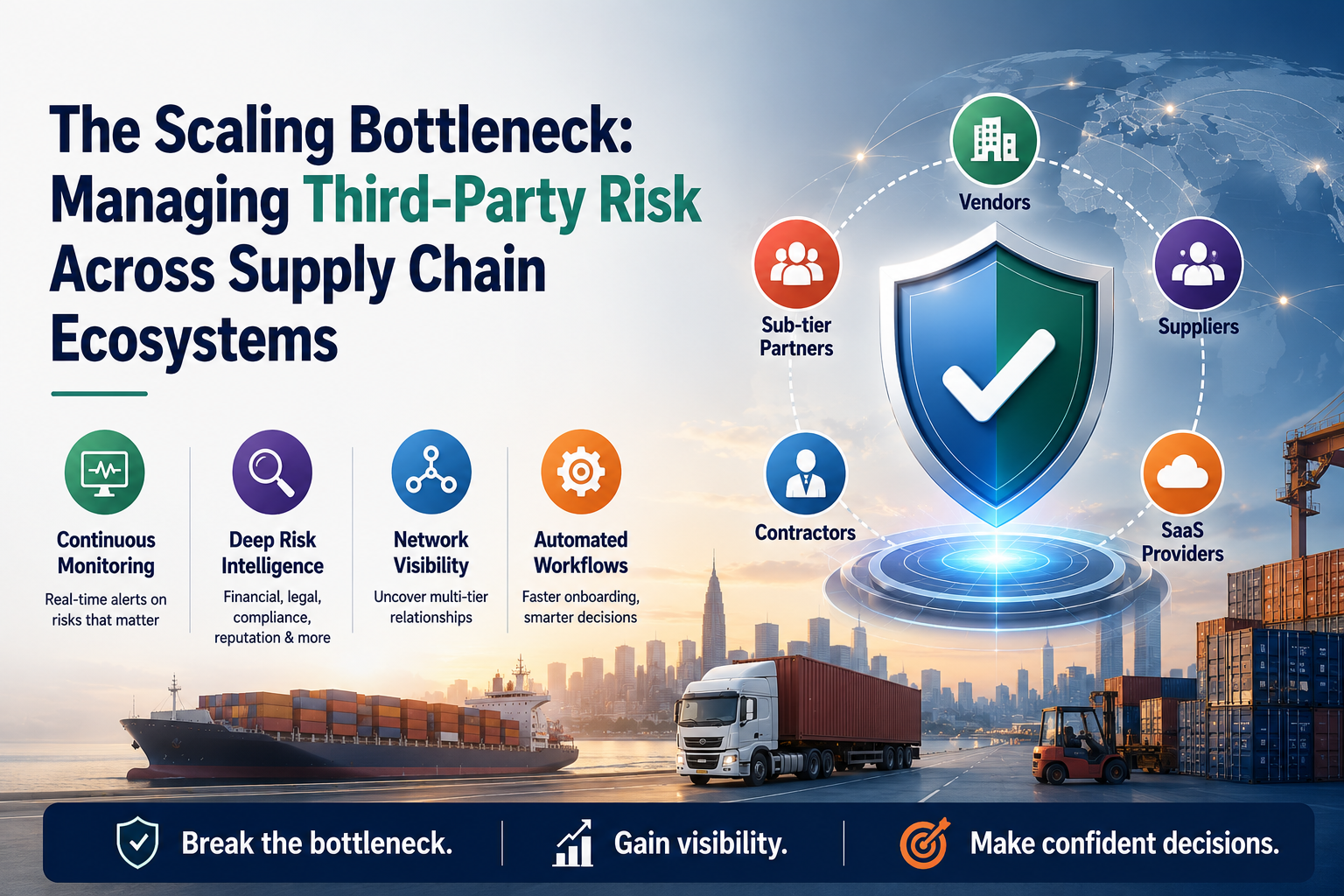





Modern enterprise growth relies heavily on outsourcing. Businesses build intricate global networks of vendors, suppliers, SaaS providers, and contractors to stay agile. However, expanding this network introduces a complex challenge: your risk surface expands exponentially with it.
Many risk, procurement, and compliance heads run into a major hurdle the scaling bottleneck.
Managing third-party risk management (TPRM) for 10 core vendors is straightforward. But when that number grows to 500 or 5,000, manual workflows quickly fall apart. When due diligence cannot scale alongside procurement, organizations are forced to make a dangerous compromise: slow down business operations to conduct thorough audits, or skip deep checks to move faster.
To break this bottleneck, enterprises are moving away from legacy, manual workflows and adopting unified risk infrastructure platforms built to handle ecosystem volume.
The Hidden Math of the Supply Chain Bottleneck
The math behind supply chain risk illustrates how quickly complexity grows. Risk does not scale linearly ($1:1$). It scales exponentially because you are not just onboarding a third party; you are inheriting their entire network of fourth- and fifth-party relationships.
Recent industry data highlights the scale of this operational pressure:
-
The Exposure Gap: As per trends in enterprise supply chains, an astonishing 78% of organizations acknowledge that their internal risk management programs address less than 50% of their entire vendor ecosystem. This leaves massive blind spots down the chain.
-
The Volume Explosion: The average enterprise now works with roughly 286 third-party vendors, a number that continues to climb year over year as operations become more modularized.
-
The Real-World Financial Impact: Data breaches and compliance violations originating from third parties are uniquely costly. Global risk benchmarks reveal that supply chain compromises are among the most expensive incidents to remediate, averaging $4.91 million per incident.
When you multiply hundreds of vendors by their financial, legal, and operational vulnerabilities, traditional point-in-time due diligence simply cannot keep pace.
How Much Of Your Vendor Ecosystem Are You Actually Assessing?
Most organizations only evaluate a fraction of their supplier network. Use our assessment checklist to identify gaps before they become operational risks.
Why Traditional Due Diligence Hits a Wall (And How SignalX Solves It)
Most companies try to solve the scaling problem by throwing more manual effort at it. They send lengthier questionnaires, request more PDF certificates, and assign more analysts to review public registries.
This approach creates three structural vulnerabilities within the supply chain, which purpose-built automated risk platforms are designed to systematically fix.
1. The “Point-in-Time” Illusion
A vendor’s risk profile fluctuates constantly. They might look financially stable and legally compliant during an annual review in January, but a structural corporate change, a silent regulatory sanction, or an ownership shift in June can alter that profile overnight. Relying on static data means managing yesterday’s risk.
The SignalX Approach: Instead of static annual questionnaires, enterprise teams utilize automated continuous monitoring. SignalX streams live data across news, regulatory filings, tax compliance records, and adverse media to detect emerging third-party risks the moment they happen, providing real-time risk visibility.
2. Manual Verification Fatigue
A comprehensive risk assessment requires analyzing structural data, litigation history, financial health, and PEP/sanctions watchlists. Manually cross-referencing these data points across fragmented government registries takes days per vendor. This creates an administrative backlog that stalls critical business operations.
The SignalX Approach: SignalX consolidates fragmented risk intelligence into a single operational platform. By running automated data aggregation across corporate registries, courts, and financial databases, platforms like SignalX Risk Master reduce manual verification workflows, allowing enterprise risk teams to evaluate prospective suppliers with structured and scalable insights.
3. Deception via Complex Corporate Layers
Sophisticated supply chain risks are rarely obvious. Shell companies, hidden cross-holdings, and multi-layered ownership structures can mask sanctioned individuals or financially unstable parent organizations. Human analysts lack the processing capacity to map these multi-tier relationships at scale.
The SignalX Approach: SignalX automatically unmasks Ultimate Beneficial Ownership (UBO) structures and visualizes connected-party networks (directors, promoters, and subsidiaries) to flag hidden affiliations, conflicts of interest, or international sanctions that would otherwise remain invisible to standard checks.
Still Verifying Vendors One Spreadsheet At A Time?
Automated risk intelligence helps uncover litigation exposure, compliance failures, ownership risks, and financial instability without slowing procurement teams down.
Live Realities of Modern Ecosystem Risk
The consequences of the scaling bottleneck are visible across global business operations, emphasizing why automated verification is critical prior to onboarding.
Case Study 1: The Invisible Third-Party Vendor Vulnerability
A prominent financial services company recently experienced a major compliance and data crisis when unauthorized access was detected in an external customer database. The breach did not happen on the firm’s core network; it occurred via a sub-contracted software vendor that lacked proper security oversight. The incident demonstrated that even highly regulated firms face immense vulnerability if their partners’ data environments are not subjected to deep, automated verification.
Case Study 2: The Cascading Manufacturing Shutdown
A major automotive manufacturer had to stall production across three regional plants because a Tier-2 supplier filed for insolvency. The manufacturer’s procurement team had run standard compliance checks on their primary Tier-1 assembly partner, but they lacked visibility into the financial vulnerabilities of the deeper sub-tier suppliers supporting that partner. One unmonitored link stalled the entire line.
Shifting From Reactive Checks to Continuous Risk Intelligence
To eliminate the scaling bottleneck, enterprise risk programs must transition from manual workflows to a centralized, automated risk framework.
By leveraging an AI-driven automated engine, SignalX turns risk management from an operational roadblock into a strategic accelerator:
-
Rapid Risk Scorecards: SignalX benchmarks prospective suppliers prior to onboarding using a proprietary A 26-parameter risk scorecard that evaluates financial stability, the background of promoters, reputational indicators, adherence to compliance, and potential legal risks.
-
Fast-Tracked Onboarding: Instead of weeks of manual compiling, comprehensive due diligence reports like SignalX Risk360 are generated in less than two days, allowing procurement to move at business speed without compromising on safety.
-
Seamless Integration: By plugging vendor compliance checks directly into existing ERP or procurement workflows via flexible APIs, automated due diligence functions silently and continuously in the background.
What Happens Between Vendor Reviews?
A vendor can become high-risk long after onboarding. Stay ahead of litigation, financial distress, sanctions exposure, and compliance failures with continuous monitoring.
Scaled Risk Management Drives Business Growth
Scaling risk management does not mean adding more steps to the onboarding process it means removing the manual friction that slows the business down.
By replacing slow, disconnected checks with automated risk intelligence, companies eliminate the scaling bottleneck entirely. This allows organizations to onboard trustworthy partners faster, maintain flawless regulatory compliance across global standards (like AML, Anti-Bribery, and ESG), and build a resilient supply chain ecosystem designed for long-term growth. Enterprise scale demands automated clarity, and utilizing targeted risk infrastructure like SignalX ensures no blind spots are left unmonitored.